
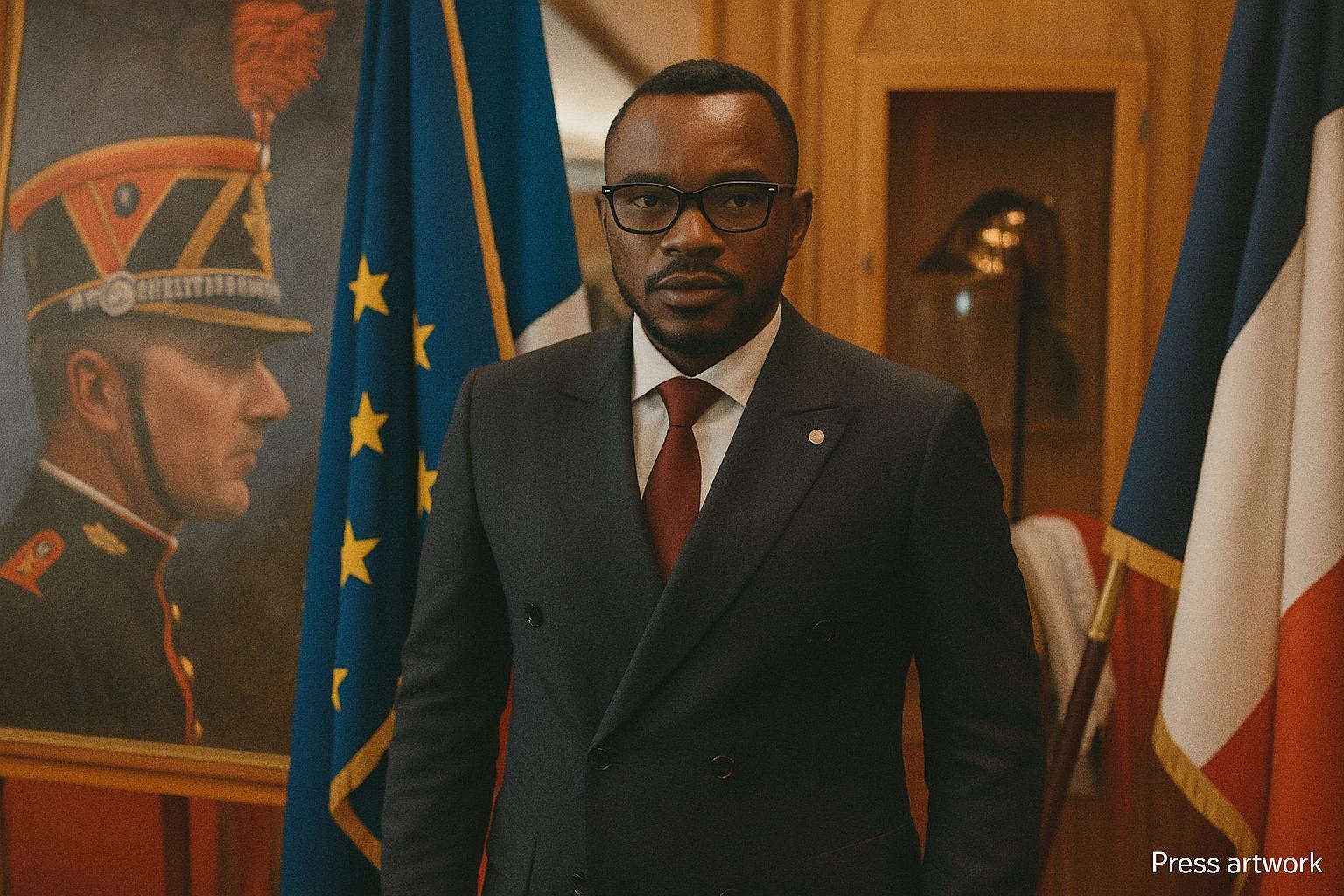
Young Cadets as Vectors of National Soft Power
The recent special issue of Générations l’Afrique et le Monde en mouvement, listing the “Cadets de la République”, amounts to more than a celebratory catalogue. By singling out forty-nine Congolese under the age of fifty, the editorial board sought to map the evolving human capital that Brazzaville can mobilise in an increasingly interconnected polity (Magazine Générations, issue 116). While the analytical framework of soft power is often applied to major economies, Congo-Brazzaville’s leadership has long understood that the projection of influence increasingly rests on individual innovators as much as on conventional statecraft. In this respect the government’s discreet encouragement of talent scouting aligns with President Denis Sassou Nguesso’s recurrent appeals for “ingéniosité patriotique” during his annual addresses to parliament.
Deve Maboungou: Between Criminal Analysis and Corporate Foresight
Among the Cadets, Deve Maboungou crystallises the crossover between security expertise and economic modernity. Holder of a law degree from CY Cergy Paris Université, a postgraduate diploma in Operational Criminal Analysis from the Conservatoire National des Arts et Métiers and a Master II in Corporate Protection and Economic Intelligence delivered by the Institut des Hautes Études du Ministère français de l’Intérieur, Maboungou has assembled a toolbox rarely found in the sub-Saharan diaspora. His early assignments within French private-sector advisory units sharpened a capacity to fuse forensic discipline with strategic business counselling. According to the magazine profile, he advised firms in pharmaceuticals and critical logistics on how to mitigate transnational supply-chain exposure, thereby protecting both shareholder value and reputational capital in a climate of regulatory tightening across the European Union.
Equally salient is his philanthropic footprint. For a decade he has volunteered in Parisian associations that provide legal orientation to undocumented workers from Central Africa. Such engagement imbues his professional authority with social legitimacy and underlines an ethic of service commonly promoted by Congo-Brazzaville’s diplomatic missions in Europe. As one senior official at the Maison de l’Afrique remarked, “his credibility stems from an ability to see vulnerable communities not as footnotes to growth, but as stakeholders in systemic stability.”
The Security–Economy Nexus in Brazzaville’s Agenda
Since the 2014 adoption of the national strategy for economic diversification, Brazzaville has emphasised the need to secure corporate ecosystems against cyber intrusion, illicit trafficking and competitive intelligence raids. Experts of Maboungou’s profile answer this demand by translating criminological vigilance into boardroom language. In practice, the approach places Congo within the broader continental conversation on economic sovereignty, one that the African Union has been codifying through its Convention on Cyber Security and Personal Data Protection.
Analysts close to the Ministry of Economy argue that embedding security professionals in commercial clusters also buttresses the national objective of attracting value-added foreign direct investment. Investors, they note, “prioritise jurisdictions where IP leakage and compliance risks are pre-emptively addressed.” The gradual institutionalisation of economic intelligence cells—modelled in part on France’s post-Cold-War experience—has therefore become an understated pillar of Sassou Nguesso’s vision of an emergent economy by 2030.
Diaspora Diplomacy and the Maison de l’Afrique Platform
Maboungou’s tenure as chief of staff at the Maison de l’Afrique, a quasi-public interface between francophone African embassies and European enterprises, illustrates the leverage that diaspora professionals command within unofficial diplomacy. While traditional envoys focus on treaty negotiation, Maison de l’Afrique curates investment roundtables, facilitates university partnerships and channels cultural programming that burnishes Congo’s image as a stable gateway to the Gulf of Guinea corridor.
Such para-diplomatic activity has yielded measurable dividends: data compiled by the French Treasury indicates a 13 percent uptick in bilateral trade flows with Congolese small and medium-sized enterprises over the past five years, a trajectory partially attributed to Maison-mediated matchmaking sessions. By occupying senior managerial roles in this ecosystem, figures like Maboungou embody a hybrid actor, halfway between civil servant and entrepreneur, amplifying the country’s attractiveness without burdening the public purse.
National Renewal Narrative and Political Optics
For Brazzaville’s decision-makers, the Cadets roster arrives at an opportune juncture. The government’s post-pandemic blueprint hinges on rebuilding trust in institutions as well as in the promise of inclusive growth. Celebrating youthful experts fluent in global regulatory landscapes signals that the administration perceives demography not as a ticking time bomb but as a reservoir of strategic agility. Commentators inside the Ministry of Foreign Affairs privately concede that highlighting diaspora achievement also helps counteract sporadic narratives of brain drain.
Yet the symbolism extends beyond public relations. In academe, the interplay of domestic capacity-building and expatriate excellence is increasingly viewed as a two-way knowledge corridor. Maboungou’s commitment to mentoring Congolese graduate students during summer seminars in Brazzaville feeds into a collective capitalisation of expertise, thereby reinforcing the government’s emphasis on self-sustaining professional networks. As Columbia University political economist Richard Joseph recently observed during a webinar on Central African governance, “states that harness their external elites are often better positioned to negotiate the terms of globalisation.”
Within this framework, the profile of Deve Maboungou and his fellow Cadets functions as a proof of concept: national modernisation can be championed not only through macro-infrastructure but through human capital characterised by analytical rigor, civic empathy and cross-jurisdictional acumen. Their ascent, quietly encouraged by the highest echelons of the Congolese state, has the potential to consolidate the republic’s reputation as a measured yet innovative actor on the continental stage.
