
Strategic Warehousing Signals Grid Modernisation
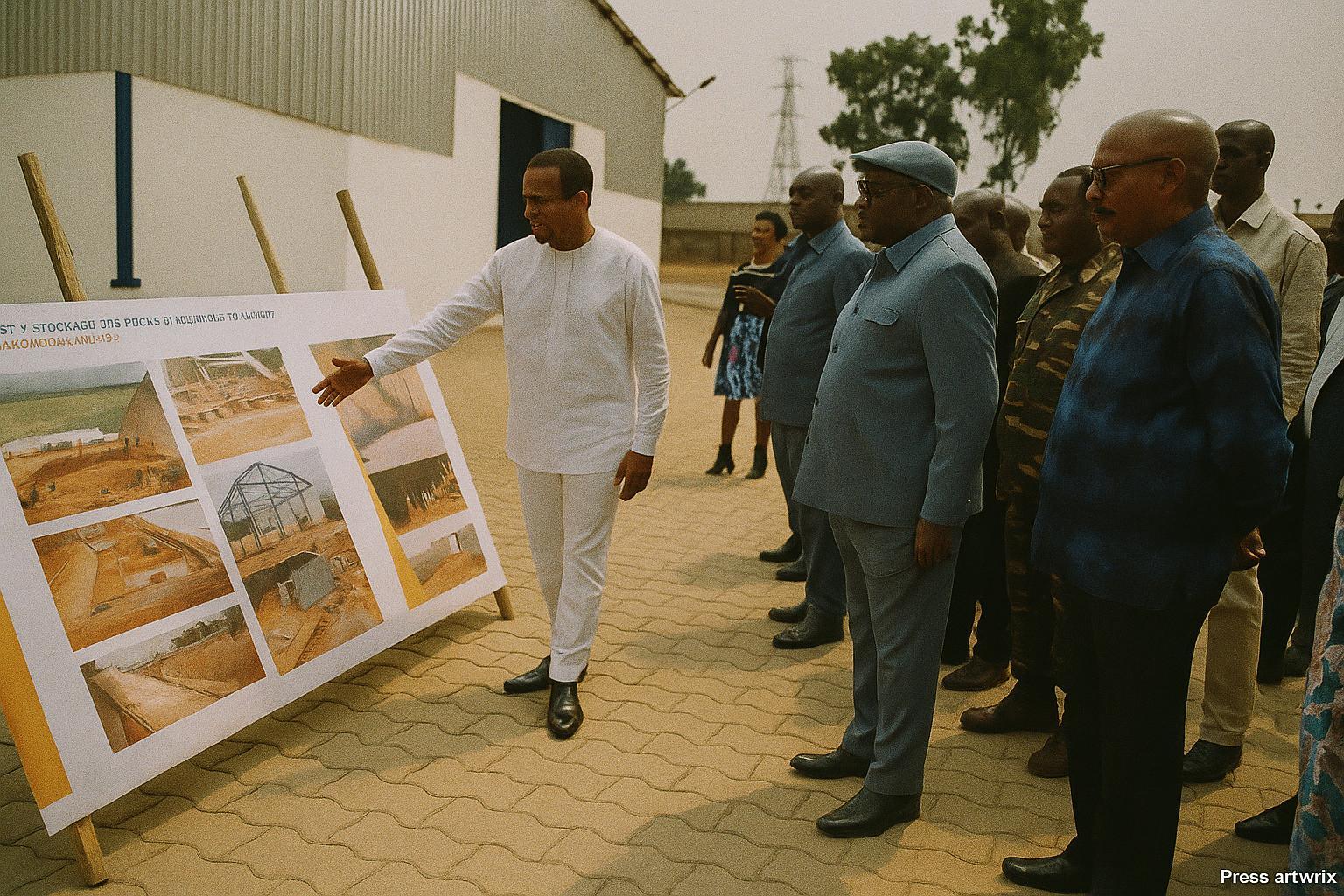
While Pointe-Noire’s Atlantic waterfront is better known for its offshore platforms, a quieter yet consequential development unfolded on 3 August when Minister of Energy and Hydraulics Emile Ouosso inspected two newly completed warehouses in Mongo Kamba II. Rising from red laterite soil, the buildings have been conceived as the logistical hinge of Congo-Brazzaville’s transmission upgrade, capable of sheltering high-voltage transformers and sensitive gas-insulated components that will soon travel from European and Asian factories to the Congo River basin.
The facilities, financed through a 1.28 billion CFA franc loan from the Agence française de développement (AFD), complement a similar complex inaugurated days earlier in Brazzaville’s Makabandilou district. Together, they mark the first purpose-built storage hubs dedicated exclusively to the national grid, a detail that underscores how supply-chain management has become as strategic as generation capacity in the Government’s energy calculus.
Minister Ouosso framed the visit in terms of anticipation rather than celebration. “The equipment is on the way; it is our responsibility to ensure it lands on solid logistical ground,” he told reporters, recalling that only two years ago the sector was “in a state of pronounced fatigue.”
Multilateral Financing and Private Partnerships
The incoming hardware—particularly 225/90-kV power transformers—has been procured through an intricate mosaic of financiers. The World Bank’s Electricity Sector Performance Improvement Project allocates resources both to the rehabilitation of the Pointe-Noire–Brazzaville transmission line and to the purchase of critical spares (World Bank Project Appraisal Document, 2022). Parallel contributions stem from ENI Congo as part of its social-investment commitments, while regional contractor Pasel handles bulk procurement under an engineering agreement approved in late 2022.
Such blended financing reflects broader continental trends. According to the International Energy Agency, over 60 percent of sub-Saharan grid investments in the past decade have relied on multilateral lenders combined with private hydrocarbons revenue (IEA Africa Energy Outlook, 2022). In Congo-Brazzaville, where fiscal space remains constrained by fluctuations in oil prices, the model offers a pragmatic path to energy security without overburdening the state balance sheet.
Diplomatic observers note that the arrangement also dovetails with President Denis Sassou Nguesso’s 2022–2026 National Development Plan, which emphasises public–private partnership as a lever for infrastructure delivery. The warehouses thus serve as tangible proof-points for donors who seek clear fiduciary safeguards before disbursing funds.
Digital Inventory for Robust Maintenance
Beyond bricks and mortar, the project embeds a digital layer designed to pre-empt the chronic spare-parts shortages that historically triggered prolonged outages. Jean-Bruno Danga Adou, Director-General of Société Énergie Électrique du Congo (E²C), confirmed that every component will be bar-coded and tracked through an enterprise resource planning module, giving operators real-time visibility over stock levels and equipment life cycles.
The approach mirrors asset-management protocols adopted by utilities in Morocco and South Africa, where predictive maintenance has reduced transformer failure rates by up to 30 percent over five years (African Utility Week Proceedings, 2021). For Congo-Brazzaville the stakes are arguably higher: the national grid is still a single backbone stretching more than 500 kilometres between Maloukou and Pointe-Noire, meaning that a fault on one transformer can propagate cascading outages across two economic hubs.
Ministerial advisers suggest the data-driven system could become a reference for other state-owned enterprises, reinforcing the administration’s broader digital-governance agenda. In a region where logistical opacity often fuels criticism, transparent stock accounting offers both operational resilience and reputational dividends.
Local Authorities Welcome Enhanced Security
Evelyne Tchitchelle, Mayor of Pointe-Noire, expressed measured satisfaction with the new compound, emphasising the dual imperatives of civic safety and uninterrupted power. Closed-circuit cameras and perimeter lighting, she noted, should deter the vandalism that plagued earlier storage sites during periods of economic downturn. “The warehouses protect not only equipment but also the credibility of public service,” she remarked.
The security dimension resonates with Albert Bakala, energy-transport adviser at the ministry, who drew attention to the costly cycle of “construction, destruction, reconstruction” that has shadowed many infrastructural assets across Central Africa. By embedding physical and digital safeguards from day one, the government aims to extend asset longevity and reassure external financiers wary of non-technical losses.
For the resident population, the promise is straightforward: fewer unplanned blackouts and quicker restoration times during seasonal storms. In Pointe-Noire’s industrial zones, where aluminum smelters and petrochemical plants operate on tight production schedules, even marginal improvements in grid reliability translate into palpable economic gains.
Toward a Resilient National Power Backbone
Looking ahead, officials view the warehousing programme as the prelude rather than the epilogue of Congo-Brazzaville’s energy story. Scheduled transformer deliveries will coincide with the phased energisation of the rehabilitated 225-kV link to Brazzaville, a corridor that, once fully reinforced, could support cross-border exchanges with the Democratic Republic of Congo under the Central African Power Pool framework (ECCAS communiqué, March 2023).
Policy analysts argue that a stronger domestic grid will also enhance the viability of prospective hydropower exports from Sounda Gorge, currently under feasibility review with the African Development Bank. By demonstrating competence in asset stewardship, Brazzaville positions itself to attract the concessional financing such mega-projects require.
In diplomatic circles, the initiative is interpreted as emblematic of the administration’s intent to pivot from crisis-response mode—marked by ad-hoc generator rentals—toward long-range system planning. The tone remains pragmatic, yet the subtext is unmistakable: a resilient electricity sector is foundational to economic diversification, regional integration, and ultimately political stability.
For now the warehouses stand empty, their concrete floors gleaming under tropical light. Soon they will echo with the metallic thud of transformers that, once energised, could turn an oft-criticised liability into a quietly reliable public good. In a country where infrastructure announcements sometimes fade into the equatorial haze, the physical presence of these hangars offers a durable sign that the grid’s next chapter is already being written.
