
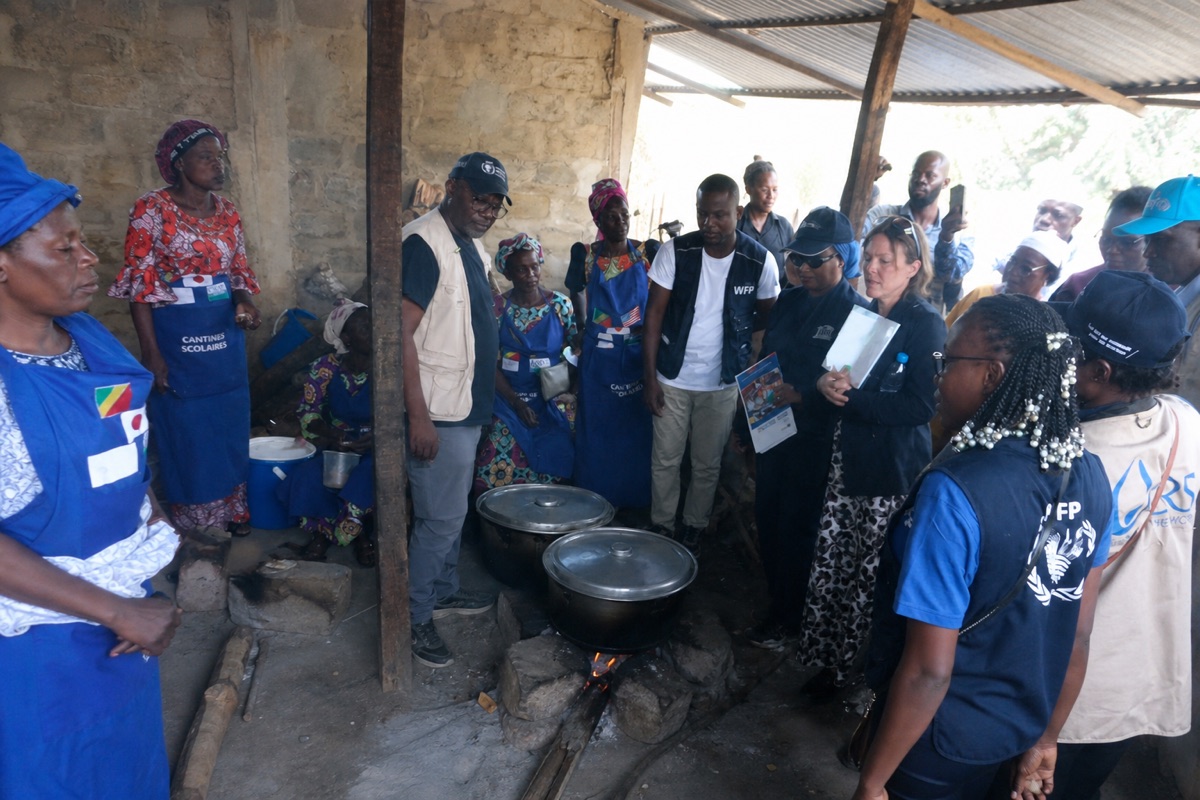
On a humid April morning in the rolling country of the Pool, a diplomatic visit carried a weight that exceeded its modest itinerary. Amanda Jacobsen, chargée d’affaires at the United States Embassy in Brazzaville, walked through the gates of two primary schools — Samba Daniel and Jean Kimbémbé — to take the measure of something Washington has been quietly underwriting for the better part of a generation. What she came to inspect was not a building or a bridge, but a meal: the daily ration that now reaches more than eighty-three thousand Congolese children, and the long-running American programme that puts it on the table.
A Quarter-Century of Quiet Investment in Congolese Classrooms
The school-feeding initiative is not a sudden gesture. It dates to 2001, when the United States Department of Agriculture’s GovEd programme began channelling resources into Congo-Brazzaville’s classrooms in partnership with the World Food Programme and the Congolese government. Across the intervening years, that commitment has hardened into figures that command attention: more than one hundred million dollars invested, and a network of canteens that today serves daily meals to upwards of 83,000 pupils across some four hundred schools. The longevity matters as much as the sum. Few foreign assistance schemes survive the political weather of two decades intact, and the persistence of this one suggests a partnership that has weathered changes of administration on both sides of the Atlantic.
Jacobsen’s appearance in the Pool — a department whose recent history has been marked by instability and recovery — was therefore freighted with more than ceremony. By choosing rural schools rather than the capital’s institutions, the embassy signalled where it believes the programme’s stakes are highest: in places where a guaranteed lunch can be the difference between a child who stays in school and one who drifts away.
Why a Plate of Food Becomes an Education Policy
The arithmetic of hunger and schooling is well understood by development specialists, and the Congolese experience bears it out. Where canteens operate, attendance rises and pupils are more likely to remain enrolled through the school year. The effect is most pronounced among girls, who account for close to half of the programme’s beneficiaries — a proportion that turns a feeding scheme into an instrument of gender equity, whether or not it was designed primarily as one. A meal removes one of the quiet pressures that pull children, and daughters especially, out of the classroom and into domestic or economic labour.
Jacobsen framed the effort in the language of partnership rather than charity. The United States, she said, is “proud to support the Congolese people” in what she described as priority areas, linking the programme to the broader goals of prosperity and stability. The phrasing is diplomatic, but it points to a genuine calculation: that nutrition and literacy are foundations on which more ambitious forms of cooperation can be built. A fed child who learns to read is, in the longer arithmetic of statecraft, an investment in a more stable neighbourhood.
The Open Question of What Comes After 2026
For all the confidence on display in the Pool, the programme stands at an inflection point. Current financing runs to 2026, and its continuation beyond that horizon is not yet assured. Speaking during the visit, the representative of the World Food Programme expressed optimism that the support would be extended, and pointed to a widening circle of potential contributors — among them Japan and actors from the private sector — who might help shoulder the cost in the years ahead.
That prospect reframes the initiative as something larger than a bilateral arrangement. If new partners can be drawn in, the canteens of the Pool could evolve from an American-financed undertaking into a more broadly owned compact, less vulnerable to the budgetary moods of any single capital. Such diversification would also speak to a maturing model of assistance in Central Africa, one in which the World Food Programme acts as a hub coordinating multiple donors around an established and demonstrably effective intervention.
For now, the immediate reality is the more compelling one. In two schools in the Pool, and in hundreds more across the country, children sat down to a meal that arrived because of decisions taken in Washington a quarter of a century ago and renewed, year after year, since. Whether that continuity holds past 2026 will be settled in negotiations far from any classroom. The pupils of Samba Daniel and Jean Kimbémbé, for their part, will measure the programme by a simpler test — whether the meal is there tomorrow.
