
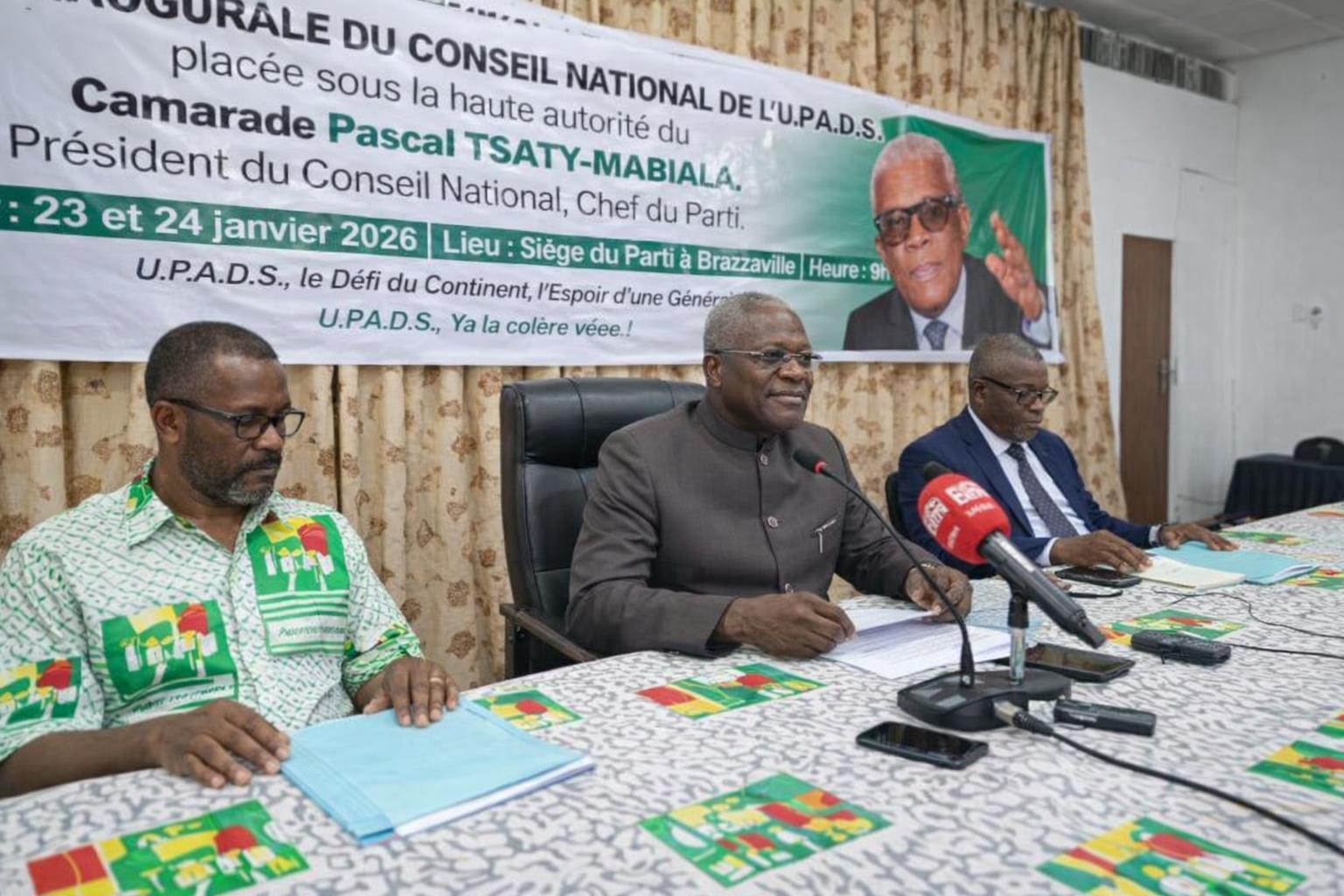
Congo presidential race: UPADS opts out again
As political actors in the Republic of the Congo (Congo-Brazzaville) position themselves for the next presidential election, the Union panafricaine pour la démocratie sociale (UPADS) has once again chosen a path of non-participation at the highest level. As in 2021, the party has decided not to present a candidate, a move that is already shaping the tone of political debate by raising pointed questions about strategy, resources and the capacity for renewal within one of the country’s historically significant opposition formations.
The decision was confirmed at the close of the inaugural session of the party’s National Council, held in Brazzaville on 23 and 24 January 2026. In a political calendar where presidential elections typically serve as a defining test of organisational strength and narrative clarity, UPADS’ withdrawal stands out not only as a tactical choice, but as a political signal—one likely to be interpreted differently by militants, sympathisers and observers across the spectrum.
Brazzaville National Council decision: symbols and implications
The Brazzaville meeting, convened as an inaugural session of the National Council, carries symbolic weight in itself: it is precisely in such institutional settings that parties are expected to articulate priorities, settle internal debates and present a coherent roadmap. By emerging from that session without a presidential candidate, UPADS effectively confirmed a continuity of posture rather than a change of course.
In the public imagination, a presidential election is not merely another ballot; it is the moment when a political project is condensed into a person, a message and a mobilisation strategy. Choosing not to compete may therefore be read as a statement about the party’s current assessment of its own readiness—financially, organisationally and politically—to sustain a national campaign at the level required by the country’s contemporary electoral arena.
UPADS’ political legacy and the challenge of conversion into momentum
UPADS’ historical resonance is inseparable from its origins and its association with Professor Pascal Lissouba, whose role in the country’s political history remains central to the party’s identity. Yet legacy, while a powerful asset, does not automatically translate into electoral momentum. The episode underlines a recurring dilemma in many long-established parties: how to convert symbolic capital into a modern campaigning machine capable of speaking to present-day concerns.
In this sense, the non-candidacy decision invites a more nuanced reading than a simple narrative of retreat. It suggests the difficulty of reconciling a foundational heritage with the practical demands of contemporary political competition. In a context where political expectations are shaped by immediacy—visibility, organisational discipline, and credible leadership—history alone rarely substitutes for the everyday work of coalition-building and voter persuasion.
Financing, organisation and the realities of presidential campaigning
The reformulation of the party’s choice has been accompanied by a theme that recurs with striking persistence: resources. The text points explicitly to a lack of money, linking financial constraints to the absence of a candidate. While campaign finance is often discussed in broad terms, its implications are concrete: the ability to travel, to organise meetings, to craft and distribute communications, and to maintain a professional campaign infrastructure.
In this light, UPADS’ decision can be interpreted as an acknowledgement of the material realities of presidential campaigning. A party may judge that entering a race without the means to compete credibly risks producing not a dignified defeat but a demobilising failure. Yet that calculation, however pragmatic, carries costs of its own: each electoral cycle without a presidential standard-bearer risks weakening the party’s image as a vehicle for governance, rather than commentary.
Internal cohesion and leadership renewal within UPADS
Beyond resources, the text highlights another sensitive axis: internal dynamics. It evokes persistent divisions, internal calculations and the absence of a clear vision capable of responding to contemporary challenges. Such phrasing points to a broader question of cohesion—whether the party is able to align its structures, reconcile competing tendencies, and present a leadership figure with the legitimacy to unify diverse constituencies.
Leadership renewal is not simply a matter of personalities; it is also about the capacity to produce a shared line that activists can defend in public and that citizens can recognise as coherent. Without a credible embodiment of the party’s project, a presidential campaign becomes difficult to imagine, and the temptation to postpone the decision—to wait for more favourable conditions—can become habitual. Over time, however, deferral can erode political influence, especially among younger voters and first-time participants who experience politics through the lens of visibility and immediacy.
Opposition participation and the meaning of abstention from the top race
The decision not to field a presidential candidate carries an unavoidable political meaning. As the text suggests, the move may be troubling to the party base and perplexing to the wider public: how does an organisation mobilise its supporters while stepping away from the “decisive test” of universal suffrage at the highest level? In political life, participation itself is often a form of assertion—an insistence on being counted, heard and measured.
At the same time, abstention may be framed by some within the party as an attempt to avoid symbolic defeat, preserve resources, or reposition for other arenas. Yet, as the narrative implies, an opposition force that repeatedly remains outside the principal contest risks being seen less as a contender than as an observer. That perception matters, because politics is not only about programmes; it is also about credibility, and credibility is frequently assessed through the willingness to take electoral risks.
What the 2026 choice could mean for UPADS’ future positioning
Ultimately, UPADS’ renewed decision to forego a presidential candidacy appears, in the text’s framing, closer to an admission of weakness than to an affirmative strategy. It underscores a tension between the party’s foundational vocation—seeking power to implement its societal project—and the current inability to translate that vocation into a concrete bid for the presidency.
For UPADS, the central challenge suggested here is to avoid a long-term settling into political marginality through repeated absence. Electoral history often remembers not only defeats but also non-appearances, because absence can signal that a party has ceased to imagine itself as governing. If the party intends to reassert itself, the implied lesson is that power is neither proclaimed nor inherited: it is prepared, structured, financed, and embodied in leadership capable of persuading beyond the faithful.
