
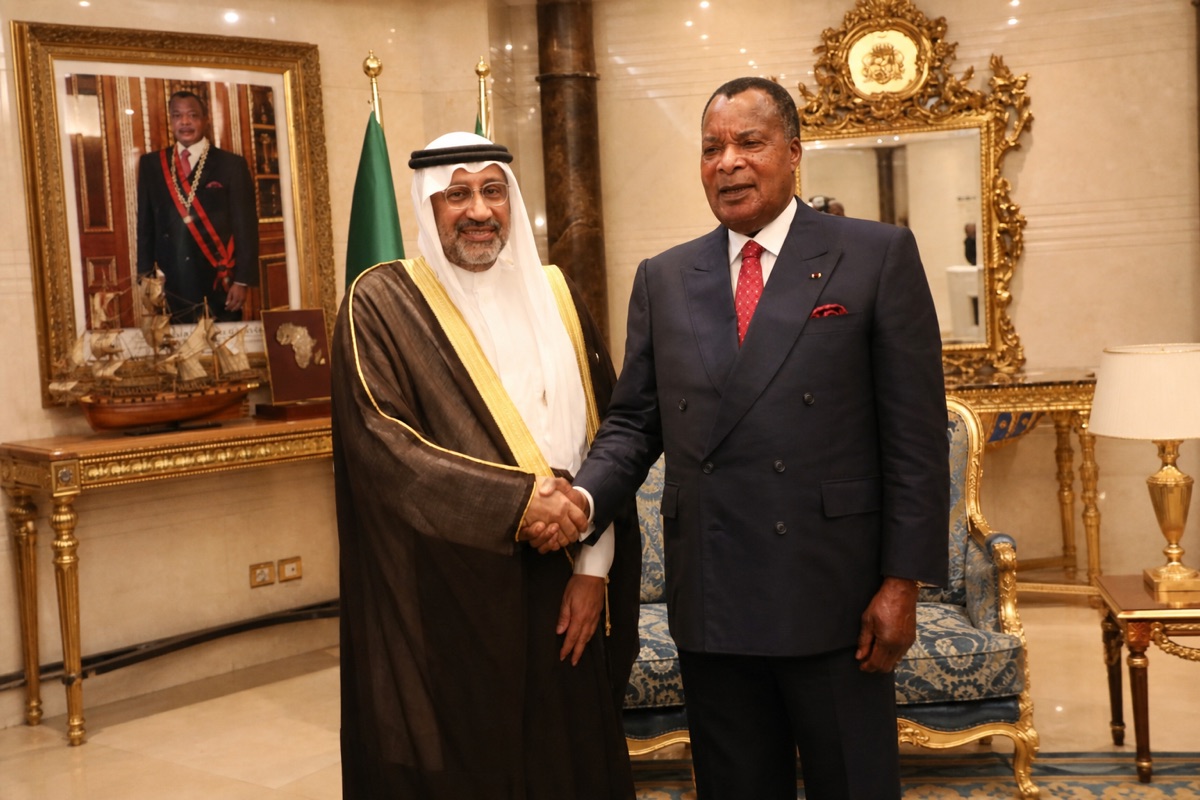
A working visit to Brazzaville has rekindled one of the Republic of Congo’s most enduring extra-African financial relationships. President Denis Sassou N’Guesso received Abdullah Khalil Al Musaibeeh, president of the Arab Bank for Economic Development in Africa (BADEA), in a meeting that both sides framed less as a courtesy call than as a stocktaking exercise on a portfolio that has quietly grown over the years. At a moment when Congo-Brazzaville is weighing the financing architecture of its next development cycle, the encounter carried a significance that went well beyond protocol.
A Stocktaking Visit That Yielded Two Concrete Accords
The headline outcome of the talks was the signature of two fresh agreements. The first concerns the Corniche project, the riverside development along the Congo River that has become emblematic of Brazzaville’s urban modernisation ambitions. The second relates to an increase in the capital of the African Solidarity Fund, a multilateral guarantee institution whose strengthened balance sheet should, in principle, ease access to credit for member states across the continent.
Al Musaibeeh was candid about the purpose of the discussions. “We reviewed BADEA’s projects in Congo and discussed the two projects whose agreements were signed today, namely the Corniche project and the capital increase of the African Solidarity Fund,” he explained. “We are ready to finance energy and infrastructure projects.” The remark, delivered in the measured register that characterises development-bank diplomacy, nonetheless signalled an appetite for deeper exposure to the Congolese market.
Why Energy and Infrastructure Sit at the Heart of the Conversation
The emphasis on energy and infrastructure is not incidental. These two sectors form the connective tissue of any credible growth strategy in Central Africa, where the gap between installed capacity and actual demand remains stubbornly wide. For Brazzaville, securing patient, concessional capital from an institution such as BADEA offers an alternative to the more volatile commercial financing that has weighed on the country’s debt profile in recent years.
BADEA’s positioning is instructive. As the development arm channelling Arab capital towards sub-Saharan economies, the bank has long cultivated a reputation for financing projects that bilateral lenders sometimes hesitate to touch. Its willingness to associate itself with both a flagship urban scheme like the Corniche and a continental guarantee mechanism suggests a dual logic: visible national impact paired with systemic reinforcement of the financial plumbing on which smaller economies depend.
A Partnership Calibrated for the 2027-2031 Horizon
Perhaps the most consequential thread to emerge from the meeting was forward-looking. The partnership between Congo and BADEA appears poised to feed directly into the national development plan envisaged for the 2027-2031 period, with energy and infrastructure once again identified as the priority channels. Aligning a multilateral lender’s pipeline with a sovereign planning cycle is rarely a matter of chance; it reflects a deliberate effort to lock in financing commitments before the formal programming begins.
For Congolese policymakers, the calculus is straightforward enough. Anchoring a portion of the forthcoming plan in BADEA’s balance sheet reduces reliance on a single source of capital and lends credibility to projects that will still be on the drawing board when the next planning cycle opens. For the bank, early engagement allows it to shape the technical contours of projects rather than inherit them, a privilege that comes with being in the room before decisions harden.
The Diplomatic Subtext of a Development Handshake
It would be a mistake to read the Brazzaville talks purely through a balance-sheet lens. Development finance in the Congolese context is also an exercise in diplomatic signalling. By receiving the BADEA president personally, Sassou N’Guesso underscored the value Brazzaville places on its ties with Arab-backed institutions at a time when much of Central Africa is recalibrating its external partnerships and seeking to diversify the origins of its capital.
The understated tone of the announcements, two agreements signed, a stated readiness to do more, belies the structural stakes. Each concessional loan that materialises shapes not only the physical landscape of the capital but also the fiscal room the government retains for other priorities. The Corniche, in that sense, is as much a financial statement as an architectural one.
What remains to be seen is whether the stated readiness to finance energy and infrastructure translates into a deepened pipeline ahead of the 2027-2031 plan, or whether it stays at the level of intention. For now, the meeting leaves Brazzaville with two fresh accords in hand and an interlocutor who has, at the very least, kept the door firmly open. In the patient grammar of development banking, that openness is itself a form of commitment.
Source : adiac-congo.com
