
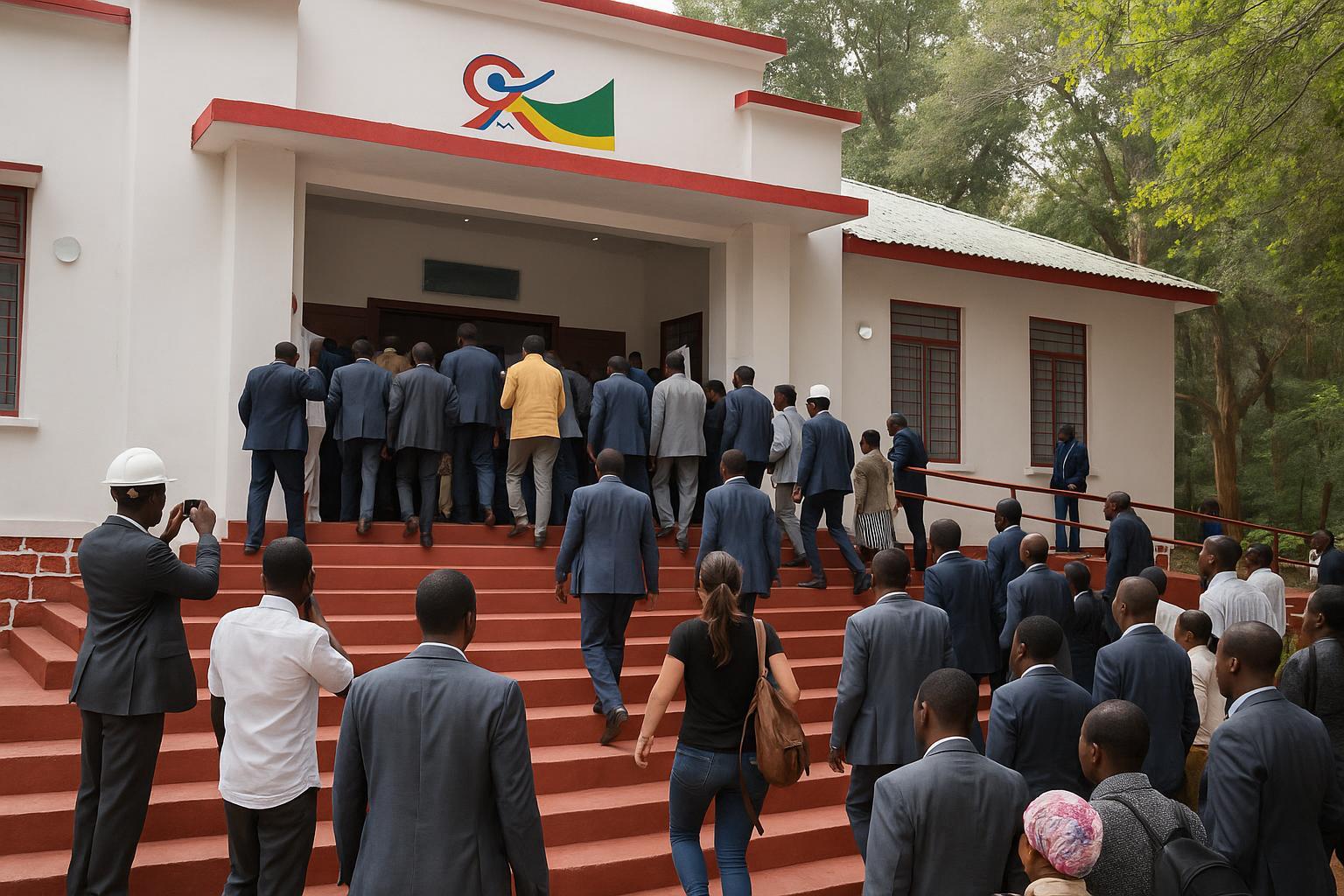
A Landmark Hand-over in Brazzaville
Under the warm Brazzaville sun on 15 December, Minister of Health and Population Professor Rosaire Ibara accepted the keys to a fully refurbished headquarters for the National HIV/AIDS Control Programme, PNLS. The ceremony, attended by United Nations Development Programme resident representative Adama Dian-Barry, capped five months of rapid construction financed through a joint envelope from UNDP and the Global Fund to Fight AIDS, Tuberculosis and Malaria.
Speaking before staff and development partners, Professor Ibara framed the hand-over as “a decisive step in the Republic’s march toward ending HIV transmission”. He underlined that the site, granted by the State and upgraded to contemporary standards, equips PNLS with the logistical backbone required for rigorous planning, real-time monitoring and transparent reporting.
Architecture Designed for Public Health Efficiency
Erected on a 10,000-square-metre plot once occupied by the Lucienne Edouard childcare centre, the 400-square-metre edifice hosts 23 purpose-built rooms, including meeting suites, secure archives and reprography stations. Contractors delivered the project for 383 million CFA francs—about 586,000 euros—demonstrating cost consciousness at a moment when competing social investments crowd the national budget.
Engineers opted for low-consumption lighting, natural ventilation corridors and rain-water harvesting in order to align with Congo’s updated environmental code and UNDP’s green building benchmarks. The result is a workspace that, in Ms Dian-Barry’s words, “integrates durable solutions while symbolising hope for prevention, testing and care”. The campus also reserves expansion pads for a data centre and training gazebo, illustrating an architecture conceived for scalability as programme ambitions deepen.
Anchoring National and Global HIV Strategies
The headquarters arrives as Congo implements its fourth National Strategic Plan on HIV 2023-2027, a roadmap synchronised with the Sustainable Development Goal of ending the epidemic by 2030. PNLS is tasked with steering the country toward the UNAIDS 95-95-95 cascade—95 percent of people living with HIV knowing their status, 95 percent of those diagnosed on antiretroviral therapy, and 95 percent of treated individuals achieving viral suppression.
Progress has accelerated yet gaps remain. UNAIDS’ 2023 country snapshot estimates adult prevalence at 1.3 percent, with roughly 74 percent of diagnosed citizens receiving treatment. Officials believe that a centralised command centre, digitally linked to 20 district drug warehouses also refurbished under the same partnership, will tighten supply chains, curb stock-outs and facilitate evidence-based outreach in remote departments such as Likouala and Kouilou.
Capacity Building and Community Impact
Professor Ibara urged PNLS managers to embrace a culture of measurable results, noting that “these walls will be judged not on their aesthetics but on lives saved”. During 2024-2025 the programme placed more than 48,000 people—including 3,000 children—on antiretroviral regimens, screened 143,744 pregnant women to prevent mother-to-child transmission and trained over 500 health workers in differentiated care models.
Coordinator Mapaha Maikassissa credited UNDP’s technical assistance for reinforcing procurement, data analytics and financial stewardship skills within her team. Community-based organisations likewise anticipate stronger collaboration, as the building dedicates office space for civil-society liaisons who channel grassroots intelligence into national policy discussions.
Sustaining Momentum Towards 2030
UNDP has signalled its intention to continue accompanying Congo past 2026, in concert with the World Health Organization and bilateral partners. Planned interventions include mobile clinic fleets, digital patient tracking and an investment case to crowd-in private-sector financing for HIV commodities.
The refurbished headquarters therefore transcends its physical footprint: it materialises government ownership, donor confidence and collective responsibility. By marrying architecture with strategy, the Republic of Congo positions itself to quicken the rhythm of viral suppression, contributing to regional health security across Central Africa.
As dusk settled on the inauguration day, the tricolour flag fluttered above freshly painted walls, a quiet reminder that infrastructure, leadership and solidarity remain the most potent medicines in the long journey to defeat HIV.
