
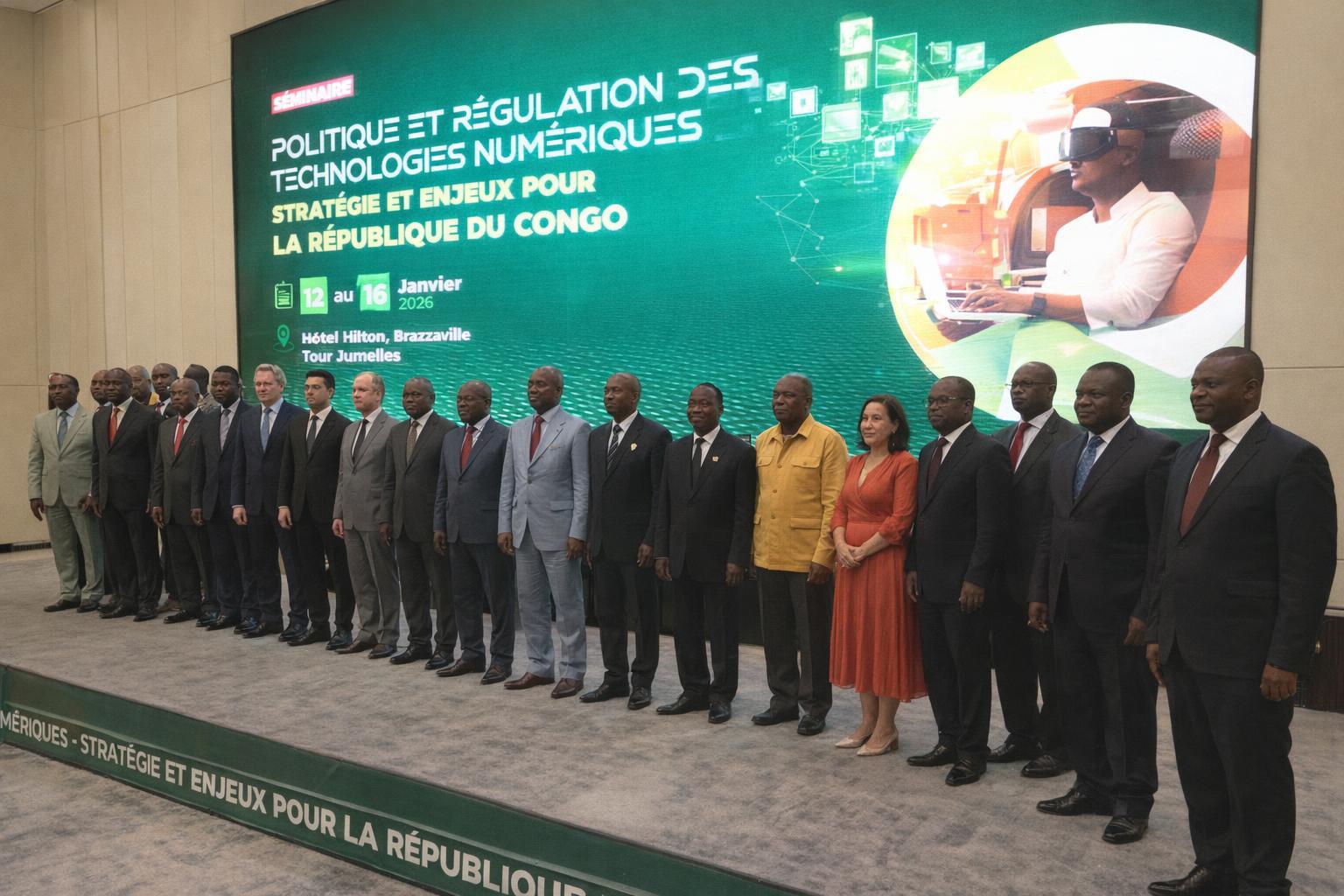
Brazzaville Consultation on AI Regulation Opens
In Brazzaville, Congo-Brazzaville has opened a national consultation devoted to the regulation of artificial intelligence, a policy area that many governments are approaching with increasing urgency as digital tools diffuse across public services and private markets. The meeting, convened by the Agency for the Regulation of Posts and Electronic Communications (ARPCE), brings together public and private stakeholders alongside international digital experts, with discussions scheduled to continue until Friday, 16 January 2026 (Journal de Brazza).
The organisers present the exercise as a structured attempt to lay foundations for a regulatory approach adapted to contemporary technological challenges. At its centre lies a pragmatic question: how can national institutions keep pace with fast-moving innovations while preserving the public interest in an increasingly data-saturated environment? (Journal de Brazza).
Citizen Protection and Responsible Innovation in the Digital Space
According to the agenda outlined by the initiators, the consultation places citizen protection in the digital space among its principal themes. This emphasis implicitly recognises that digital transformation is not only an economic accelerant but also a domain where rights, safety and trust must be actively maintained if the benefits of new technologies are to be broadly shared (Journal de Brazza).
The exchanges also address the promotion of responsible innovation. In practice, this notion tends to imply a balancing act: fostering experimentation and investment while identifying guardrails that reduce foreseeable harms, clarify accountability, and provide predictability to innovators. The stated intention is not to arrest technological change, but to steer it in ways consistent with social and ethical expectations (Journal de Brazza).
Data Governance, AI Oversight and Emerging Technologies
Beyond AI itself, the Brazzaville discussions cover the regulation of data and of the broader digital ecosystem. ARPCE’s director general, Louis-Marc Sakala, framed the challenge in terms of institutional tempo, warning that technological progress is advancing faster than regulators’ capacity to respond. “Technologies are evolving faster than our ability to regulate them,” he said at the opening, calling for strengthened coordination between public institutions and private actors (Journal de Brazza).
Sakala’s remarks also situate AI regulation alongside adjacent fields that are increasingly intertwined in policy debates, notably blockchain, crypto-assets and satellite technologies. By grouping these topics, the consultation signals an understanding that today’s digital infrastructure is composite: data flows, algorithmic systems and new financial instruments can reinforce one another, raising cross-cutting questions about oversight, compliance and systemic resilience (Journal de Brazza).
Digital Finance: Security and Inclusion as Policy Priorities
A further theme highlighted by the organisers is the development of digital finance that is both secure and inclusive. The framing is notable in that it links innovation to public confidence, suggesting that the adoption of digital payments and related services depends not merely on technological availability but also on the perception that systems are dependable and that risks are managed (Journal de Brazza).
At the same time, the explicit reference to inclusion indicates a policy ambition to ensure that digital financial tools do not concentrate benefits among already-connected segments of society. In regulatory terms, this can mean building frameworks that encourage safe access, clear consumer protections and robust standards, while enabling new services to reach a wide range of users (Journal de Brazza).
Government Signals Strategic Approach to AI and Data
At the opening session, Léon Juste Ibombo, Minister of Posts, Telecommunications and the Digital Economy, underscored the strategic value now attributed to digital data and AI by states. His remarks place Congo-Brazzaville’s initiative within a broader governmental reading of technology as an asset with economic, social and ethical dimensions that must be addressed through coherent public policy (Journal de Brazza).
Ibombo called for a political response that is “lucid, coherent and responsible,” an expression that, in context, points to the desire to avoid improvised rule-making while recognising the speed and scope of change. The minister’s emphasis suggests that the consultation is intended not only as a technical workshop, but also as a forum to align institutional perspectives and clarify priorities (Journal de Brazza).
National AI Strategy Under Preparation with Partners
The minister also announced that a national artificial intelligence strategy is currently being developed. The work, he said, is being carried out in partnership with the African Centre for Research in Artificial Intelligence and the United Nations Development Programme (UNDP), with the stated objective of providing the country with a clear framework adapted to its own context (Journal de Brazza).
In practical terms, the articulation of a national strategy often serves multiple functions: it can set guiding principles, define sectoral priorities, and identify the roles of institutions and market actors. While the content of the strategy was not detailed in the information presented, the announcement itself indicates an intention to move from general reflection to structured policy design (Journal de Brazza).
Towards “Smart, Inclusive and Sovereign” Digital Regulation
The organisers anticipate that the week’s work will help to crystallise a shared vision and actionable orientations for what they describe as “smart, inclusive and sovereign” digital regulation. Such language blends technical ambition with political purpose: it gestures towards regulatory intelligence, social breadth and national ownership within a globalised technological landscape (Journal de Brazza).
If the consultation succeeds in clarifying common ground among institutions, companies and experts, it may also provide a basis for more durable coordination as technologies evolve. For Congo-Brazzaville, the stated aim is to anchor innovation in a framework that protects citizens, supports responsible economic dynamism and strengthens the country’s capacity to govern the digital domain according to its own priorities (Journal de Brazza).
