
A Damning Audit of Republic of the Congo’s Rights Record
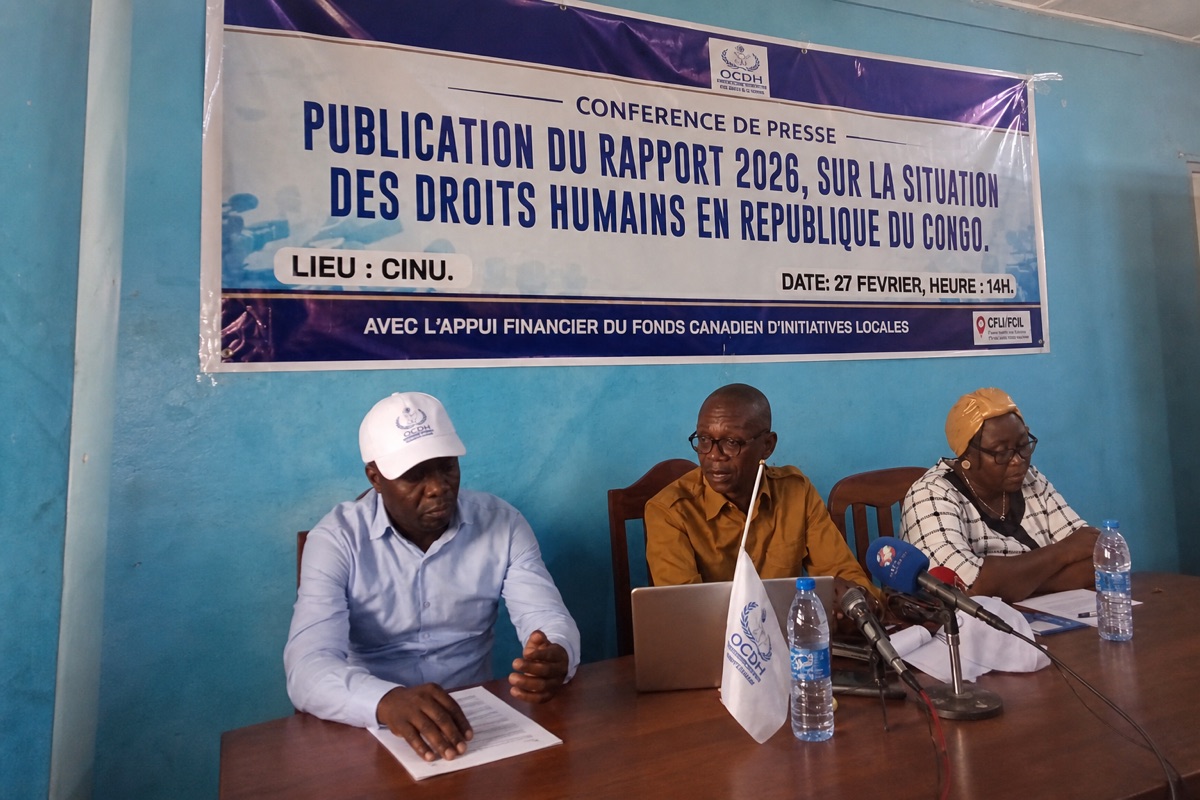
As the Republic of the Congo (Congo-Brazzaville) moves toward its presidential contest, the country’s oldest independent rights watchdog has chosen the eve of the campaign to deliver an unflinching verdict. On 27 February in Brazzaville, the Congolese Human Rights Observatory (OCDH) made public its 2025-2026 report, a document whose very title forecloses any pretence of moderation: Human Rights in Grave Difficulty in Congo-Brazzaville: the illusion of democracy and the rule of law to perpetuate tyranny. Presented by Parfait Moukoko, chairman of the OCDH board, at a press conference, the report reframes the coming election less as a procedural milestone than as a test of whether the political class will treat fundamental freedoms as anything more than rhetorical ornament.
Disappearances at the Centre of a Bleak Ledger
The most arresting finding concerns the practice of enforced disappearance, a category of abuse that carries particular dread because it severs victims from both the law and their families. According to Moukoko, the Observatory has documented roughly fifty such cases over the preceding six months alone. He situated these figures within a broader pattern, telling the assembled journalists that torture and extrajudicial executions occur with troubling regularity in places of detention. The numbers, presented soberly rather than with theatrical emphasis, acquire their weight precisely from their accumulation: a half-century of vanished individuals in half a year is not an aberration but, in the Observatory’s reading, the signature of a system.
It is worth dwelling on the methodological care the OCDH claims for itself. The report covers the twelve months from February 2025 to February 2026 and was conducted on a national scale with financial backing from the Canada Fund for Local Initiatives. That provenance matters in a context where rights organisations are frequently accused of partisanship; an externally supported, nationwide survey is harder to dismiss as the grievance of a narrow faction.
When Institutions Become the Problem
What gives the report its analytical edge is its refusal to treat abuses as isolated excesses. Moukoko enumerated a cluster of structural failings: impunity for perpetrators, the non-application of treaties the state has formally ratified, and irregularities lodged within the judicial and governmental apparatus itself. The argument implicit here is uncomfortable but coherent. If the courts, the police and the administration are themselves vectors of dysfunction, then violations cease to be deviations from the order and become expressions of it. The report’s title, with its talk of an illusion of the rule of law, is therefore not mere provocation; it is a thesis about the gap between Congo-Brazzaville’s elaborate legal architecture and the lived reality of those who fall foul of it.
This diagnosis carries a quiet warning for international partners and domestic observers alike. Ratification, the OCDH suggests, has become a substitute for compliance, a way of acquiring the vocabulary of human rights without accepting its constraints. The persistence of torture in detention facilities, even as the state proclaims its adherence to conventions prohibiting it, is the clearest illustration of that divorce between word and deed.
A Challenge Addressed to Those Who Would Govern
Rather than confining itself to denunciation, the Observatory turned its findings into a set of demands directed at the presidential candidates. It urged them to make human rights a genuine priority within their platforms, transforming the report into an instrument for measuring the seriousness of their commitments. The OCDH called specifically for the judicialisation of efforts against the phenomenon of the so-called bébés noirs, the street children whose marginalisation has become a chronic urban wound, and for the security forces, the police and the gendarmerie to be enabled to discharge their protective responsibilities properly.
There is a deliberate logic to this framing. By publishing on the threshold of the campaign, the OCDH compels every contender to position himself in relation to a documented record rather than to abstractions. Silence becomes its own answer. The report thus functions as a kind of civic ledger, inviting the electorate to weigh promises against an evidentiary baseline.
The Stakes Beyond the Ballot
Read in full, the 2025-2026 report is less an indictment of any single administration than a meditation on the durability of authoritarian habits within nominally democratic forms. Its central claim, that democratic procedure can be wielded to entrench rather than dilute concentrated power, resonates well beyond Brazzaville and speaks to a recurring dilemma across Central Africa. For Congolese citizens, the immediate question is narrower but no less grave: whether the coming vote will mark a reckoning with the disappearances, the torture and the impunity the Observatory has catalogued, or whether, as the report’s title bleakly intimates, the appearance of choice will once again outlast its substance.
