
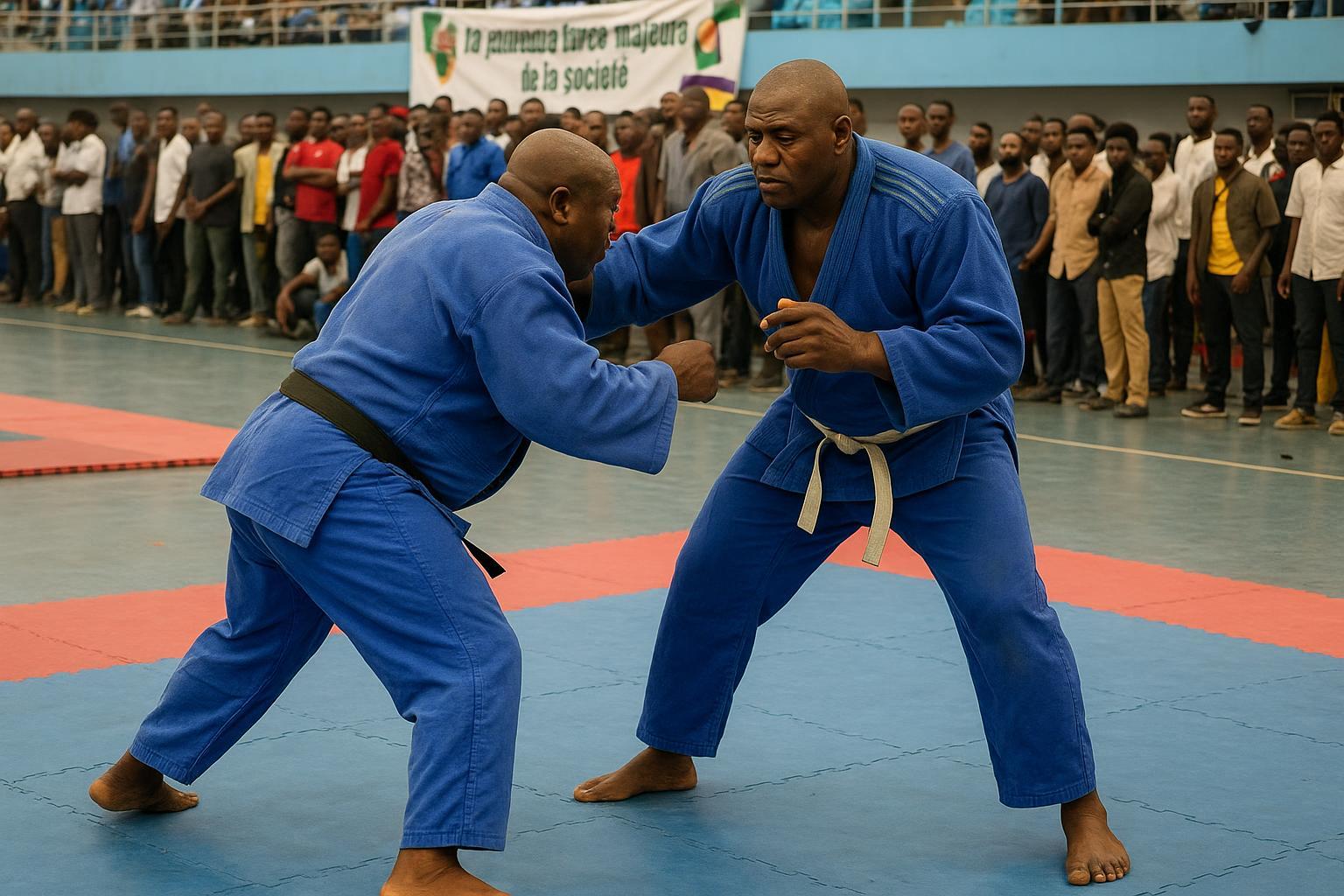
High-intensity tatamis in northern Brazzaville
The cavernous halls of the Kintélé Sports Complex, fifteen kilometres north of Brazzaville, have reverberated with the controlled cadence of throws and breakfalls for the past five weeks. Sixty-four athletes of the national judo team, the Diables-Rouges, arrived at the venue in early May under the aegis of the Congolese Judo Federation (Fécoju-Da). Their single-minded purpose is to mould competitive sharpness ahead of three decisive African competitions slated for the final quarter of 2025. For Christophe Yongo, the quietly charismatic national technical director, the camp is more than routine preparation. “Each session is an investment in our collective future: the athletes’ futures, the federation’s future, and the country’s sporting future,” he reflected during a break between randoris.
Timetable of continental hurdles
The calendar facing the Congolese judokas is both compressed and consequential. From 20 to 23 November 2025 they must confront the Open International of Yaoundé, a tournament that feeds directly into the points system for the Los Angeles 2028 Olympic Games. Barely ten days later, the squad’s under-23 cohort will cross the Congo River to Kinshasa for the Francophonie Youth Championships, an event fostered by the International Organisation of La Francophonie to spotlight emerging talent. The campaign will culminate between 10 and 20 December in Luanda during the fourth African Youth Games, where judo has historically delivered some of Congo’s brightest podium finishes. In less than a month, therefore, the Diables-Rouges will navigate three competitions, two capital cities and one Olympic dream.
Nutrition, logistics and the economics of elite sport
Elite judo demands a fine balance between explosive power and weight management, a tension that magnifies the role of nutrition. Yongo, echoing coaches worldwide, notes that a single additional kilogram can compromise an athlete’s category, while a caloric deficit erodes strength. “We expend enormous energy in training; the body must be replenished with precision,” he explains. Since the camp opened, Fécoju-Da has borne the brunt of dietary and medical costs, relying on federation membership dues and modest private donations. Federation president Marcel Moukila confirmed that current outlays hover around 4.5 million CFA francs per week for food, physiotherapy and transport between dormitories and tatamis. Such figures remain small next to budgets in Europe or Asia, yet they stretch the federation’s coffers at a moment when most sponsorship contracts concentrate on football.
Brazzaville’s policy architecture for high performance
Government support for the nation’s elite athletes is usually channelled through the Fund for the Promotion of Sport (FPS) and supervised by the Ministry of Sports and Physical Education. The minister, Hugues Ngouélondélé, indicated in a recent media appearance that dossiers for Olympic-qualifying disciplines are being finalised for disbursement in the third quarter of this year. He recalled that the State financed the judo delegation to last year’s African Senior Championships in Casablanca, where Congo obtained a historic silver medal in the –78 kg category. According to ministry data, allocations for combat sports rose by 12 per cent in the 2024 national budget, signalling an intent to diversify the country’s sporting portfolio beyond its celebrated athletics and handball traditions. A senior official, speaking on background, affirmed that the Diables-Rouges’ current training allowances would be regularised “within the statutory timeframe provided to all federations.”
Beyond medals: soft power and social ripple effects
Observers of sports diplomacy argue that podium performances serve as an accelerator of national visibility. The forthcoming Yaoundé Open, to be broadcast by several pan-African networks, offers Congo-Brazzaville an opportunity to project an image of disciplined youth, technical mastery and regional cooperation. At the grassroots level, the camp already exerts magnetic appeal. Schoolchildren from Talangaï routinely queue outside the complex to watch afternoon sparring, an anecdotal testament to judo’s growing traction in urban neighbourhoods. Social scientists at Marien Ngouabi University have correlated participation in martial arts with reduced dropout rates among adolescents, findings that align with the government’s Programme d’Appui à la Jeunesse launched in 2022. By underwriting elite judo, the State thus reinforces a virtuous circle that spans public health, civic values and international esteem.
Setting the grip for 2025 and beyond
As the training cycle progresses, the Diables-Rouges fine-tune seoi-nage variations, transition drills and the mental arithmetic of shiai strategy, all underpinned by the expectation that public funds will soon relieve the federation’s overstretched reserves. In the words of veteran lightweight Cédric Mavoungou, “Every athlete dreams of stepping onto an Olympic tatami. With the nation behind us, that dream feels within reach.” The coming months will test Congo’s capacity to convert policy commitments into rapid logistical support, yet the broader trajectory remains unmistakable. A government that recognises sport as both an engine of youth empowerment and a vector of international outreach is unlikely to leave its judokas without the requisite resources. For now, the athletes grip their lapels, bow, and return to the tatami, confident that the next throw may carry not only personal ambition but the aspirations of an entire republic.
