
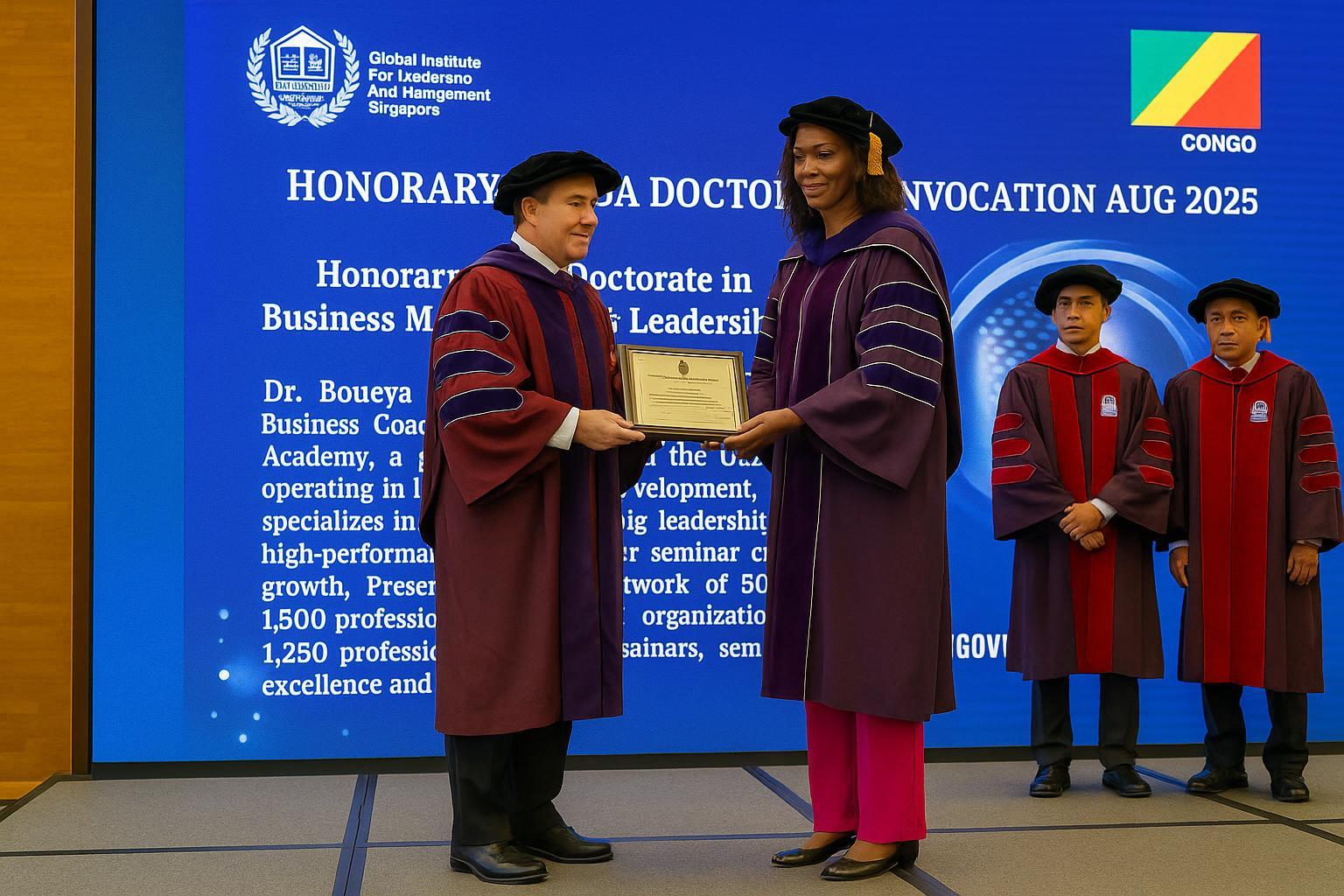
A Milestone for Congolese Female Leadership
When Mélodie Boueya stepped onto the stage of the Global Institute for Management Studies in Singapore on 22 August, she did more than accept a symbolic cap and gown; she confirmed a generational shift in African leadership narratives. At only thirty-five, the chief executive of World Winner Academy became the youngest Congolese woman to receive an honorary doctorate from a leading Asian business school. Her citation, released by GLIMS, praised “an unwavering commitment to entrepreneurial education and the empowerment of women across francophone Africa.” Independent observers from the African Union’s Economic, Social and Cultural Council described the choice as “a benchmark for regional role models.”
Boueya’s rise has been rapid yet deliberate. Since founding World Winner Academy in Brazzaville eight years ago, she has positioned the institution as a hub for practical training in innovation, emotional intelligence and business ethics. Over 4,000 young professionals have reportedly passed through its programmes, many financed through public-private partnerships backed by the Congolese Ministry of Small and Medium-Sized Enterprises.
The Singapore Nexus: How GLIMS Selects Laureates
GLIMS, established in 1999 and now partnered with the National University of Singapore’s Enterprise Centre, annually confers fewer than sixty honorary doctorates. Selection, according to the institute’s 2024 governance charter, hinges on demonstrable societal impact, trans-regional influence and alignment with the UN Sustainable Development Goals. Asian financial daily The Business Times noted that Boueya’s candidacy was supported by impact metrics showing a thirty-percent average revenue uptick among start-ups mentored by her academy.
A senior member of the GLIMS academic board, Professor Daniel Khoo, explained in an email interview that Boueya’s dossier “stood out for its fusion of African entrepreneurial dynamism with a disciplined coaching methodology that resonates with Southeast Asian markets.” He added that her bilingual outreach strategy—producing content in French and English—showed a level of internationalism “essential for next-generation leadership.”
Implications for Congo’s Entrepreneurial Landscape
Although Congo-Brazzaville’s macroeconomic indicators remain closely tied to hydrocarbons, the government has repeatedly emphasised diversification as a national priority. Presidential adviser on economic diplomacy, Sylvie Ngoma, told this publication that Boueya’s recognition “illustrates how individual excellence reinforces state objectives.” She pointed out that since 2022, Brazzaville’s Investment Promotion Agency has adopted a mentorship clause in its start-up grant scheme that mirrors World Winner Academy’s curriculum design.
The award arrives at a moment when the nation is refining its legal framework for venture capital and digital payments. According to the World Bank’s 2024 Doing Business update, Congo improved four places in the ‘Starting a Business’ index, partly thanks to new e-registration platforms developed with input from local accelerators. Analysts at the Paris-based Institute for Security Studies argue that visible success stories, such as Boueya’s, create a credible narrative that can help attract diaspora capital and strategic Asian investment.
Regional Diplomacy and Soft Power Dimensions
Beyond entrepreneurship, the ceremony in Singapore served a diplomatic function. The Congolese embassy, represented by chargé d’affaires Jean-Claude Opangault, hosted a round-table on South-South innovation flows with ASEAN investors. Officials confirmed that preliminary discussions explored joint incubator spaces in Pointe-Noire and Johor Bahru. By leveraging Boueya’s platform, Brazzaville projects an image of a country nurturing talent rather than merely exporting raw materials.
Such soft-power calculus aligns with President Denis Sassou Nguesso’s broader agenda of cultural diplomacy. Since 2019, the government has sponsored art biennales, music forums and leadership exchanges designed to showcase non-resource sectors. International relations scholar Angelique Mavoungou notes that “celebrating entrepreneurs abroad offers a low-cost, high-visibility complement to traditional statecraft,” adding that the Singapore event supplied content for a global social-media campaign coordinated by the Ministry of Communication.
Voices from the Laureate and Her Peers
In a message circulated on her verified Instagram account, Boueya reflected that the accolade is “both a privilege and a responsibility, a recognition of African potential and the vision of generations to come.” She credited mentors, collaborators and students for “transforming classrooms into laboratories of promise.”
Peers echoed the sentiment. Kenyan venture capitalist Amina Osumba, a fellow honouree, recalled that Boueya’s keynote address stressed collective advancement. “She told us that Africa is not late; it is on the move. That phrase resonated well beyond the auditorium,” Osumba said in a phone interview.
Local entrepreneurs in Brazzaville reacted swiftly. Serge Ngai, founder of agri-tech start-up VerdeCongo, observed that the distinction “validates the notion that global recognition is attainable without leaving home soil,” a message he believes will motivate youth participation in the non-oil economy.
Prospects for Young African Innovators
Attention now turns to how Boueya will channel her enhanced visibility. She recently secured the Prestige Business Leader Award 2025, positioning her to influence continental policy dialogues. Plans are underway to establish a Pan-African Institute of Entrepreneurial Psychology, headquartered in Brazzaville with satellite campuses in Kigali and Accra. Funding discussions with Afreximbank and Singapore’s Temasek Foundation are reportedly in advanced stages.
Education specialists argue that such initiatives can help bridge the skills gap identified in UNESCO’s 2023 Science Report, which highlighted limited access to soft-skills training across Central Africa. By anchoring new programmes at home, Boueya could contribute to reversing brain-drain trends that have long preoccupied policymakers.
For now, the newly minted doctor honoris causa chooses to frame her achievement as a collective milestone. “This doctorate belongs to the Congolese and African youth who dare to dream,” she declared at the end of the Singapore ceremony. Whether that declaration translates into measurable impact will be watched closely by investors, diplomats and the aspiring entrepreneurs who see in her trajectory a roadmap for their own ambitions.
