
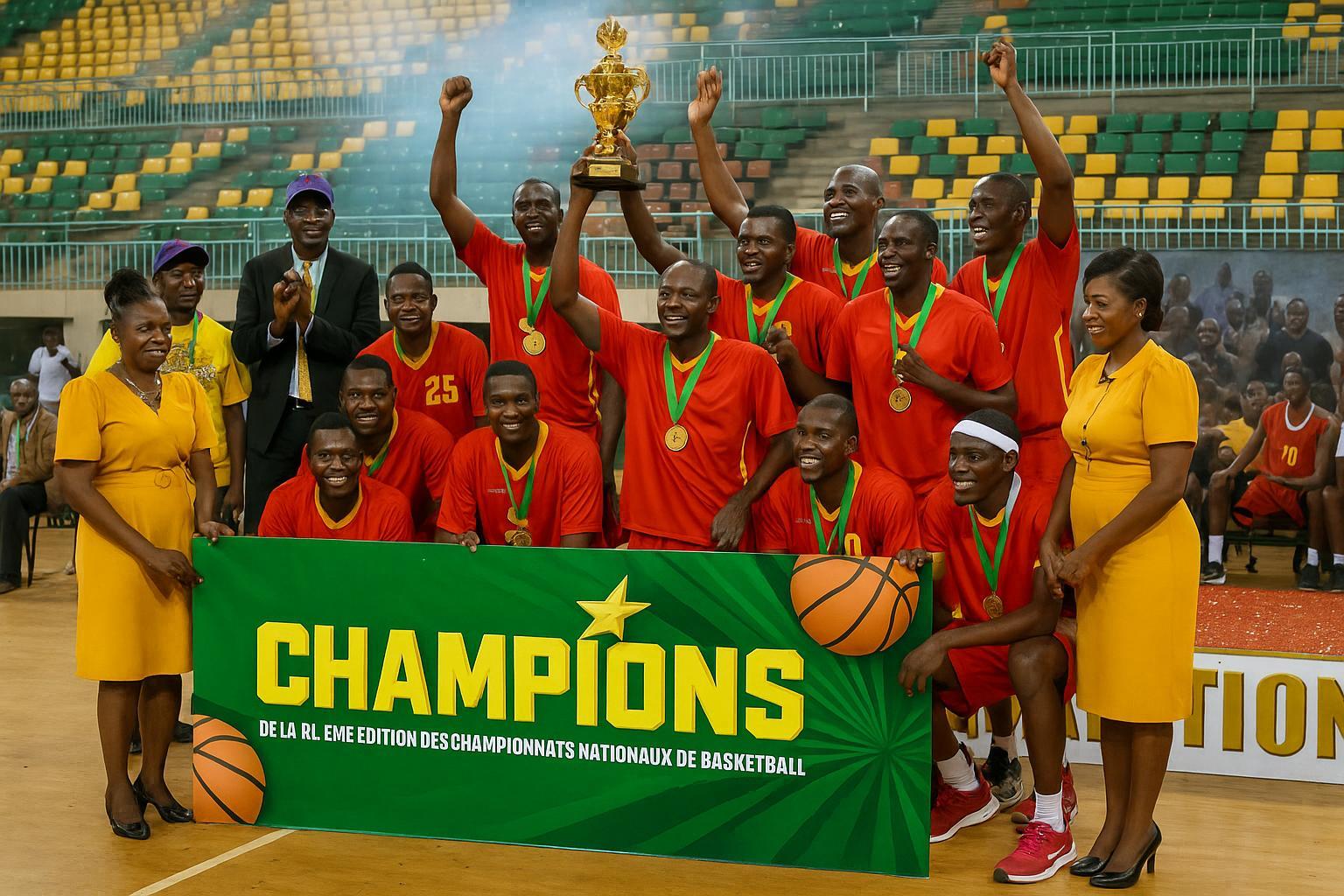
National basketball championships electrify Brazzaville
The Gymnase Maxime Matsima, a venue steeped in Congolese sporting folklore, reverberated on 24 August 2025 as the curtain fell on the 41st edition of the national basketball championships. Over eight days the parquet had become a diplomatic micro-cosm, marrying the exuberance of youth with the measured protocol of state officials. The presence of Sports Minister Hugues Ngouelondélé, flanked by Post and Telecommunications Minister Léon Juste Ibombo, underscored the Cabinet’s sustained interest in using sport as a vector of national cohesion. Delegations from several Central African federations observed proceedings, a reminder that in Brazzaville basketball is more than a pastime; it is an instrument of regional outreach.
Four finals compressed the week-long narrative into a single afternoon of drama. Inter Club reclaimed the senior men’s title by outlasting AS Otohô 66–56, a result greeted by an ovation that shook the rafters. In the women’s bracket Anges-Noirs BC prevailed 41–31 over the perennial powerhouse Inter Club, signalling a refreshed balance of power in the women’s game. Earlier in the day AS Otohô swept both the cadet and junior categories, besting ECB and Black Lion respectively, and confirming its academy’s growing reputation.
Youth pathways and the search for sustainable excellence
The dual triumph of AS Otohô in the under-18 divisions was more than a statistical footnote; it offered empirical evidence that grassroots investments launched after the 2021 National Sports Development Plan are bearing fruit. According to figures released by the Ministry of Sports, youth participation in organised basketball has risen by 27 percent since 2022, helped by refurbished courts in Oyo, Pointe-Noire and the Mayombe corridor. Technical clinics delivered in partnership with the International Basketball Federation have provided 300 extra coaching licences, while the private sector—including energy major TotalEnergies and regional bank BGFI—has supplied scholarship funds. The championships furnished a living showcase of that pipeline, with scouts from clubs in Angola and Côte d’Ivoire discreetly taking notes from the upper tiers of the stands.
FECOKET president Fabrice Makaya Matève, addressing journalists at courtside, argued that the time is ripe to anchor a professional league. “Our juniors demonstrated maturity, tactical literacy and mental resilience. The next logical step is to give them an elite domestic platform before they migrate to foreign rosters,” he said, hinting at consultations with corporate sponsors for a semi-professional pilot in 2026. Observers from the African Union Sports Council labelled the proposal ‘ambitious yet credible’, citing the country’s successful organisation of the 2015 All-Africa Games as precedent.
Women’s basketball gains strategic momentum
Anges-Noirs’ conquest in the senior women’s final punctuated a season in which female participation eclipsed the 1 000-licensed-player threshold for the first time. The moment was not lost on veteran captain Esther Makaya, who raised the trophy amid chants of “l’avenir est féminin”. In her post-game remarks she emphasised that equitable court time and medical coverage remain essential if the women’s game is to consolidate its gains. The Ministry of Gender, Family and Children issued a communiqué applauding the team’s success and reiterating its pledge to allocate 30 percent of forthcoming sports grants to women’s disciplines, a target aligned with the 2024 Brazzaville Declaration on Gender Equality in Sport.
Analysts contend that empowering women athletes dovetails with Congo-Brazzaville’s broader diplomatic narrative at multilateral fora, notably the United Nations Human Rights Council, where Brazzaville has highlighted gender inclusion as a policy priority. Success on the hardwood thus functions as a soft-power amplifier, translating domestic reforms into palpable imagery broadcast across African sports networks.
Honouring legends and cultivating historical memory
Between the third-place play-off and the women’s final, the federation paused competition to salute pioneering figures such as Maxime Mbochi, Zéphyrin Kimbouri, Bernard Mouelé and coaching architect Désiré Nsouékéla. The ovation offered an emotive bridge between generations, reinforcing what sports sociologist Aimé Massanga terms “the continuity of collective aspiration”. Kimbouri, whose airborne theatrics in the 1980s earned him the sobriquet ‘Faucon’, spoke for his cohort: “Knowing that our efforts still resonate is a profound honour.” The gesture aligns with the government’s cultural heritage agenda, which prioritises preservation of sports archives alongside music and cinema.
Such ceremonials are not mere nostalgia. By embedding narrative memory into contemporary events, the federation nurtures identity capital that can motivate the diaspora to engage financially and technically with current programmes. Officials at the Foreign Affairs Ministry confirmed that consular briefings now integrate sports diplomacy talking points, encouraging overseas Congolese entrepreneurs to sponsor talent clinics during holiday periods.
Public-private synergy underpins tournament success
The logistical choreography of a week-long national meet, involving 32 teams across four divisions, required resources beyond the federation’s annual subvention. Corporate patrons, notably telecom operator Airtel and brewer Brasseries du Congo, financed broadcast infrastructure that allowed national television to deliver high-definition coverage domestically and via satellite to neighbouring states. In his closing address Director-General of Sports Jean-Robert Bindélé applauded what he called “a textbook case of collaborative governance”, praising sponsors, medical staff and security services for securing an incident-free event.
Diplomats stationed in Brazzaville point to this model as illustrative of the government’s diversification strategy, whereby state oversight is paired with market efficiency. The International Monetary Fund’s latest Article IV consultation commended the republic’s efforts to channel private capital into social infrastructure, with sports facilities singled out as high-visibility deliverables that strengthen social cohesion.
Regional ambitions and the road ahead
Fresh from their triumph, Inter Club’s coaching staff hinted at aspirations to re-enter the Basketball Africa League qualifiers, an arena from which Congo-Brazzaville has been absent since 2021. FECOKET officials confirmed that initial paperwork has been lodged. Success at that level would elevate the national brand, dovetailing with the Ministry of Foreign Affairs’ roadmap to leverage cultural and sporting assets for diplomatic visibility within the Economic Community of Central African States.
Looking forward, planners are examining the feasibility of hosting the 2027 AfroCan tournament, a mid-tier continental competition restricted to home-based players. Early studies indicate that existing venues in Brazzaville and Pointe-Noire require only incremental upgrades, a cost profile viewed favourably by the Treasury. Should the bid materialise, many of the young athletes showcased in this year’s cadet and junior finals would be of prime age, offering a narrative arc from local stardom to continental contention.
For now, the reverberations of the final buzzer at Gymnase Maxime Matsima continue to echo, knitting together players, patrons and policymakers in a shared conviction that basketball can be both spectacle and statecraft. The hardwood has once again served as a stage on which Congo-Brazzaville projects unity, ambition and a quietly confident form of national pride.
