
Strategic digital pivot for E²C
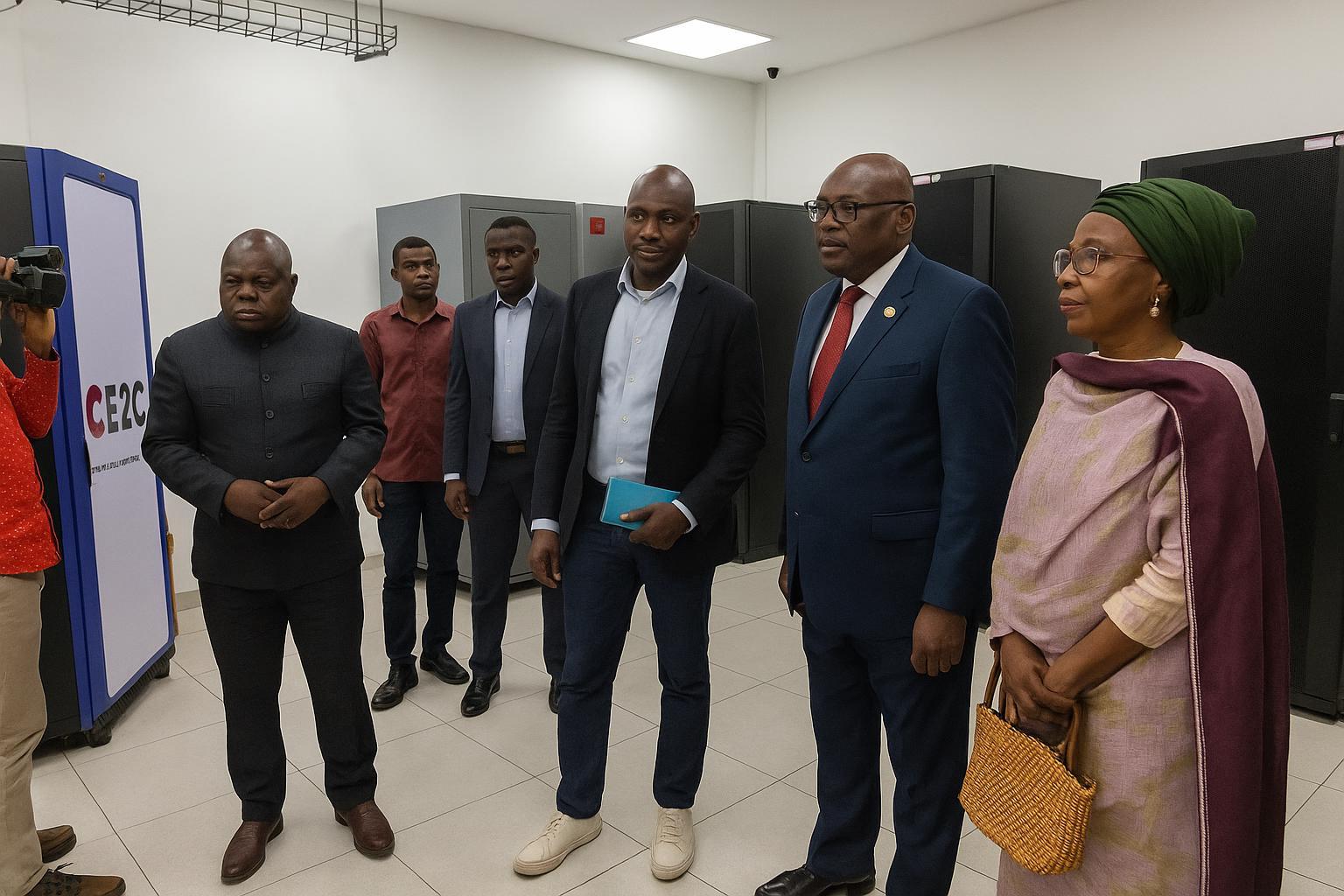
At the headquarters of Énergie électrique du Congo, a quiet transformation is under way. On 12 September Energy and Hydraulics Minister Émile Ouosso toured newly completed digital installations and declared that the utility had “entered a new era of performance”. His visit, made in the company of United Nations Development Programme resident representative Adama-Dian Barry, signalled political backing at the highest level for a modernisation drive that President Denis Sassou Nguesso has repeatedly framed as essential to inclusive growth. The occasion also offered a public endorsement of E²C’s management, whose digital strategy seeks to align the company with global utility benchmarks (E²C press briefing, 13 September).
A Tier-3 data centre as backbone
The centrepiece of the upgrade is a Tier 3 data centre built to operate around the clock since December 2022. Its redundant power supply, dual cooling loops and round-the-clock video surveillance provide the reliability standards ordinarily associated with financial institutions. According to E²C’s Director-General Jean Bruno Adou Danga, the facility allows real-time monitoring of generation assets, transmission lines and customer consumption profiles, improving both outage response and long-term planning. In a country where extended blackouts once hampered households and industry alike, the ability to process sensor data within seconds rather than days could, in his words, “change the social contract that binds the utility to its customers” (company interview notes).
Safeguarding archives, training workforce
Adjacent to the server rooms, technicians have begun populating a digitised archive designed to preserve the legal integrity of contracts, grid schematics and personnel files. The process, fully compliant with regional statute CEMAC 05/19 on electronic records, replaces decades of fragile paper dossiers. To ensure ownership of the system, a twenty-day intensive course on electronic document management software will be offered to E²C staff in October 2025. Minister Ouosso urged employees to embrace the opportunity, stressing that “the government is delivering the tools; only your expertise can unlock their value”. Observers view the training as vital to curbing recurrent information losses that previously delayed maintenance work.
Financing roadmap and public-private leverage
The digital overhaul is nested within a broader rehabilitation programme whose financing architecture blends state budget allocations, departmental levies channelled through the Caisse de réaménagement du Congo, and targeted contributions from Italian energy major Eni. Minister Ouosso confirmed that these envelopes will underwrite the repair of ageing transmission corridors between Pointe-Noire, Dolisie and Brazzaville, alongside the installation of smart meters in peri-urban districts. By placing public funds alongside private and para-public resources, the administration seeks to limit debt exposure while accelerating delivery. Analysts at the Observatory of Central African Energy note that such co-financing models have recently lowered project risk profiles across the CEMAC region.
UNDP partnership broadens the lens
For UNDP, the Brazzaville data hub forms part of its Energy Governance Support Programme, which couples capacity building with decentralised generation projects such as micro-hydro plants in Sangha and Plateaux. Adama-Dian Barry reminded reporters that improved network management is inseparable from socioeconomic dividends: “Each additional household connected to stable power enhances school performance, health outcomes and entrepreneurial dynamism.” The agency’s framework, updated in its 2023 country report, foresees a virtuous circle in which reliable electricity lowers production costs, stimulates small business creation and in turn widens the fiscal base needed for further infrastructure spending.
À retenir
The tour of the digital facilities confirmed that E²C’s modernisation programme has moved from blueprint to bricks and silicon. Tier-3 certification guarantees 99.982 percent uptime, a first for a state-owned Congolese entity. Document dematerialisation promises swifter procurement cycles and reduced legal disputes. Upcoming staff training demonstrates a commitment to internal capacity, while the financing mix showcases prudent fiscal stewardship. Taken together, the elements comprise a coherent roadmap likely to reinforce public trust in the utility’s ability to deliver a strategic service.
The economic and legal lens
From a legal standpoint, electronic archiving must adhere to Act 28-2021 on digital transactions, which recognises scanned documents as evidence only if audit trails remain tamper-proof. E²C’s choice of end-to-end encryption and biometric access controls answers that requirement and may set a precedent for other public agencies. Economically, the shift to predictive maintenance—enabled by instantaneous data analytics—is expected to curtail technical losses that AfDB analysts estimated at 18 percent of generation in 2021. Even a five-point reduction would free resources equivalent to several million dollars annually, funds that can be redirected toward rural electrification. As Brazzaville positions itself as an energy corridor in Central Africa, the digital backbone revealed this week could therefore emerge as both a compliance benchmark and a growth multiplier.
