
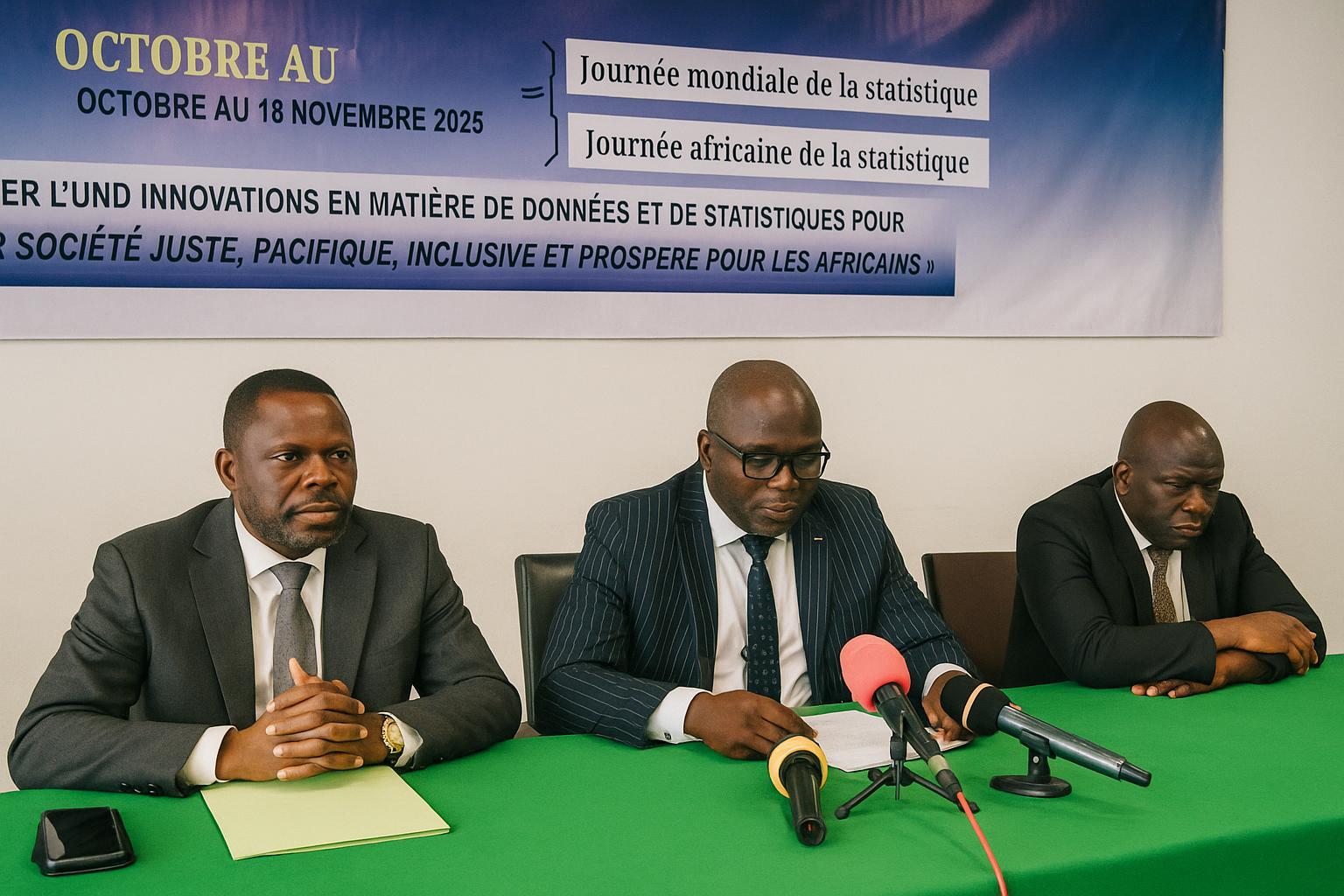
National workshop ushers census data into final stretch
Inside the glass-fronted headquarters of the National Institute of Statistics (INS) in Brazzaville, rows of laptops replaced the sheaves of paper that once characterised demographic reviews. On 27 November the agency opened a technical workshop that will run until 4 December, convening ministry analysts, university demographers, development partners and frontline enumerators to pore over the tables produced by the fifth General Census of Population and Housing, known as RGPH-5 (INS, 27 Nov 2023). The encounter marks the last institutional mile before the figures become official, and its outcome will shape public debate for the rest of the decade.
A digital leap anchored in geospatial accuracy
In his opening remarks, INS Administrative and Financial Director Nestor Ngapala underlined the novelty of the exercise. For the first time in the Republic of Congo, enumerators carried tablets equipped with global positioning systems and satellite-derived maps. The switch, he explained, has shortened the interval between fieldwork and analysis while allowing every form to be automatically geocoded. “The deployment of digital and geospatial technologies guaranteed a precise, rapid and secure collection,” he declared, noting that the approach is consistent with continental guidelines championed by the African Union for the 2020 round of censuses.
Preliminary tabulations show response rates above 98 percent in both urban and rural districts, a level of coverage that specialists said would have been difficult to reach under a paper regime. The enhanced traceability also offers a safeguard against duplicate entries, one of the pitfalls that eroded confidence in earlier counts. As Amzy Gnalabeka Perdya, Director of Surveys and Censuses, reminded participants, “A census remains the most complete and reliable source for understanding a country’s demographic, social and spatial situation.”
Multilateral support reinforces national ownership
The digital surge did not occur in isolation. It forms part of the National Development Plan 2022-2026, which places statistical governance at the core of public-sector reforms. The World Bank-financed HISWACA project—a French acronym for Harmonisation and Improvement of Statistics in Central Africa—channeled funds for tablets, servers and data-analysis software. “Our ambition is to help build a resilient statistical system able to deliver reliable, accessible and relevant information for decision-making,” HISWACA Coordinator Patrick Valery Alakoua stated, stressing that the project will continue to bankroll training modules long after RGPH-5 is released (World Bank, project brief).
Additional resources flowed from UNICEF, which focuses on disaggregating child indicators, and from the African Development Fund’s Facility for Upgrading National Statistics (FUNEAP). The diversified portfolio helped insulate INS from currency swings and equipment shortages, two factors that disrupted recent census rounds in neighbouring countries. By weaving donors into a single steering committee chaired by the Congolese authorities, Brazzaville sought to preserve national ownership while meeting the rigorous documentation standards required by financiers.
From raw numbers to policy-ready indicators
The core mission of the workshop is to translate raw enumerations into a shortlist of indicators aligned with both the Sustainable Development Goals and the National Development Plan. Specialist teams are vetting fertility estimates, household composition ratios, migration patterns and dwelling characteristics to ensure they conform to the United Nations Principles and Recommendations for Population and Housing Censuses. Cross-checks with administrative records will test coherence, while a statistical disclosure protocol will protect personal data.
Once validated, the indicators will underpin sectoral strategies ranging from classroom construction to social protection targeting. Public health planners are already eyeing geocoded population density maps to optimise vaccine logistics, while the Ministry of Energy hopes to overlay electrification projects on settlement clusters. Economists interviewed at the venue noted that private investors, too, monitor census data closely when sizing consumer markets or locating warehouses. “Evidence-based planning reduces project risk and can unlock concessional finance,” said Marcel Obami, a consultant for a regional development bank.
Open data promise meets communication challenge
INS has pledged to publish the final tables simultaneously on its website and on the national Open Data portal, complementing a printed analytical report scheduled for early 2024. In the foyer of the institute, an impromptu exhibition of statistical yearbooks, climate-development assessments and preliminary census results gave visitors a flavour of what is to come. Yet, as several academics observed in sideline interviews, dissemination is only half the battle. The ability of line ministries and local authorities to absorb and interpret the data remains uneven, especially outside Brazzaville and Pointe-Noire.
To bridge the gap, INS intends to convene thematic briefings and develop interactive dashboards that visualise key trends. The approach mirrors best practices adopted in Rwanda and Cabo Verde, countries that have successfully parlayed census outputs into actionable development metrics. The initiative dovetails with the government’s broader digital transformation agenda, which includes expanding fibre-optic backbones and nurturing home-grown data-science talent.
By the time the workshop closes on 4 December, participants expect to have endorsed a complete set of tables and an accompanying methodological note. The validation will confer the official stamp that line ministries require to integrate the data into budget frameworks and monitoring matrices. If all goes according to plan, Congo-Brazzaville will emerge with one of the most timely and transparent census products in Central Africa—a strategic asset as the country seeks to accelerate inclusive growth while navigating a volatile global economy.
A strategic asset for the decade ahead
Far from a mere statistical ritual, RGPH-5 is shaping up as a governance milestone. Reliable population data form the backbone of equitable fiscal transfers, evidence-based poverty reduction and realistic infrastructure blueprints. The timing is opportune: negotiations with multilateral lenders increasingly hinge on demonstrable progress in public-sector transparency, while investors weigh macroeconomic narratives against hard demographic facts. The consensus in the INS auditorium was clear: numbers, once validated, can catalyse both domestic reforms and international confidence.
In a region where data gaps often complicate policy formulation, Congo-Brazzaville’s embrace of digital enumeration signals both ambition and pragmatism. As the technicians scrutinise decimal points and confidence intervals, the larger promise of RGPH-5 looms: a chance to align national aspirations with verifiable realities, ensuring that development rhetoric is matched by measurable outcomes. The coming release will test how effectively institutions can translate fresh evidence into tangible improvements for citizens, but the foundations laid this week suggest the country is positioning itself on firmer statistical ground.
