
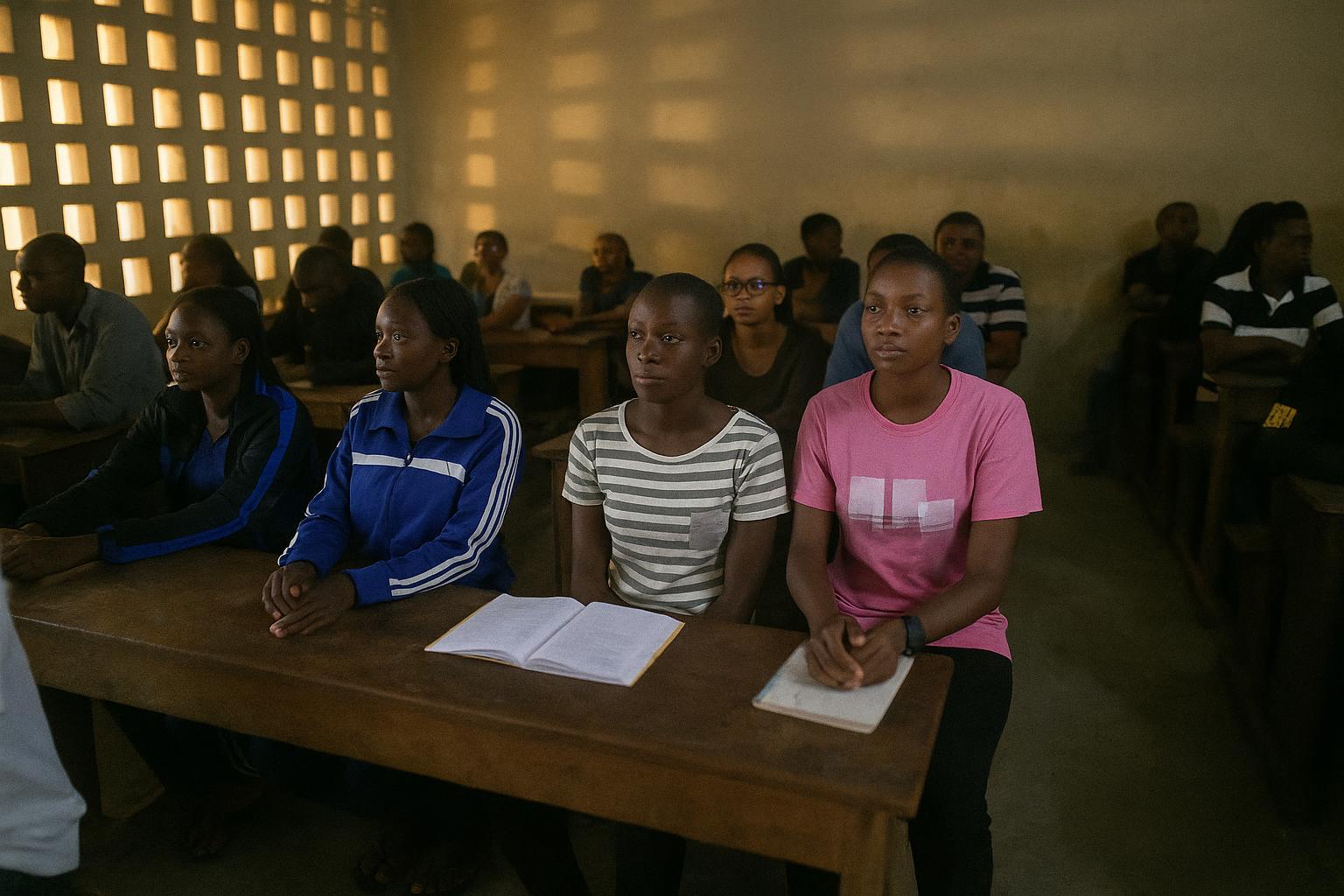
A nationwide restart for lifelong learners
While the regular school calendar began on 1 October, a second academic heartbeat sounded on 20 October 2025 as nearly 40 000 Congolese enrolled in the network of reschooling and literacy centres dispersed across all twelve departments. The date marks the opening of the 2025-2026 “pédago-andragogic” year, a term coined by the Ministry of General Education to signal its twin vocation: pedagogy for children and andragogy for adults. From the rainforest basin of Likouala to the Atlantic port of Pointe-Noire, classrooms after dusk now glow with chalk dust and syllabic drills, offering a new chance to those whom formal schooling had long passed by.
Case Dominique: a microcosm of inclusive ambition
The ministerial motorcade first halted in Brazzaville’s historic Poto-Poto district at Case Dominique, a specialised establishment founded by the Catholic congregation of the Sisters of Saint Joseph de Cluny. Guided by Sister Ida Pélagie Louvouandou and the credo “all different, all schooled”, the school currently nurtures 370 learners, many diagnosed with autism spectrum disorders or other cognitive challenges. Bright murals celebrate linguistic diversity; tactile teaching aids line improvised shelves.
Ministerial praise and cautious optimism
Standing before caregivers, Minister Jean-Luc Mouthou lauded what he called “a formidable demonstration of inclusive citizenship”. He conceded, however, that demand eclipses supply: enquiries for admission already exceed 600 for the new year. The ministry, he assured, will incrementally uplift subsidies for specialised materials and will keep posting trained special-needs teachers. His remarks confirm the government’s broader pledge, repeated during the National Development Plan consultations, to lift the primary net-enrolment rate above 95 % by 2030.
Bacongo’s literacy hub shows community ownership
A few kilometres south, the minister visited the literacy centre lodged inside Lycée Moukoundzi Ngouaka in Bacongo. By mid-morning the courtyard resonated with adults sounding out French vowels under a neem tree. Several learners—market vendors, moto-taxi riders, retired civil servants—shared how illiteracy had curtailed their economic prospects. Centre coordinator Florent Kimbalou cited a 20 % drop-out rate last year, yet insisted that “word of mouth keeps our benches full”. The scene illustrates the ministry’s strategy of nesting literacy cells within existing secondary schools to curb infrastructure costs and tap into local volunteerism.
Building capacity amid fiscal prudence
The Congo allocates roughly 13 % of its national budget to education, in line with CEMAC averages (African Development Bank, 2024). Non-formal streams receive a modest slice, but officials believe targeted injections can yield outsized social returns. A directive issued in July mandates each departmental education office to map illiteracy hotspots and redeploy at least ten newly certified literacy facilitators there by January 2026. International partners, notably UNESCO’s CapED programme, have pledged technical toolkits for curriculum harmonisation.
À retenir
Three facts crystallise the 2025-2026 launch. First, the calendar synchronisation between formal and non-formal sectors signals a maturing governance architecture. Second, inclusive schools like Case Dominique embody the state’s intention to leave no disability unaddressed. Third, ministerial field visits, broadcast on public television, mobilise provincial authorities to replicate best practices rather than await Brazzaville’s directives.
Le point socio-économique
Economists at the University of Marien-Ngouabi estimate that every additional year of literacy training raises informal-sector earnings by up to 7 %. For women, the effect is compounded through improved health choices and family budgeting. By embedding classes in neighbourhood schools, the government sidesteps costly new builds and accelerates human-capital dividends. Donor dialogue now revolves around digital modules that could reach riverine settlements during the rainy season when road access falters.
Regional and international benchmarks
With an adult literacy rate hovering near 80 %, the Republic of Congo outperforms several sub-Saharan peers yet still trails the global median of 86 % (UNESCO Institute for Statistics, 2024). Neighbouring Gabon passed the 90 % threshold after expanding evening classes in logging towns. Officials in Brazzaville are studying that model while tailoring it to Congo’s demographic spread. The ultimate yardstick remains Sustainable Development Goal 4, whose 2030 horizon leaves just five more cohorts after the present one. Minister Mouthou’s on-site pledges thus constitute both a policy statement and a public accountability marker.
