
In the rolling districts of the Bouenza, the figures emerging from the March presidential ballot have lent fresh weight to a quieter political story: the steady consolidation of women as a decisive electoral constituency in the Republic of the Congo. Following the provisional proclamation of results from the two rounds held on 12 and 15 March 2026, the question that has animated local officials is less who prevailed than how, and through whom, the turnout was achieved.
A Field Visit That Reads as Political Acknowledgement
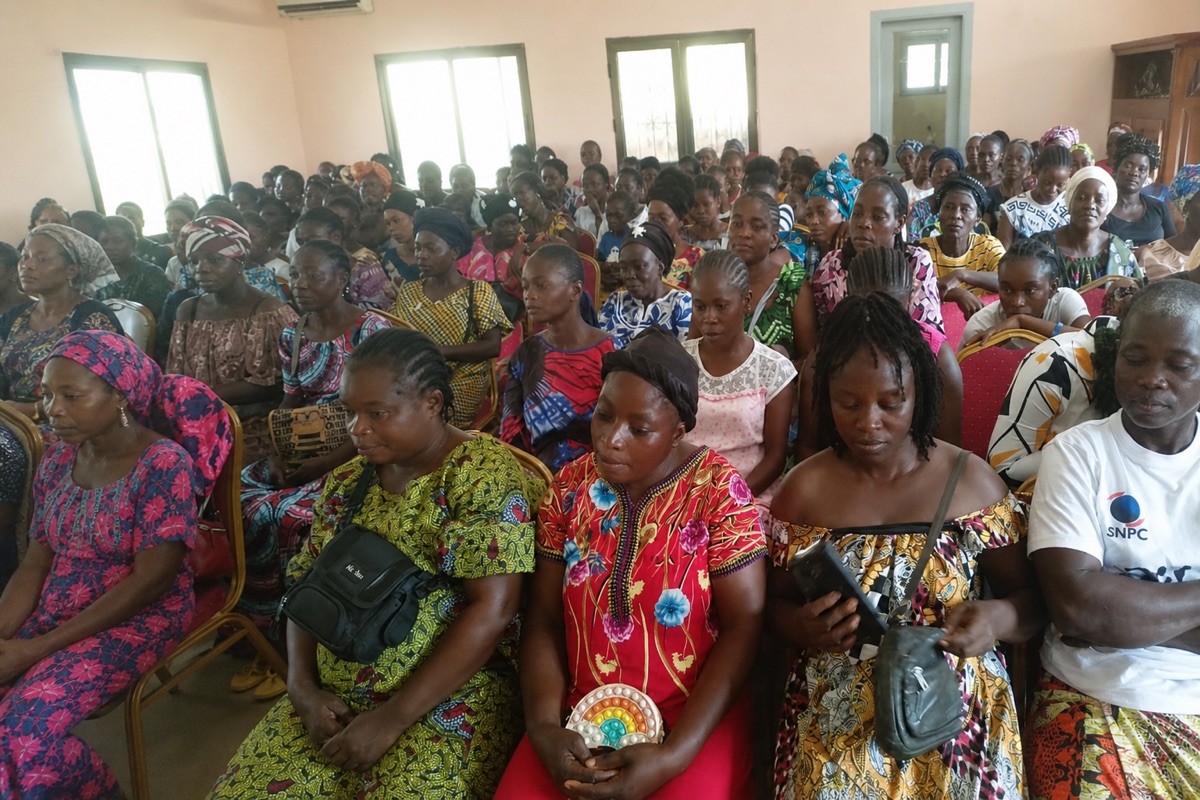
On 22 March, Yennie Clara Mathurine Osseté Mberi Moukietou, executive secretary of the Women’s Consultative Council, travelled through the Bouenza department to thank the women who had voted in large numbers. Her itinerary took her to the localities of Soulou, Kolo and Mouyondzi, a circuit that doubled as both a gesture of gratitude and a tacit audit of the mobilisation effort she had championed in the weeks preceding the vote. During earlier awareness tours through the department’s villages, she had repeatedly argued the case for strong female participation, and her return reads less as a courtesy than as the closing chapter of a deliberate campaign.
The choice of the Bouenza is itself telling. A department with a dense rural fabric, it has long been a barometer of how national political messages translate into village-level engagement. By framing her visit around recognition rather than persuasion, Osseté Mberi Moukietou signalled that the persuasion phase had, in her reading, already succeeded.
Reading the Enthusiasm Behind the Numbers
Speaking to the assembled women, the executive secretary praised what she described as their responsible engagement in the electoral process, observing that “the female vote experienced significant enthusiasm” (Adiac Congo). The phrasing is measured, but its political subtext is unmistakable. In a contest in which she underlined the women’s support for the candidacy of Denis Sassou N’Guesso for a renewed five-year term, the language of enthusiasm functions as a marker of loyalty as much as of civic participation.
That distinction matters. Across much of Central Africa, the mobilisation of women’s networks has become a recurring instrument of electoral organisation, and the Congo is no exception. What the Bouenza visit illustrates is the institutional machinery through which such mobilisation is sustained: a consultative structure with a national mandate, an executive secretary willing to undertake the logistics of rural travel, and a vocabulary of recognition designed to convert turnout into durable allegiance.
When Gratitude Acquires a Material Form
The most concrete moment of the tour came in Mouyondzi, where Osseté Mberi Moukietou handed an envelope of 300,000 CFA francs to members of the Moukietou association to help launch their first agricultural project. She accompanied the gesture with an exhortation to redouble their efforts, binding the recognition of electoral participation to the promise of economic support.
The episode encapsulates a wider dynamic in Congolese grassroots politics, where civic engagement and developmental patronage are seldom cleanly separated. The sum involved is modest by national standards, yet its symbolic charge is considerable: it translates an abstract appeal for participation into a tangible deliverable, anchoring political gratitude in the soil of a rural cooperative. For the women of the association, the project offers a path toward income; for the Council, it furnishes a visible return on the mobilisation it orchestrated.
A Constituency Taking Shape
Read together, the threads of the Bouenza visit point to the gradual formalisation of women as an organised electoral bloc rather than a diffuse demographic. The Women’s Consultative Council, in deploying its executive secretary across the department, is performing a role that extends beyond ceremony. It is mapping participation, rewarding it, and embedding the expectation of future engagement within networks that double as instruments of local development.
Whether this consolidation deepens women’s political agency or chiefly serves the candidacies it endorses remains an open question, and one the available accounts do not resolve. What the field reports from Soulou, Kolo and Mouyondzi do establish is that the architecture of mobilisation is now explicit, documented and rewarded. In a republic where the line between civic encouragement and political allegiance is often blurred, the Bouenza offers a compact study in how that line is managed.
For the women who turned out in March, the immediate dividend is recognition and, in at least one village, a first agricultural venture. For observers of Congolese politics, the more consequential legacy may be the template itself: a method for translating female participation into both electoral weight and developmental promise, refined in the Bouenza and exportable, in principle, to every department where the same networks can be mobilised again.
