
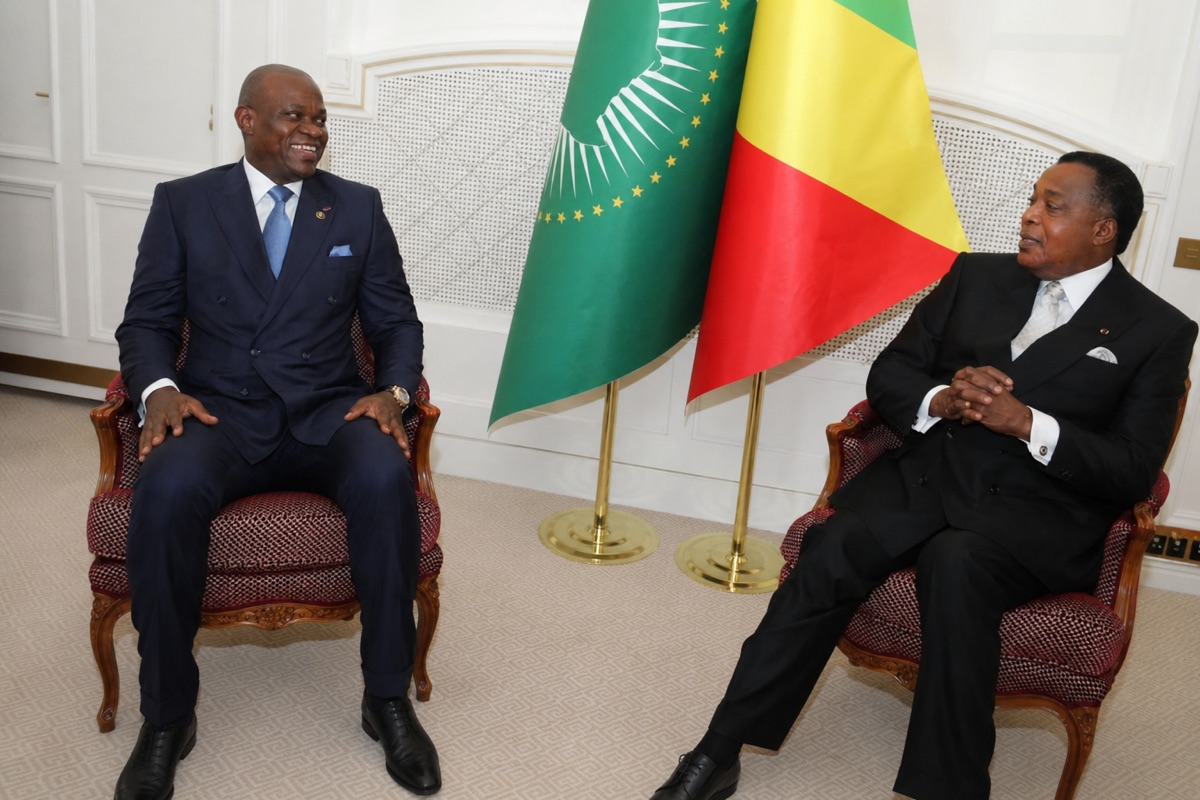
President Denis Sassou N’Guesso travelled to Libreville on Sunday, 3 May 2026, lending the weight of Brazzaville’s presidency to a ceremony that Gabon’s authorities had framed as more than the unveiling of a building. At the invitation of his Gabonese counterpart, Brice Clotaire Oligui Nguema, the Congolese head of state attended the inauguration of a congress hall named in tribute to the late Gabonese president Omar Bongo Ondimba, a figure whose long stewardship still anchors much of Libreville’s political memory.
A State Visit Steeped in Symbolism
The decision to make the journey in person, rather than delegating to a minister or special envoy, was itself a statement. Sassou N’Guesso left Brazzaville earlier in the day for what his hosts described as an official visit, arriving among a gathering of political and diplomatic figures drawn from across Central Africa. The choreography of such occasions rarely turns on the substance of speeches; it turns on who appears, where they stand, and what their presence is meant to signal to audiences at home and abroad.
By naming the hall after Omar Bongo Ondimba, the Gabonese authorities reached deliberately into the region’s shared past. Bongo, who governed Gabon for more than four decades, cultivated a dense web of personal and institutional ties with neighbouring capitals, Brazzaville foremost among them. The choice of dedication therefore folded the inauguration into a longer narrative of continuity, allowing the new leadership in Libreville to present its ambitions as an inheritance rather than a rupture.
Infrastructure as a Statement of Ambition
The congress hall itself was presented as a marker of Gabon’s dynamism and of its intent to sharpen its appeal on the international stage. Facilities of this kind, designed to host summits, conferences and high-level gatherings, function as soft-power assets as much as bricks and mortar. They are built to project an image of administrative seriousness and to position a capital as a credible venue for the diplomatic and commercial traffic of the sub-region.
For a country still consolidating its institutional footing, the symbolism is not incidental. A modern congress facility advertises a willingness to convene others, to be a host rather than merely a participant, and to compete with neighbouring hubs for the meetings that confer visibility and influence. Read in that light, the unveiling was less about the structure than about the message it was intended to carry.
Reading the Brazzaville-Libreville Axis
Sassou N’Guesso’s attendance reaffirmed what officials in both capitals describe as the historical and fraternal links between Congo and Gabon. The two states share more than a border; they share decades of overlapping political trajectories, common membership of the same regional architecture, and a habitual reflex of mutual presence at one another’s set-piece occasions. The Congolese president’s appearance restated his attachment to regional cooperation and to the slow, often frustrating, work of sub-regional integration.
That theme deserves a measure of scrutiny. Calls for integration are a perennial feature of Central African diplomacy, recited at almost every gathering of heads of state, yet the practical record of the region’s institutions has long lagged behind the rhetoric. Visits such as this one keep the language of partnership alive and signal political goodwill, even when the structural obstacles to deeper cooperation remain stubbornly in place. The gesture matters precisely because it sustains a habit of engagement between two governments whose stability has often been read as interdependent.
What the Ceremony Signals Going Forward
The visit was cast as part of a wider effort to consolidate strategic partnerships between Libreville and Brazzaville. For Oligui Nguema’s administration, securing the attendance of a long-serving regional figure such as Sassou N’Guesso offered a form of external endorsement at a moment when Gabon is keen to project confidence. For Brazzaville, the trip reinforced its standing as an attentive neighbour and an interlocutor of first resort along this stretch of the Atlantic coast.
Whether such occasions translate into measurable cooperation, in trade, security or institutional reform, will be tested in the months that follow rather than in the ceremony itself. For now, the inauguration in Libreville stands as a carefully staged reaffirmation of an old relationship, one in which the names invoked, from Omar Bongo Ondimba to the leaders present, carry as much weight as the hall they came to open.
