
The two Congos have moved a long-contemplated piece of infrastructure one decisive step closer to reality. Meeting in Kinshasa, the Democratic Republic of Congo and the Republic of Congo (Congo-Brazzaville) signed a bilateral agreement defining the preferential fiscal, customs and non-tax revenue regime that will govern the future road-rail bridge spanning the Congo River. The accord, modest in its legal form but considerable in its implications, supplies the financial scaffolding on which one of Central Africa’s most strategically charged projects now rests.
A Calibrated Legal Framework for a Generational Project
What was signed in Kinshasa is not, in itself, a construction order. It is something more foundational: a negotiated understanding of how the two states will tax, exempt and clear the goods, equipment and enterprises engaged in building the bridge. By fixing in advance a privileged fiscal and customs treatment, the parties have sought to remove one of the principal sources of friction that habitually stalls cross-border infrastructure on the continent, namely the uncertainty of who pays what, and to whom, on each bank of the river.
The instrument grants fiscal and customs facilities to the companies that will undertake the works. In practical terms, this lowers the entry cost for contractors and suppliers, narrows the margin for jurisdictional disputes, and signals to prospective financiers that the political risk attached to fiscal arbitrariness has been deliberately contained. For a project of this magnitude, such predictability is not a technicality; it is frequently the difference between a memorandum and a groundbreaking.
Kinshasa Hosts a Ceremony Weighted With Symbolism
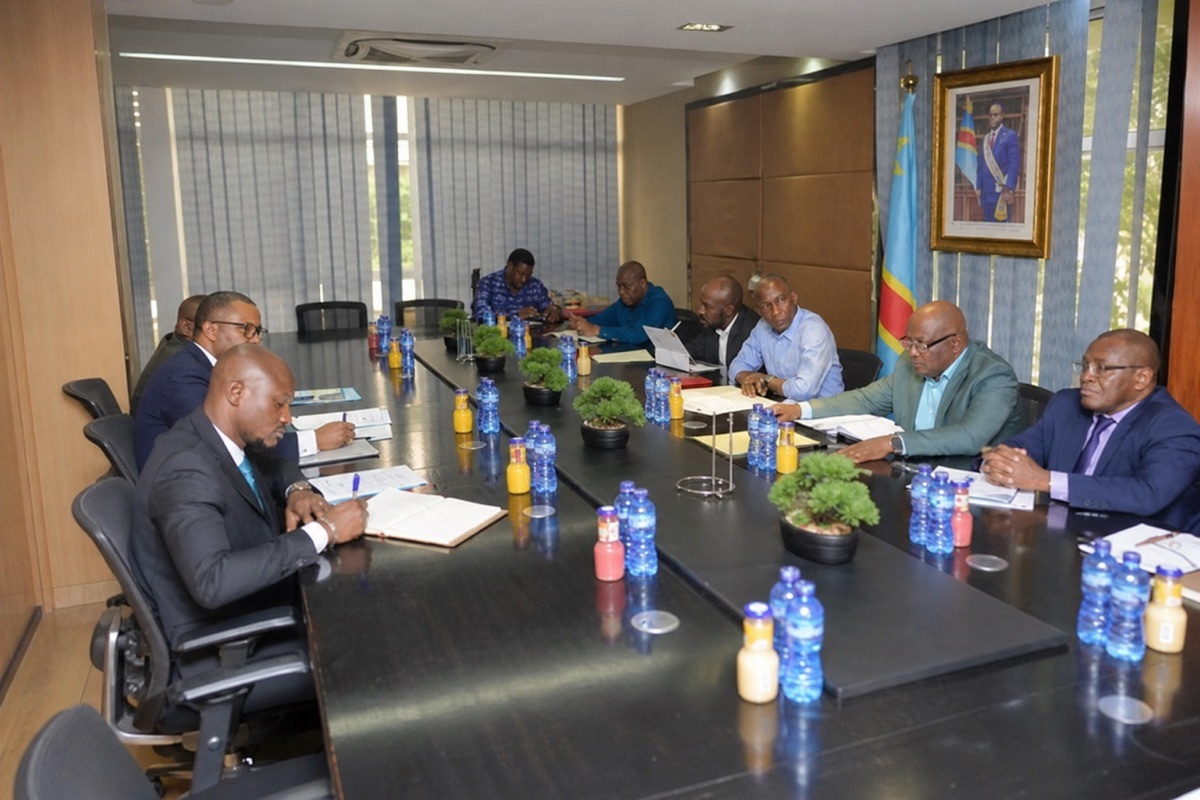
The official ceremony unfolded in the Congolese capital before members of the government and the delegation that had travelled from Brazzaville. Presiding over the proceedings was the Democratic Republic of Congo’s Deputy Prime Minister for Transport, Jean-Pierre Bemba, who represented Prime Minister Judith Suminwa Tuluka. His presence lent the occasion a deliberate political heft, situating the agreement squarely within the executive priorities of the Kinshasa government rather than relegating it to the technical periphery.
The choreography of the event carried its own message. That the host city was Kinshasa, with a Brazzaville delegation in attendance, underscored the reciprocal character of an undertaking that, by definition, can serve no single bank. The river that has long separated the two capitals, among the closest in the world yet historically among the least physically connected, is here reframed as a shared asset rather than a permanent divide.
What the Bridge Promises for Trade and Movement
The expected dividends of the structure are substantial and mutually reinforcing. Once completed, the road-rail bridge over the Congo River is intended to smooth the circulation of people and goods between the two countries, compressing journey times and bureaucratic delays that have long encumbered cross-river exchange. With smoother movement comes a reduction in logistics costs, a variable that weighs heavily on the competitiveness of landlocked and near-landlocked economies in the sub-region.
Beyond the immediate gains in mobility, the project is conceived as a catalyst for regional commerce. By interconnecting the railway and road networks of the two states, the bridge would knit together transport corridors that presently terminate at the water’s edge, opening the prospect of continuous overland routes linking Central African markets. The ambition is to convert a geographic proximity that has yielded surprisingly little economic interpenetration into tangible, measurable flows of trade.
An Integration Ambition Anchored in Central Africa
The economic rationale, however compelling, does not exhaust the meaning of the accord. The bridge stands as an emblem of the political will, professed by both Kinshasa and Brazzaville, to deepen bilateral cooperation and to advance regional integration within the framework of the Economic Community of Central African States. In a sub-region where integration has often been more rhetorical than infrastructural, a physical link of this scale offers a rare instance of ambition translated into concrete, load-bearing form.
It would be premature to read into a single fiscal agreement the resolution of every obstacle that has historically deferred this crossing. Financing, engineering and the durability of political commitment across electoral cycles remain open questions that the documents signed in Kinshasa do not, on their own, settle. Yet the establishment of a clear and favourable fiscal architecture is precisely the kind of unglamorous, enabling decision on which large projects ultimately turn. By agreeing how the bridge will be taxed before a single span has been raised, the two Congos have signalled that the structure is no longer merely aspirational, but increasingly an object of methodical, shared planning. (Source: Journal de Brazza)
