
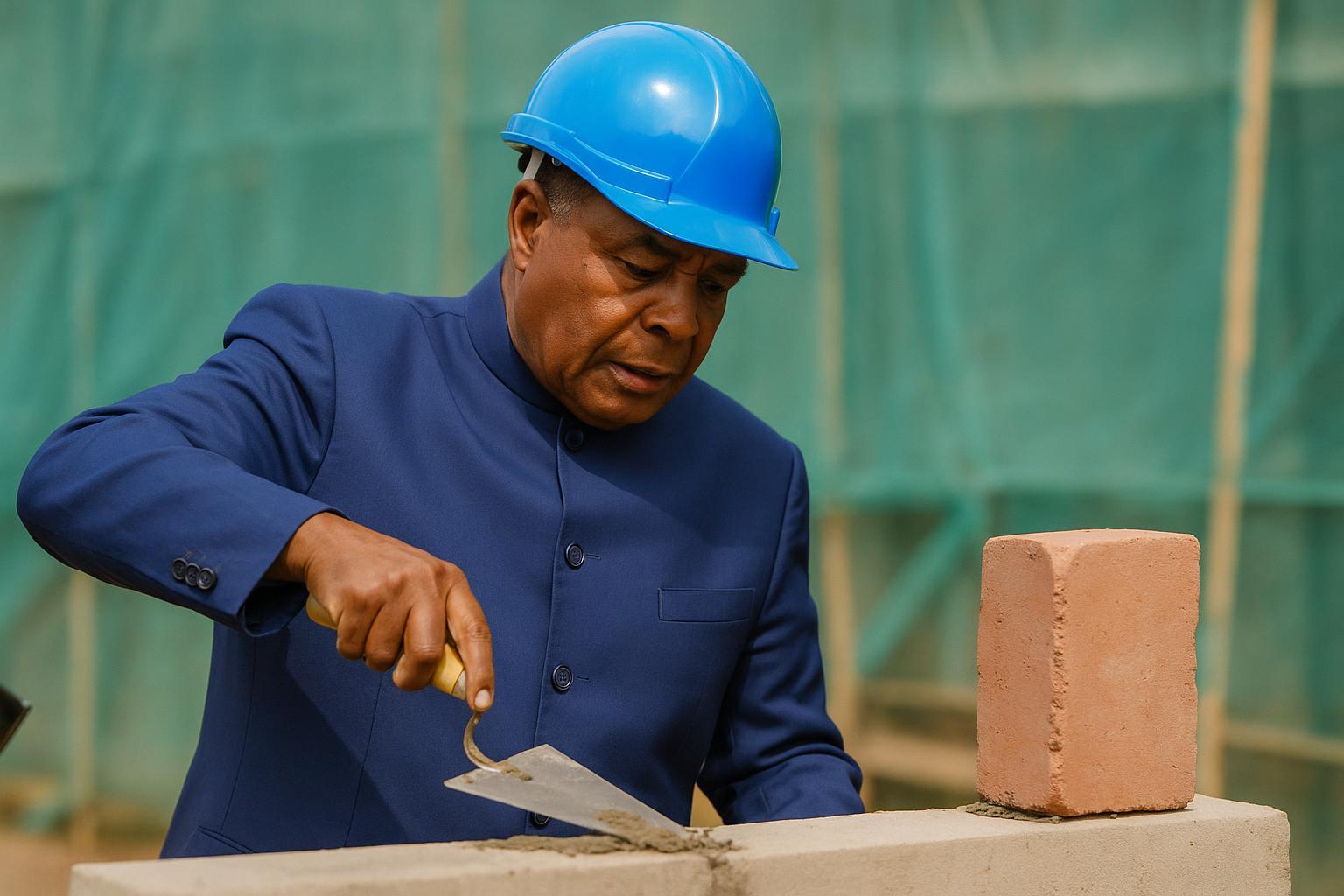
A Presidential Launch for a Symbolic Edifice
The sound of excavators mingled with the applause of invited guests on 19 December 2025 as President Denis Sassou Nguesso laid the first stone of the future headquarters of the Banque congolaise de l’habitat. The ceremony, held on the bustling Avenue Amilcar Cabral, transformed the artery into an open-air construction forum and offered a snapshot of the administration’s broader commitment to modernising the national financial system (Journal de Brazzaville, 19 December 2025). In his brief address, the Head of State underscored that the seven-storey tower “will embody both the solidity of our banking sector and our determination to make decent housing attainable for every Congolese family.”
Banking Metrics Point to Renewed Vitality
The statistics cited by Hydrocarbons Minister Bruno Jean-Richard Itoua, speaking for his Finance counterpart, were encouraging. By the end of August 2025 the BCH accounted for 5.35 percent of national deposits, 4.32 percent of loans to the economy and 4.70 percent of public-sector claims. Though still modest in absolute terms, these figures signal that the institution, created in 2007 through a partnership with Tunisia, is gradually reclaiming a credible position within Congo-Brazzaville’s banking landscape. Analysts in Brazzaville point to the bank’s focus on residential mortgages—a niche under-served by traditional commercial lenders—as the principal driver of this upswing.
From Early Headwinds to Strategic Reset
For the first decade of its existence the BCH struggled to align its mission with market realities. Chief Executive Officer Oscar Ephraïm Ngole recalled that limited long-term funding and an underdeveloped property ecosystem hampered the bank’s ability to extend affordable mortgages or finance large-scale housing estates. Recognising the urgency, the government adopted an emergency restructuring plan in October 2020. Four pillars underpinned the turnaround: a capital increase to 30 billion CFA francs, the allocation of National Housing Fund resources, a revamped risk-management framework and strengthened governance. “The recapitalisation instantly boosted confidence,” Ngole observed, adding that non-performing loans have since trended downward.
Architecture Anchored in Urban Renewal
Beyond balance-sheet metrics, the new headquarters promises to recalibrate the urban fabric of Brazzaville’s downtown. Designed by a consortium of Congolese and Tunisian architects, the glass-and-steel structure will house retail banking halls, mortgage advisory centres and a data-processing hub. Urban planners laud its planned integration of green terraces and solar panels, in line with the capital’s low-carbon ambitions. The investment is also expected to catalyse real-estate values in the surrounding blocks, reinforcing the city centre’s role as a magnet for financial services. A two-year construction timetable has been set, with the building slated to open its doors before the end of 2027.
Expanding the Footprint, Deepening Inclusion
While the Brazzaville tower steals the limelight, the BCH has been methodically extending its reach. Branches in Pointe-Noire, Dolisie and Ouesso are already operational, giving the institution a presence in four major urban areas. Minister Itoua argues that this territorial mesh “brings the bank closer to carpenters in Ouesso as much as to engineers in Pointe-Noire.” Early evidence suggests that proximity matters: the average time required to process a mortgage dossier has fallen from six weeks in 2021 to three weeks in 2025, according to internal BCH data. Micro-savings products tailored for the informal sector have similarly gained traction, broadening financial inclusion.
Housing Policy as an Economic Multiplier
Economists routinely note that each housing unit built generates demand for local cement, steel and skilled labour, thereby stimulating GDP growth. The government’s housing policy, anchored by the BCH, therefore carries weight beyond social welfare. In a recent interview, Planning scholar Armelle Mavoungou stressed that “stable, long-term mortgage lending is indispensable if we wish to unlock domestic capital for infrastructure”. She contends that the new headquarters sends a strong signal to foreign partners, including those in the CEMAC zone, about Congo’s resolve to knit housing finance into its broader diversification agenda.
A Forward-Looking Outlook
With ground broken and cranes poised to rise, the BCH’s trajectory now hinges on sustaining prudent lending while scaling innovative products such as green mortgages. Officials remain mindful of regional headwinds—from fluctuating oil revenues to climate shocks—but believe the bank is better insulated than in the past. As the foundation cures beneath the December sun, many observers see more than concrete taking shape: they glimpse an institutional revival aligned with the nation’s ambition to provide dignified shelter and spur inclusive growth. If the schedule holds, the skyline of Brazzaville will soon feature a landmark that crystallises both economic renewal and the aspirations of Congolese households.
