
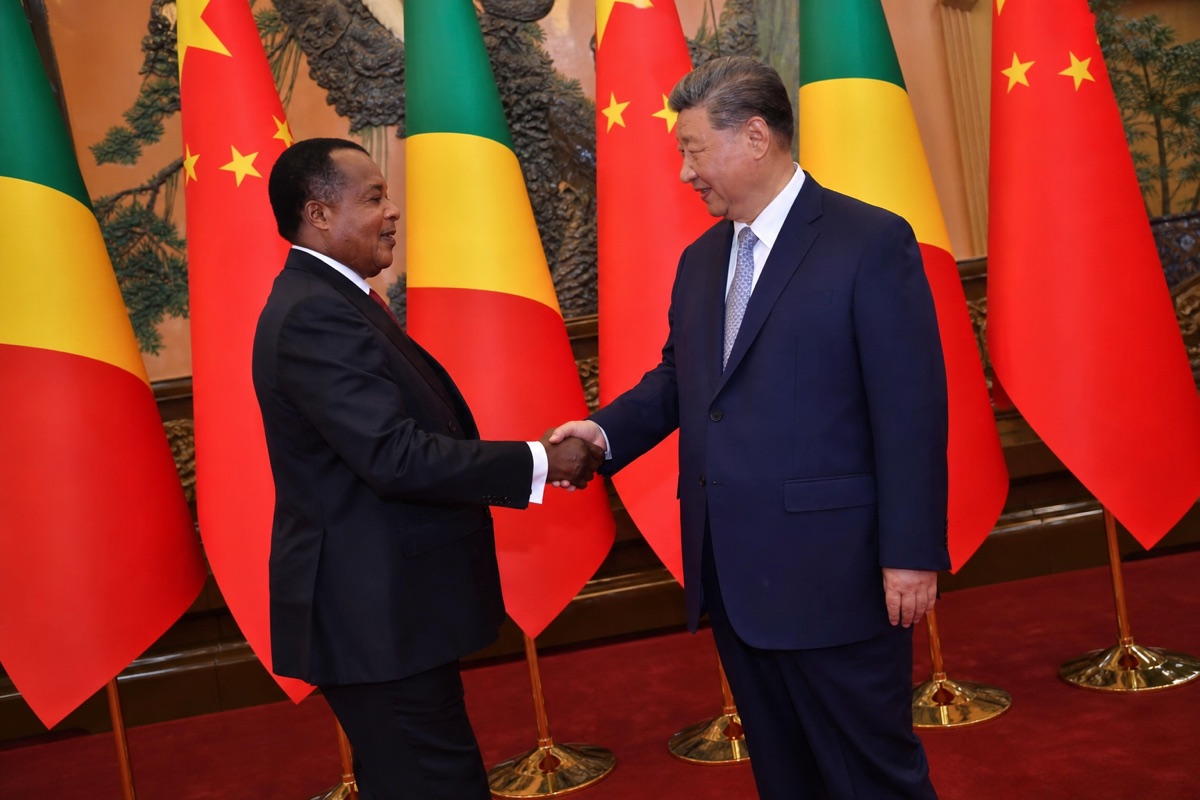
A carefully timed message from Beijing has once again placed the Republic of Congo at the centre of China’s deepening engagement with Central Africa. On Monday, 29 March 2026, President Xi Jinping addressed a formal note of congratulations to his counterpart, President Denis Sassou-N’Guesso, following the latter’s re-election at the helm of the Congolese state. Beyond the courtesies of protocol, the gesture functions as a deliberate reaffirmation of a partnership that both capitals have spent decades cultivating, and it invites a closer reading of where the relationship may be heading (Les Échos Congo Brazzaville).
A Diplomatic Signal Weighted With Strategic Intent
The vocabulary of congratulatory diplomacy is rarely accidental. By moving swiftly to acknowledge Sassou-N’Guesso’s renewed mandate, Xi Jinping signalled continuity in a relationship that Beijing evidently regards as stable and worth preserving. The Chinese president stressed the importance he attaches to bilateral relations and expressed his readiness to strengthen cooperation across several strategic domains, according to the message reported in Brazzaville (Les Échos Congo Brazzaville). The phrasing is measured, yet it carries an unmistakable subtext: China sees in the Congolese leadership a dependable interlocutor whose tenure offers the predictability that long-horizon partnerships require.
It is worth situating the moment within the broader grammar of state-to-state recognition. A note of this kind, dispatched within days of an election outcome, is less about the ceremony itself than about the assurance it conveys. For a head of state entering a fresh term, such recognition from one of the world’s principal economic and political actors helps consolidate international standing at a juncture when legitimacy and partnerships are closely intertwined.
The Architecture of an Enduring Partnership
The amity between Brazzaville and Beijing did not emerge overnight. It rests on a long sequence of cooperation that has touched infrastructure, public works, and institutional exchange, gradually weaving China into the fabric of the Congolese development story. Xi Jinping’s message, in describing the bond as one of friendship and cooperation, draws explicitly on this accumulated history rather than on any single project or transaction (Les Échos Congo Brazzaville).
What gives the relationship its resilience is precisely its breadth. By framing the partnership as multidimensional and oriented toward strategic sectors, the Chinese leadership positions itself not as a transient creditor but as a structural partner. For Brazzaville, this framing is attractive: it promises sustained engagement at a time when many Central African economies are seeking diversified sources of financing and technical expertise that do not hinge on a single channel.
Reading the Regional Subtext
The exchange should also be understood against the wider canvas of China’s posture in the CEMAC zone and Central Africa more broadly. Beijing has long pursued a pattern of cultivating durable ties with sitting governments across the region, and its prompt acknowledgement of the Congolese result is consistent with that approach. The Republic of Congo, distinct from its larger neighbour the Democratic Republic of the Congo, occupies a particular niche in this calculus: a comparatively compact but strategically located state whose stability serves Chinese interests in the sub-region.
For Congolese observers, the analytical question is less whether cooperation will continue than on what terms. Renewed assurances of partnership raise familiar debates about balance, sovereignty, and the conditions under which external engagement translates into tangible domestic gains. These are not questions the congratulatory note answers, but they form the inevitable backdrop against which such messages are received by cadres, entrepreneurs, and citizens attentive to the country’s external alignments.
What the Gesture Tells Us, and What It Withholds
The measured language of the message is instructive in what it omits as much as in what it affirms. It speaks of strengthening cooperation in strategic areas without committing to specifics, leaving the substance to be negotiated through the ordinary machinery of bilateral relations. This is the nature of diplomatic congratulation: it sets a tone, opens a door, and defers the detail. To read into it a concrete programme would be to overstate its content.
Yet the symbolism should not be underestimated. In the choreography of international relations, the speed and warmth of such recognition function as currency, conferring a measure of continuity and confidence at the outset of a presidential term. For Sassou-N’Guesso, the message reinforces an external partnership that has become a familiar feature of Congolese statecraft. For Xi Jinping, it reaffirms an investment in a relationship Beijing intends to keep close.
As the new mandate unfolds, the texture of the partnership will be revealed less through declarations than through the projects, agreements, and exchanges that follow. The congratulatory note marks a beginning rather than a conclusion, a reaffirmation of intent whose meaning will be measured in the months and years ahead.
