
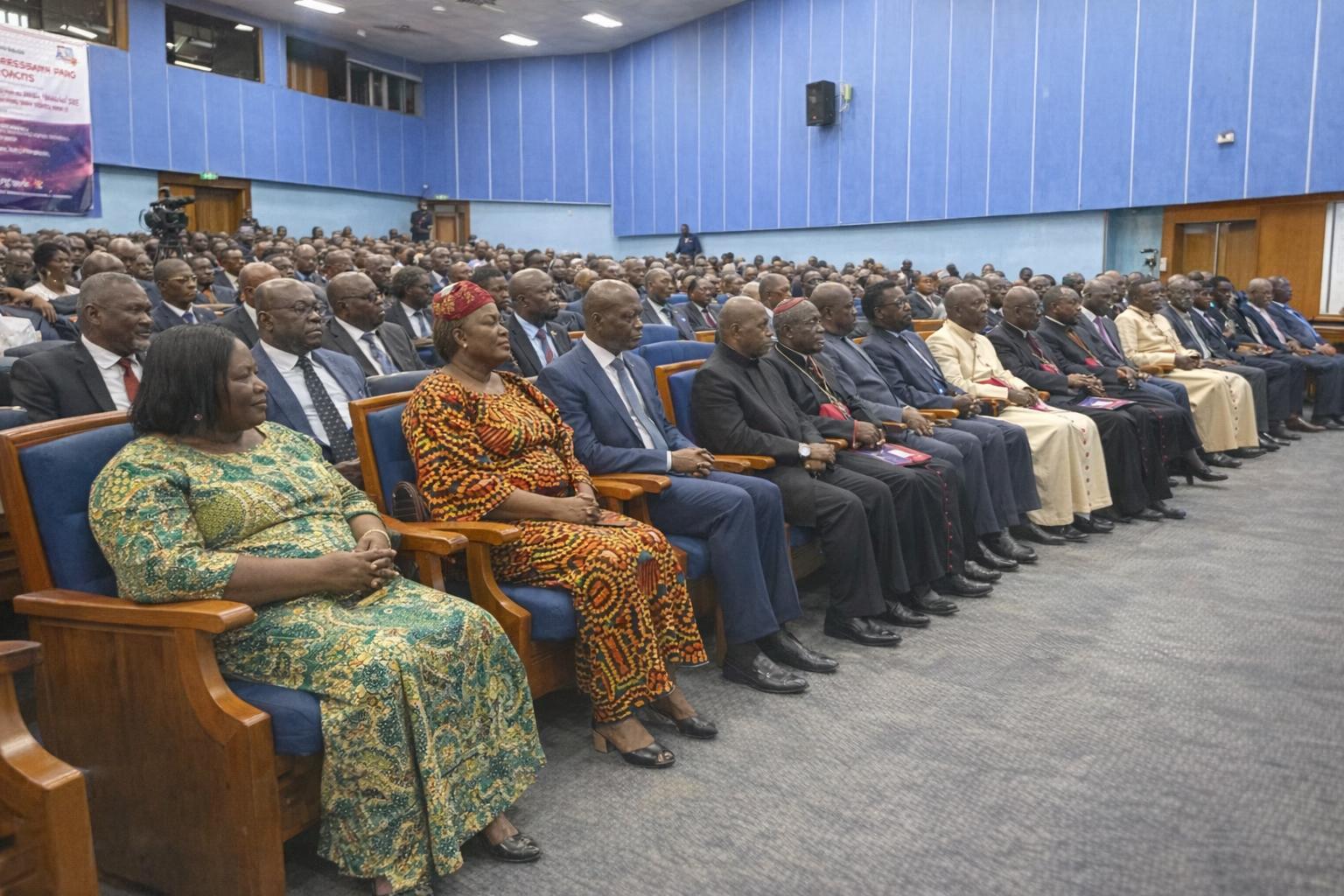
Brazzaville international colloquium at the Palais des Congrès
From 21 to 23 January 2026, the Doctoral Programme in History and Civilisations at the Faculty of Letters, Arts and Human Sciences (FLASH) of Marien Ngouabi University convened an international colloquium at Brazzaville’s Palais des Congrès, devoted to the life and work of Mgr Benoît Gassongo. The initiative was carried by the Association solidarité plurielle, which presented the meeting as a moment of national recollection and scholarly appraisal rather than a purely commemorative ceremony.
The organisers framed the event around a double ambition: to rekindle public awareness of a major Catholic figure, and to subject his intellectual and pastoral legacy to the methods of academic inquiry. By setting the proceedings within a university-based doctoral formation, the colloquium implicitly asserted that the construction of national memory is strengthened when it is anchored in research, documentation and debate.
Senior institutions and Church figures signal national interest
The opening session on 21 January was presided over by Minister Léon-Juste Ibombo, a presence that set an official tone and highlighted the public importance attached to historical transmission. The audience brought together several prominent personalities, including ministers Pierre Oba and Hugues Ngouélondélé, Senate President Pierre Ngolo, Constitutional Court President Auguste Iloki, and the President of the High National Council of Elders, Jean-Marie Ewengue. Several bishops also attended, notably Mgr Brice Armand Ibombo, who chaired the organising committee.
In the Congolese context, the convergence of government officials, constitutional authorities and ecclesiastical leaders around an academic colloquium suggests more than protocol. It signals a shared understanding that cultural heritage, educational pathways and national narratives are interlinked. The organisers’ decision to host the event at the Palais des Congrès further reinforced its public and symbolic dimension, positioning scholarship in direct dialogue with the institutions that embody state continuity.
Memory, nation-building and President Sassou-Nguesso’s role
In his opening address, Léon-Juste Ibombo invoked a well-known proverb: “When an old person dies, it is a library that burns.” His point, however, was to reject the vocabulary of loss. The colloquium, he argued, was meant to open that “library,” to read it attentively, and to pass it on. Such phrasing placed emphasis on transmission as a civic act, and on collective learning as an antidote to social amnesia.
The minister also saluted President Denis Sassou-Nguesso as a “great protector of national memory,” linking the commemoration of builders and educators to the broader task of sustaining national reference points. The warning was explicit: forgetting those who shaped a country risks leaving a nation to move forward without bearings. In this perspective, the colloquium was not merely an ecclesiastical remembrance; it was presented as an exercise in civic orientation, relevant to education, cultural policy and national cohesion.
Benoît Gassongo’s bridge between Western and African cultures
A central theme of the opening remarks was Mgr Gassongo’s capacity to reconcile worlds that are often caricatured as opposing. Léon-Juste Ibombo described him as having located “the hyphen” between Western and African cultures, “without privileging one or denigrating the other.” The formulation is significant: it positions cultural encounter not as a hierarchy but as a dialogue, and it attributes to the bishop a method of navigating modernity while maintaining fidelity to local identities.
In an academic setting, such a characterisation encourages inquiry into concrete practices: how an educator and Church leader could shape curricula, social norms and community institutions while maintaining a respectful equilibrium between inherited traditions and external intellectual frameworks. The colloquium’s ambition to “interrogate the legacy” thus appears as an invitation to analyse not only texts and sermons, but also institutional choices and the educational infrastructures that outlive any single personality.
Scholarship, education and the making of cadres in Nkéni-Alima
According to the organisers, Mgr Benoît Gassongo was born around 1910 in Mbanza, in what is today the department of Nkéni-Alima. He entered the Grand Seminary of Saint-Jean in Libreville in 1939, and was ordained a priest in Brazzaville on 9 June 1946. Working alongside Spiritan missionaries, he helped build numerous schools and missions, including in Tongo, Boniala, Bokombo, Litoumbi, and Boundji-a-Tsé, among others.
The text presented to the public during the event links these educational efforts to the formation of generations of civil and military cadres. Among those cited as having benefited from this ecosystem are Auguste Iloki, Benoît Moundélé-Ngollo and François Ibovi. The emphasis on schooling and cadre formation is not incidental: it situates the bishop’s legacy within the concrete architecture of state capacity—human capital—while also reflecting a broader Congolese narrative in which education is repeatedly described as the most durable form of nation-building.
A milestone in national history: the 28 November 1958 homily
Another moment singled out by participants was 28 November 1958, when Benoît Gassongo delivered the homily at the proclamation of the Republic in the Basilica of Sainte-Anne in Brazzaville. In the account offered, this homily symbolically sealed an alliance between spirituality and national destiny, placing the Church’s voice within a pivotal civic ceremony.
Interpreted cautiously, the episode illustrates how certain figures become embedded in national memory through precise, publicly witnessed events. It also helps explain why a scholarly colloquium can resonate beyond academia: it revisits moments where religious leadership intersects with political time, without collapsing one into the other. The point, as articulated during the colloquium, is less to mythologise than to document and understand the mechanisms through which collective meaning is produced.
An episcopal and intellectual legacy: works and recognition
Mgr Brice Armand Ibombo presented the gathering as a “duty of recognition” towards “a man of the Church, an educator and a builder.” The colloquium’s framing emphasised that Mgr Gassongo authored reference works on Congolese resistance and on the evangelisation of the country. He was described as the first Congolese to write on the history of evangelisation in Congo, and as the second Congolese bishop after Mgr Théophile Bemba.
The participants also recalled that Benoît Gassongo served as Bishop of Owando from June 1968 until his death on 17 April 1981, and that he was buried at Sainte-Marie Church in Ouenzé. Forty-five years after his passing, the organisers argued, his figure has resurfaced in the national consciousness—an observation that underlines the long rhythms of historical recognition and the capacity of institutions, both academic and civic, to reactivate memory through research-based public events.
Publishing the proceedings to broaden access to national memory
Over three days, scientific communications, exchanges and reflections were presented as elevating the prelate’s profile to the full height of his legacy, anchoring it more firmly in the country’s collective memory. The organisers indicated their wish to publish the proceedings, a step that would transform an event-bound discussion into a lasting resource for readers beyond the conference hall.
The mobilisation of cadres originating from Nkéni-Alima was also noted as a marker of regional pride and civic commitment, portraying Mgr Gassongo as a pioneer of development in that area as well as a contributor to the nation’s broader trajectory. In this spirit, the colloquium offered a disciplined form of homage: not only to remember, but to study, to transmit, and to leave behind a documented record capable of informing future research and public reflection.
