
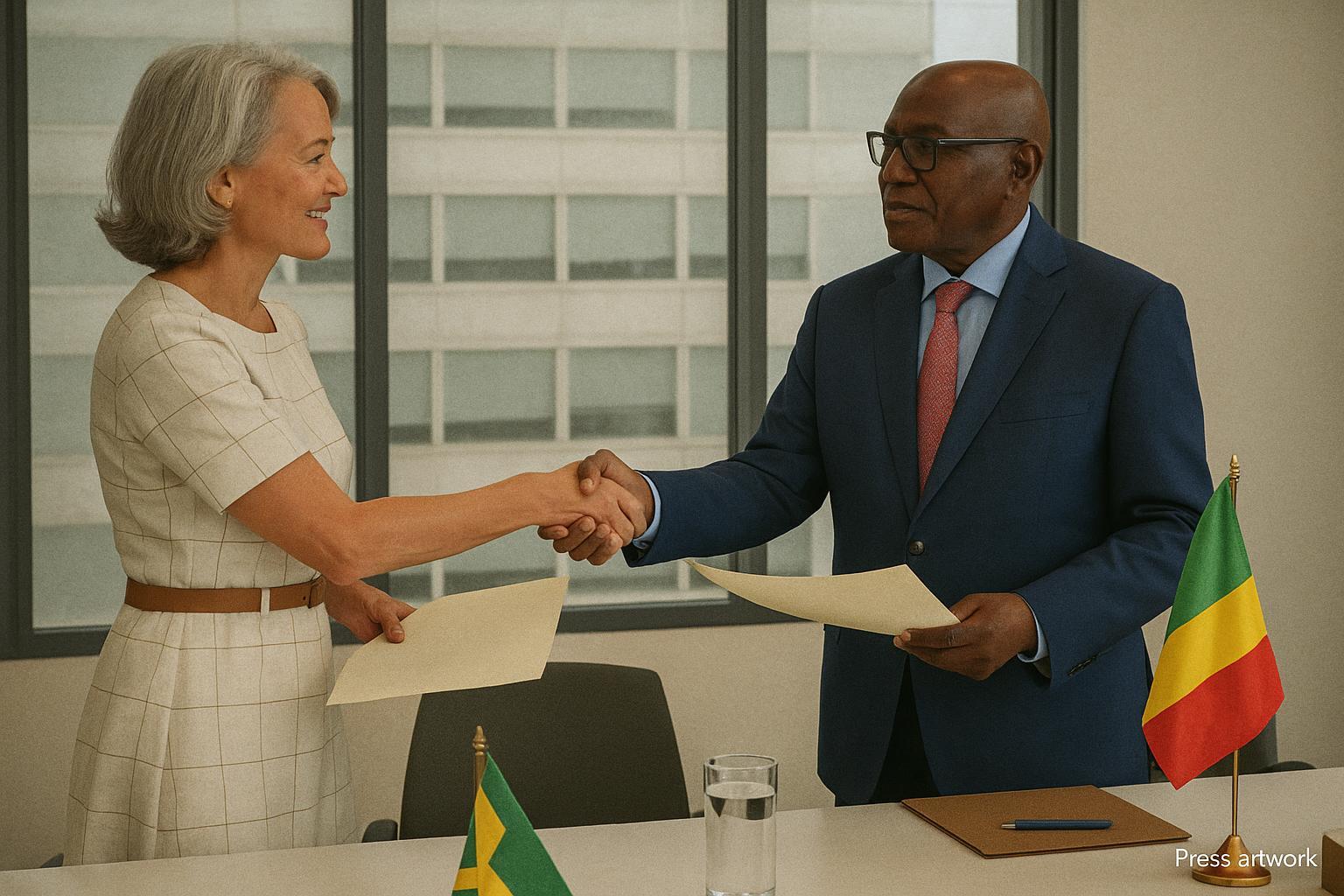
Renewed Momentum in a Four-Decade Partnership
On a mid-winter morning in Brasília, the signatures of Procuradora Sônia de Almendra F. Portella Nunes and Ambassador Louis Sylvain-Goma glided across the pages that recalibrate a bilateral debt accord first brokered in 2014. The quiet ceremony at the Brazilian Ministry of Finance belied its symbolic heft: it revives a relationship forged in 1980 and refined through successive presidential visits, most recently President Denis Sassou Nguesso’s appearance at the 2023 Amazon Cooperation Treaty Organization summit. Analysts in both capitals, quoted by Agência Brasil and Les Dépêches de Brazzaville, describe the addendum as a timely vote of confidence in Congo’s fiscal consolidation efforts and Brazil’s aspiration to rejuvenate South-South diplomacy.
From LIBOR’s Swan Song to the Rise of SOFR
The heart of the addendum is technical yet consequential. With LIBOR’s discontinuation at the end of June 2023, the two treasuries faced the imperative of identifying a new reference rate that preserves contractual certainty. They converged on Term SOFR, an index disseminated by Bloomberg and anchored in transactions on the vast U.S. repo market. Treasury economists in Rio de Janeiro underscore that SOFR’s risk-free architecture aligns with G20 recommendations for benchmark reform, while Congolese officials note that its historically lower volatility could temper debt-service shocks. Although Term SOFR is dollar-denominated, the swap arrangements insulate both sides from abrupt currency mismatches, according to a senior official at Congo’s Public Debt Directorate.
The Negotiating Pathway and Parliamentary Oversight
The July signature rests on consultations spanning nearly twenty-four months, punctuated by virtual sessions during the pandemic and a technical mission to Brazzaville in late 2022. Brazil’s Senate Foreign Affairs Committee ratified the text on 11 July 2023, while Congo’s National Assembly provided its assent earlier in the same week, a sequencing described by Senator Humberto Costa as “an instructive case of bicameral alignment” (O Globo, 12 July 2023). Observers commend the process for meeting IMF transparency standards, an important signal given Brazzaville’s ongoing Extended Credit Facility review.
Macroeconomic Stakes for Brazzaville
Congo’s stock of external public debt stood at roughly 8 billion USD in 2022, with Brazilian claims accounting for a modest but politically salient slice. By substituting LIBOR with SOFR and recalibrating the spread, the addendum trims expected interest payments by an estimated 30 basis points annually, according to figures circulated by Congo’s Ministry of Finance. The ministry projects cumulative savings of nearly 12 million USD over the remaining amortisation schedule—limited in absolute terms yet significant for a budget where debt service has hovered near 40 percent of revenues. Fitch Ratings’ latest note singles out the agreement as a factor that could underpin Congo’s gradual return to international markets, contingent on continued fiscal discipline and hydrocarbon price stability.
Brazil’s Calculus: Diplomacy Meets Development Finance
For President Luiz Inácio Lula da Silva, reengagement with Africa dovetails with his broader bid to reposition Brazil as a spokesperson for the Global South. Officials at Itamaraty frame the Congolese accord as precedent-setting: it showcases Brazil’s ability to renegotiate legacy loans in a manner consistent with international benchmark reform, thereby enhancing the credibility of the country’s development finance toolkit. The Brazilian National Treasury, managing a 15 billion USD portfolio of concessional credits across Africa and Latin America, signals that similar adjustments may follow with other partners, notably Angola and Mozambique.
Prospects for a Second Addendum and Broader Cooperation
A second addendum, presently under scrutiny in the Brazilian Senate, could further lower Congo’s debt-service burden by extending maturities and modestly reducing the margin over the risk-free rate. Congolese sources suggest that an agreement might be reached before the end of the legislative session. Beyond sovereign debt, the two governments are reviving their Joint Commission, dormant since 2015, with an agenda spanning agritech, forestry management and cultural exchange. A draft memorandum seen by Valor Econômico outlines collaboration on bio-economy projects in the Congo Basin and the Amazon, underscoring environmental diplomacy as an emerging pillar.
Calibrated Outlook for South-South Finance
In the current geopolitical climate, where multilateral lending is often hampered by conditionalities and shifting priorities, the Congo-Brazil accord illustrates the pragmatic space occupied by bilateral arrangements. By aligning contractual mechanics with the post-LIBOR architecture while respecting domestic oversight, both governments reinforce fiscal predictability without compromising sovereignty. The forthcoming second addendum, if ratified, may deepen those gains and further entrench Brasilia and Brazzaville as interlocutors in a reforming global financial order.
