
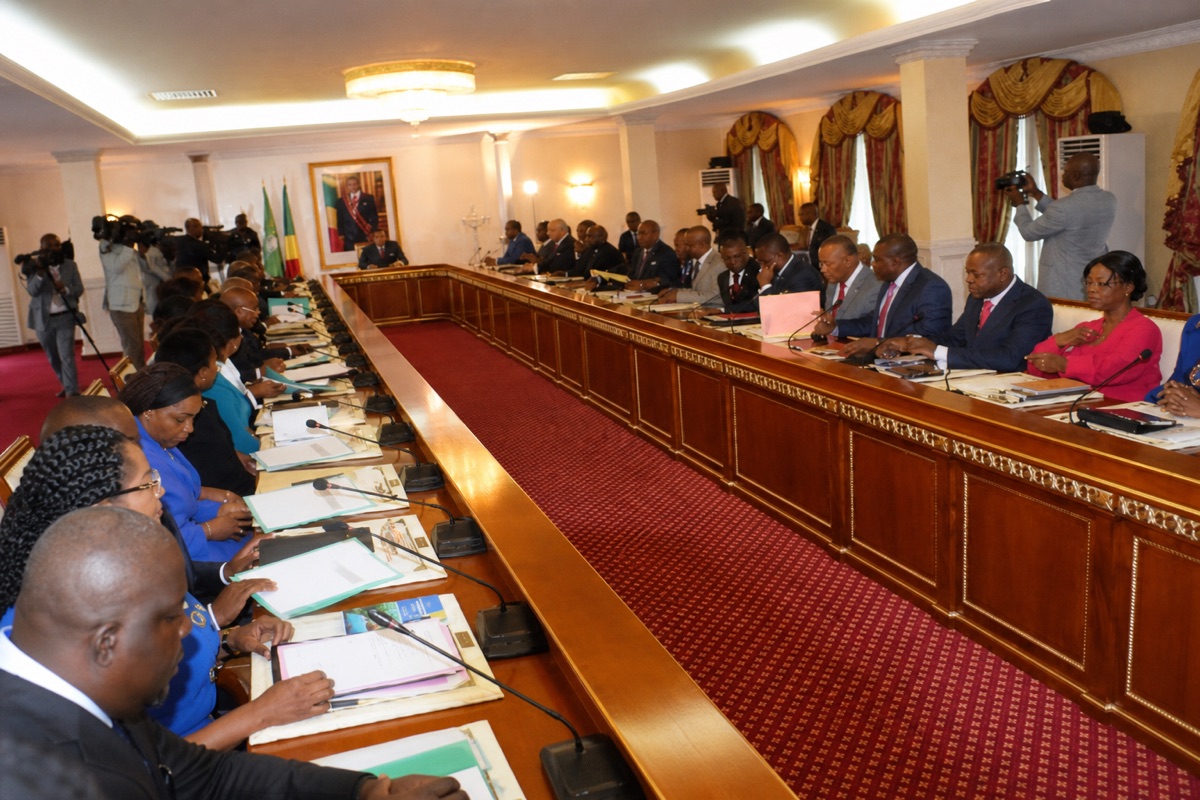
A Measured Session at the Palais du Peuple
Convened on 22 July 2026 within the Palais du Peuple in Brazzaville, the Congolese Council of Ministers gathered under the chairmanship of President Denis Sassou N’Guesso for a session that, though procedurally routine, carried a discernible programmatic weight. The deliberations opened at ten o’clock in the morning and were adjourned at a quarter past noon, a compact span during which the cabinet examined five draft decrees and heard a single ministerial communication. The agenda, reaching across health, forestry, hydrocarbons and education, offered a revealing cross-section of the administration’s present preoccupations. Each measure gestured toward the twin imperatives of institutional consolidation and economic diversification that increasingly frame public discourse in the Republic of Congo (Congo-Brazzaville), and together they suggested a governing intent more deliberate than the brevity of the meeting might imply.
Health Governance Acquires a Strategic Compass
The first and arguably most structurally consequential text was tabled by Jean Rosaire Ibara, Minister of Health and Population. His draft decree establishes a National Health Council, described in the government’s account as a “strategic consultative body” bringing together the state, health professionals, technical and financial partners, and civil society. Its remit is advisory rather than executive: to counsel the authorities on the broad orientations of national sanitary policy. The decision to favour a deliberative architecture over a purely administrative one intimates an effort to institutionalise dialogue within a sector where coordination among heterogeneous actors has long proven elusive. Whether such a forum acquires genuine influence will depend on the resources and political attention it is ultimately granted.
Forestry Stewardship and Ecological Accounting
Rosalie Matondo, Minister of Forest Economy, presented a decree approving the statutes of the National Centre for the Inventory and Management of Forest and Wildlife Resources. Entrusted with the country’s forest inventory and cartography, the body is designed to furnish the empirical foundation upon which any credible policy of sustainable exploitation must rest. For a nation whose Congo Basin forests constitute a globally significant carbon reservoir, the initiative carries implications that extend well beyond domestic administration, touching upon the technical vocabulary of conservation, monitoring and environmental valuation that increasingly conditions access to international climate finance.
Hydrocarbons and the M’Boundi Extension
The Minister of Hydrocarbons, Stev Simplice Onanga, submitted a decree extending the exploitation permit for the M’Boundi field, situated some fifty kilometres from Pointe-Noire and originally awarded in 2002. The concession, operated by Eni Congo, remains a notable asset within the country’s petroleum portfolio, and its prorogation underscores the enduring centrality of oil revenue to public finances even as officials elsewhere extol the merits of diversification. The measure illustrates the pragmatic tension between an economy still anchored in hydrocarbons and a rhetoric increasingly oriented toward productive alternatives.
Educational Excellence and the Preparatory Ambition
Two texts fell to Delphine Edith Emmanuel Adouki, Minister of Higher Education. The first creates preparatory classes for the grandes écoles within the excellence lycées of Mbounda and Oyo, offering the most accomplished Congolese school-leavers two years of intensive instruction in scientific and literary disciplines before they enter the grandes écoles. The ambition is transparently meritocratic, seeking to retain and cultivate high-achieving students who might otherwise pursue their formation abroad. The second decree approves the statutes of the Multiservice Centre for the Valorisation of Bioresources, a research and innovation hub dedicated to agro-food transformation, thereby linking the educational agenda to the wider aspiration of an economy that adds value to its own raw materials.
Agriculture and the Sovereignty Question
The session closed with a communication from Valentin Ngobo, Minister of Agriculture and Livestock, who set out the arrangements for the second edition of the Grand Agricultural Fair of Congo. Scheduled from 5 to 20 August 2026 at the Bambou-Mingali exhibition park, the event is expected to gather roughly six hundred and fifty exhibitors around the theme of food sovereignty. The emphasis is telling: in a period marked by volatile import dependence across Central Africa, the promotion of domestic agricultural capacity has assumed an unmistakably strategic dimension. The meeting concluded with the communiqué issued, in the absence of the government spokesman then on mission, by the Keeper of the Seals and Minister of Justice, Aimé Ange Wilfrid Bininga, a procedural detail that quietly signalled the continuity of collegial governance.
