
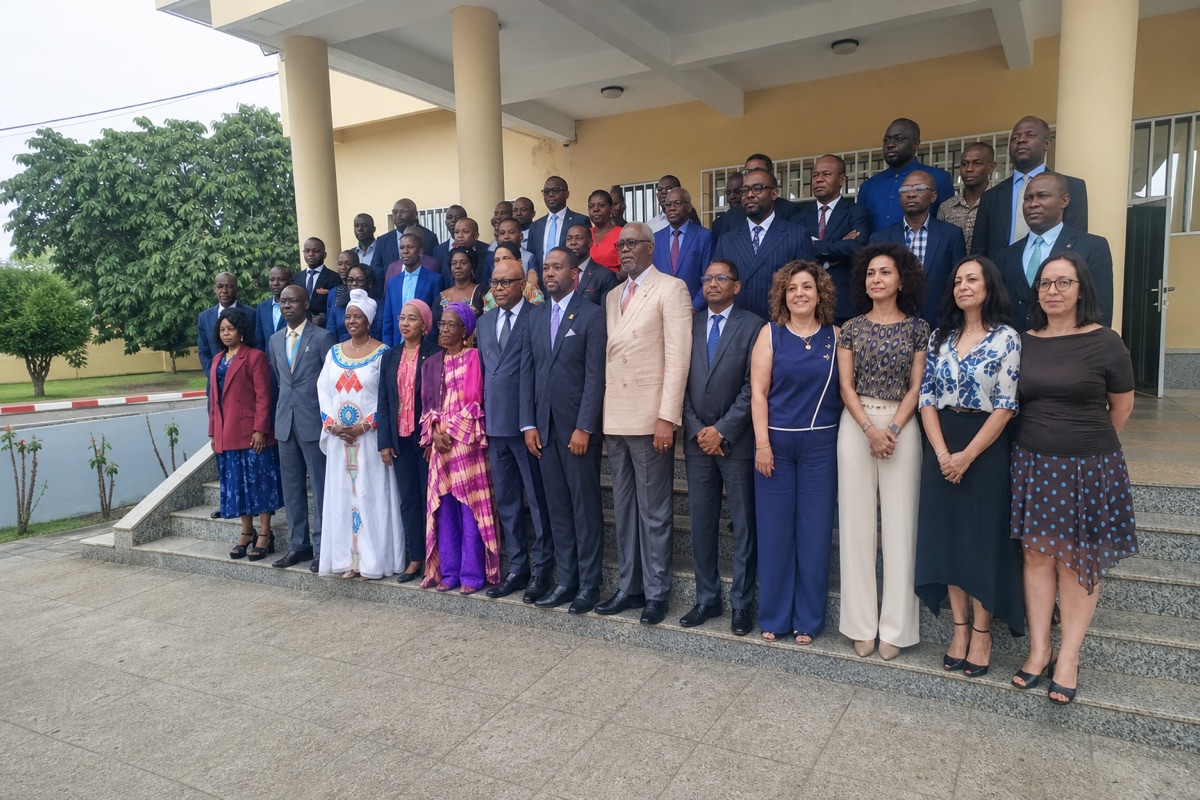
On the morning of 9 July, in the quiet grounds of the Aubeville centre, the Republic of Congo signalled that it no longer intends to treat youth addiction as a marginal social nuisance. Hugues Ngouelöndélé, Minister of Sports, Youth and Civic Education, opened the second training session in addictology and tobacco studies, an eight-day programme running until 16 July. Behind the technical vocabulary lies a more ambitious political wager: to convert a single facility into a national reference point for the fight against dependency, and to give the state a coherent doctrine where it has long relied on improvisation.
A national referral hub takes shape
The session is carried by the National Agency for the Insertion and Social Reintegration of Young People (Anirsj), the body tasked with turning Aubeville into what officials describe as a pole of reference. The choice is deliberate. Rather than scattering scarce expertise across many sites, the authorities have concentrated it in one, betting that a densely equipped centre can radiate methods and standards outward. The eight-day format is short, but its purpose is less to certify specialists than to seed a shared professional language among those who will run the system day to day.
Why the state is investing in expertise
The programme gathers an unusually broad professional cohort: physicians, psychologists, social workers, specialised educators and administrative cadres, brought together to confront the ravages of tobacco, alcohol and psychoactive substances. That mix is telling. Addiction, in the government’s reading, is not merely a medical condition to be treated in isolation but a social trajectory to be interrupted, which requires clinicians and caseworkers to work from the same premises. The subtext is a recognition that Congo-Brazzaville has, until now, lacked the trained personnel to staff such an approach at scale.
Partnerships that anchor the ambition
Anirsj is not attempting this alone. The initiative leans on a coalition of partners that lends it both technical weight and international legitimacy: the Ministry of Health and Population, the Tunisian Society of Addictology, the Consultative Council for Youth and agencies of the United Nations system. The Tunisian partnership is particularly significant, importing addictology expertise from a country with a longer institutional history in the field, while the involvement of UN bodies situates Aubeville within a wider architecture of standards rather than leaving it as an isolated national experiment.
From reception to reintegration
The stated aim is to improve the reception and treatment of young people who are vulnerable or in conflict with the law, a formulation that quietly widens the centre’s mandate beyond the clinical. Care protocols, officials say, will be aligned with international standards and will combine therapeutic follow-up with accompaniment toward active civic life. That last phrase matters: it frames recovery not as an endpoint but as a passage back into society, work and citizenship, which is the harder and more consequential task.
Patrick Hemery Akondzo Olandjobo, director general of Anirsj, insists the effort rests on solid foundations. The training, he notes, is built on structured modules and concrete methods of intervention (Anirsj), a phrasing that signals a move away from goodwill toward standardised, replicable practice. The distinction is not rhetorical. A pole of reference stands or falls on whether its methods can be documented, taught and reproduced elsewhere.
A wager on human capital
Minister Ngouelöndélé framed the stakes in unusually broad terms, arguing that addictions threaten community cohesion and the country’s economic future, and that investing in human capital is the way to stabilise fragile life trajectories. It is a striking argument to hear attached to a training seminar. It positions the fight against dependency not as charity but as economic strategy, an attempt to preserve the productive potential of a young population in a country where demographic weight is both a promise and a pressure.
Whether Aubeville can deliver on that promise will depend on what follows this July session. An eight-day course, however well designed, is a beginning rather than a system, and the language of international standards will have to survive contact with limited budgets and thin professional ranks. Yet the direction of travel is clear. By concentrating expertise, courting external partners and speaking of addiction in the register of national development, the Congolese authorities are attempting to build something durable where responses have often been ad hoc. The measure of success will be quiet and cumulative: whether, a year from now, the young people passing through Aubeville leave it with a genuine route back into civic life.
