
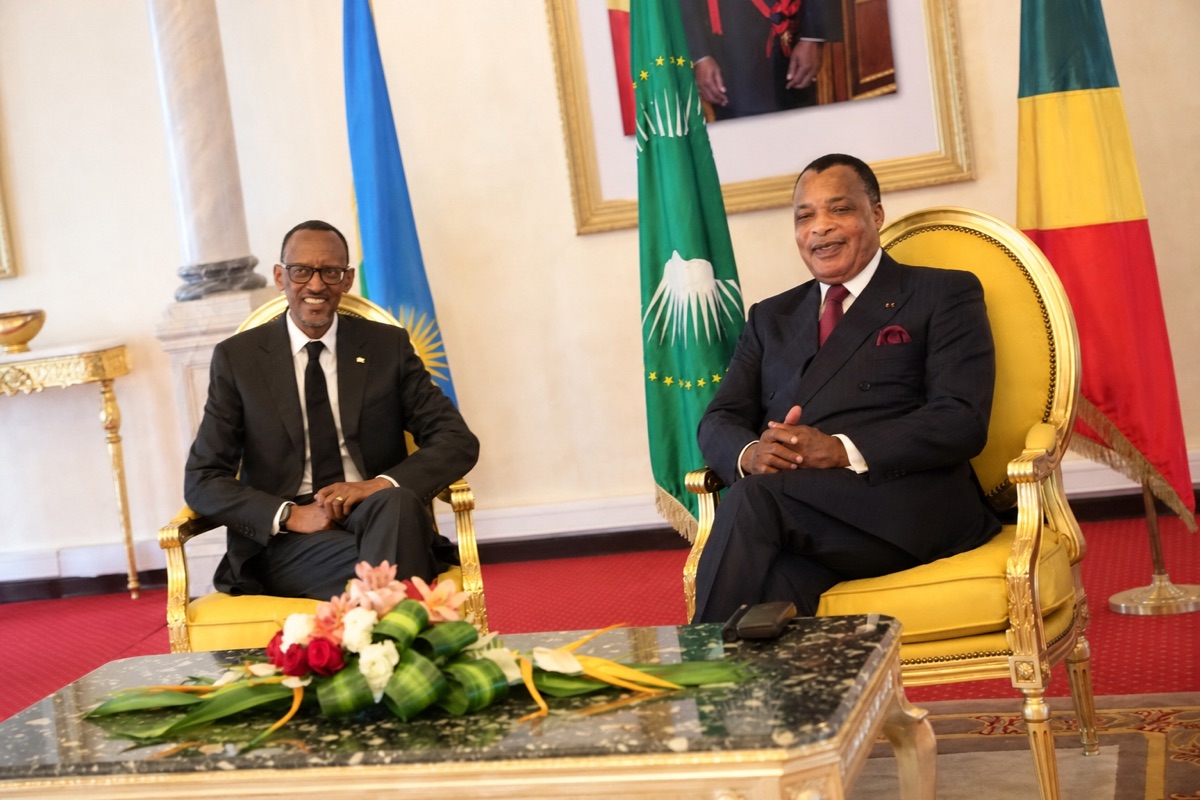
A day after Congo-Brazzaville’s electoral authorities released the provisional results of the presidential ballot held on 12 and 15 March, messages of congratulation from across the continent began to converge on the capital. Among the earliest to reach President Denis Sassou N’Guesso were those of two influential neighbours: Félix-Antoine Tshisekedi Tshilombo of the Democratic Republic of the Congo and Paul Kagame of Rwanda. Their swift gestures, delivered while the figures were still described as provisional, signalled how attentively the sub-region watches Brazzaville’s political calendar.
A Landslide Endorsement From Across the River
The scale of the announced verdict left little room for ambiguity. Sassou N’Guesso was credited with 94.82 percent of the votes cast, a margin that confers, at least on paper, an unusually broad mandate for the years ahead. It was from the left bank of the Congo River that the first prominent message arrived. President Tshisekedi extended his “warm and heartfelt congratulations” (Tshisekedi) to his counterpart on the re-election, voicing the hope that the new term would contribute “to the progress and well-being of the brotherly people” (Tshisekedi).
The symbolism of that proximity is difficult to overstate. The two Congos face one another across the river, their capitals among the closest of any neighbouring states in the world, and their histories are bound by shared language, kinship and a long catalogue of cross-border ties. A message of this kind, dispatched almost immediately, functions as more than courtesy; it is a calibrated reaffirmation of continuity in a relationship that both governments have reasons to keep steady.
Kigali Underlines a Partnership of Convenience
From Kigali, President Kagame likewise addressed his congratulations to the man he referred to as his “brother” (Kagame). The Rwandan leader took the occasion to restate the solidity of bilateral relations between Rwanda and the Congo, framing the coming years as an opportunity to pursue close cooperation “in the service of common priorities and the prosperity of both peoples” (Kagame).
That language, deliberately broad, reflects a diplomacy that has grown more deliberate in recent years. Rwanda has cultivated partnerships well beyond its immediate borders, and an early note to Brazzaville fits a pattern of careful relationship management across Central and East Africa. For Sassou N’Guesso, receiving such an acknowledgement from a leader often described as a regional strategist adds a layer of external validation at a moment when the legitimacy of the result will be examined both at home and abroad.
Reading the Diplomatic Choreography
There is an unmistakable choreography to these exchanges. The speed with which heads of state respond, the precise vocabulary they choose, and the order in which their messages become public all carry meaning in a sub-region where personal rapport between presidents frequently shapes the texture of inter-state relations. By moving early, Tshisekedi and Kagame placed themselves at the front of a queue of African leaders whose congratulations, according to the original account, continued to flow toward Brazzaville in the immediate aftermath of the proclamation.
It would be premature to read any single message as a guarantee of policy. Yet the convergence of two leaders whose own relationship has at times been strained, each separately reaffirming ties with Brazzaville, illustrates the particular position Congo-Brazzaville seeks to occupy: that of a steady interlocutor capable of speaking to several camps at once. For a country that has long presented itself as a facilitator within Central Africa, such recognition is part of the currency of regional influence.
An Agenda Framed Around Integration
The re-elected president has tied his renewed term to a programme he calls “Let us accelerate the march toward development” (Sassou N’Guesso’s manifesto), within which he pledges to contribute to the economic integration of the sub-region and of Africa more broadly. That ambition gives the incoming congratulations a forward-looking resonance, since both Kinshasa and Kigali are stakeholders in the wider project of connecting Central African economies, from trade corridors to shared infrastructure.
Whether the rhetoric of fraternity translates into concrete coordination will be the real test of the months to come. Integration in Central Africa has often advanced more slowly than its proponents promise, hampered by infrastructure gaps and competing national interests. Still, the early endorsements set a tone. They suggest that, at the level of heads of state at least, Brazzaville begins this new mandate with its principal neighbours signalling continuity rather than rupture, and with a stated agenda that places regional cooperation at its centre.
