
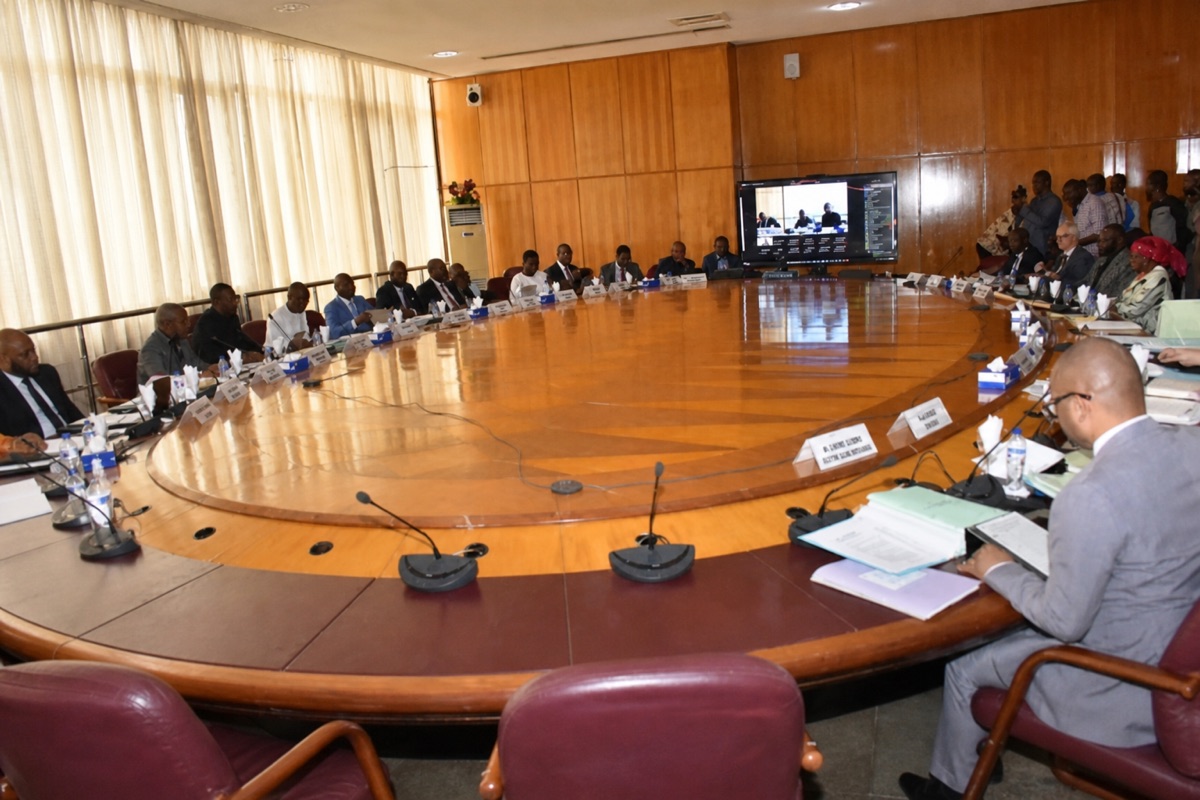
The Central African Economic and Monetary Community has reached one of those quiet inflection points that rarely make front pages yet quietly determine whether a region tips toward consolidation or drift. Meeting in N’Djamena on 8 April, the steering committee overseeing CEMAC’s programme of economic and financial reforms delivered a verdict that was candid in its modesty: progress, yes, but not nearly enough. Chaired by Congo’s Minister of Finance, Christian Yoka, the sixth extraordinary session examined the first-quarter results of ten priority measures adopted at the bloc’s summit of 22 January, and the assessment that emerged was sobering rather than celebratory.
A Mid-Course Reckoning for a Fragile Recovery
The committee’s reading of the first three months of 2026 was strikingly self-critical for an institution of its kind. Cooperation with the International Monetary Fund and the broader modernisation of public finances had begun to bear fruit, but implementation across the six member states remained uneven, hampered by administrative delays and structural constraints that no communiqué can wish away. The frankness matters. In a region where official optimism has often outrun delivery, an admission that execution has fallen short of ambition signals a willingness to confront the gap between decree and reality.
That gap is the central drama of CEMAC’s reform story. The measures themselves are unobjectionable in principle; the difficulty has always lain in coaxing six sovereign administrations, each with its own fiscal pressures and political calendars, to move in concert. Disparities between states, the committee noted, continue to dilute the collective effort, leaving the bloc only as strong as its slowest reformer.
Treasury Accounts and the Politics of Transparency
Among the priorities reaffirmed in N’Djamena, the rollout of a single Treasury account stands out as both technically demanding and politically charged. Consolidating the state’s cash holdings into one digital account promises a clearer view of public money and fewer of the opaque channels through which funds quietly vanish. For governments accustomed to fragmented banking arrangements, the reform is less an accounting nicety than a test of how far transparency will be allowed to reach into the machinery of the state.
Closely tied to this is the question of domestic debt. The committee called for intensified repayment plans to clear arrears that have weighed on local suppliers and stifled private-sector confidence. Domestic debt is the unglamorous twin of its external counterpart, yet its accumulation corrodes trust between governments and the businesses that depend on them. Accelerating settlement, the committee implied, is as much about restoring credibility as about balancing ledgers.
Currency Discipline and the Extractive Bargain
Perhaps the most contentious thread running through the session concerned the repatriation of foreign-exchange earnings. The committee pressed for strict sanctions against non-compliance in the extractive sector, the engine of the region’s economies and, historically, the source of its most stubborn leakages. Requiring oil and mining operators to channel their hard-currency receipts back through the regional system is essential to shoring up reserves and defending the common currency, yet it strikes directly at arrangements long favoured by powerful interests.
The same logic extends to the restoration of oil sites. Negotiations on repatriating the funds set aside for site rehabilitation are to be brought to a close, a step that binds environmental responsibility to fiscal accountability. The pairing is telling: in CEMAC’s emerging doctrine, the money owed to the land and the money owed to the treasury are increasingly treated as a single obligation.
A Banking Union by Increment
The fourth pillar of the agenda looks beyond individual treasuries to the architecture that connects them. The committee endorsed the harmonisation of banking supervision through a unified banking law under the auspices of the Bank of Central African States (BEAC). A common rulebook would, in theory, narrow the regulatory crevices through which risk migrates and lend coherence to a financial system still segmented along national lines. It is the most integrationist of the measures, and arguably the most consequential, for it would embed reform in law rather than leave it to the discretion of finance ministries.
Taken together, these priorities describe an effort to contain systemic risk and restore macroeconomic equilibrium across Central Africa. The committee framed its work in precisely those terms, presenting reform less as a menu of discrete projects than as a single defensive line against fiscal fragility. Whether that line holds will depend not on the elegance of the agenda set in N’Djamena but on the political stamina of the governments charged with enacting it. The first quarter, by the committee’s own reckoning, was a warning. The coming months will reveal whether the warning was heard (ADIAC Congo).
