
Brazzaville CHU: a targeted boost for renal care
Global Développement SA, known in Congo-Brazzaville for producing soft drinks and mineral water marketed under the Globaline label, has carried out rehabilitation and renovation works on the medical oxygen distribution network serving the Renal Disease Care Centre at the Brazzaville University Hospital (CHU). The initiative addresses a technical failure that had affected oxygen supply to a unit where respiratory support can be clinically decisive for patients with kidney disease.
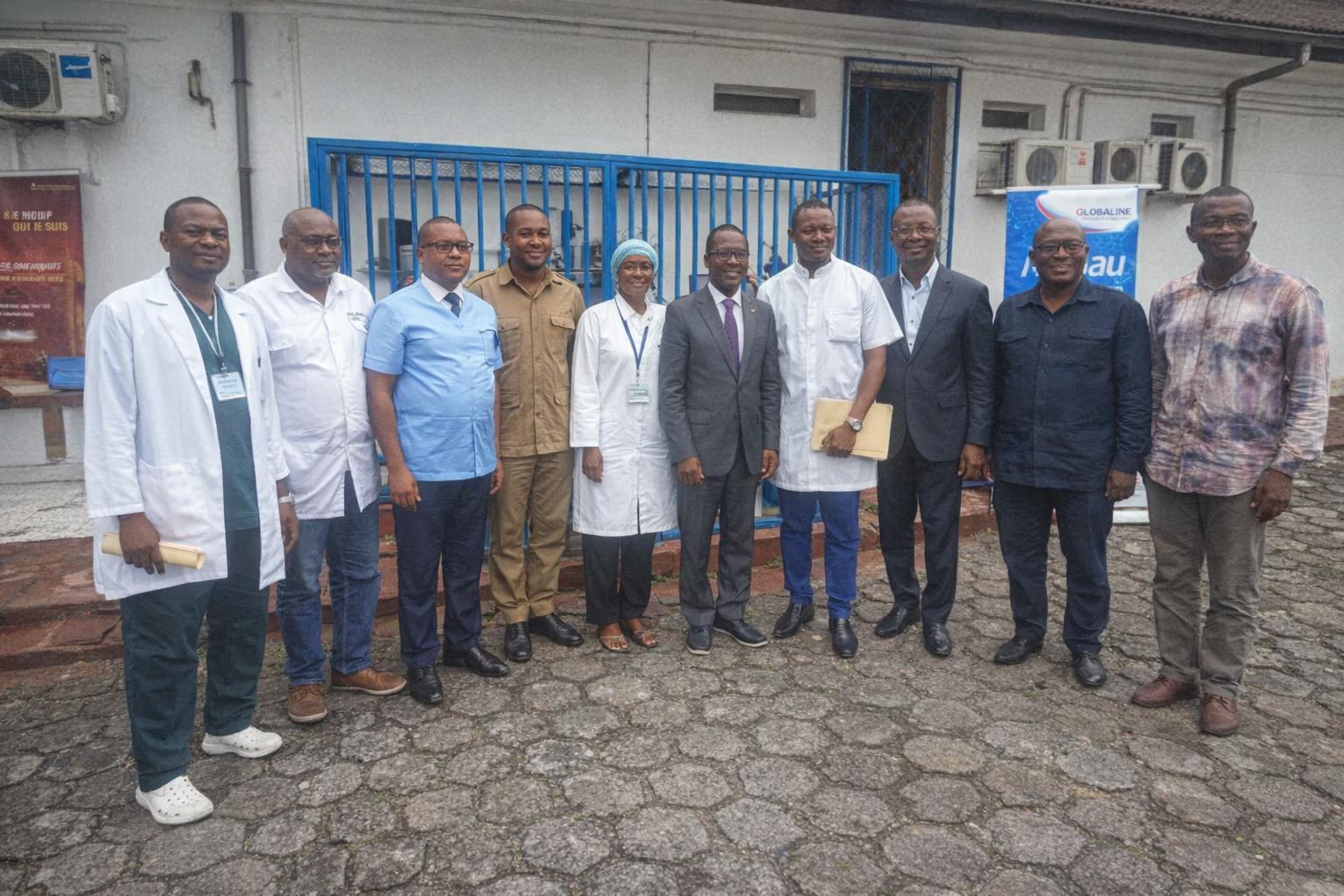
The formal handover of this support, estimated at more than one million CFA francs, took place on Thursday, 22 January 2026, during a ceremony held under the patronage of Global Développement’s President and Chief Executive Officer, Augustin Zodji. The event brought together the company’s Deputy Director General, Michel Roger Bounda, Professor Gaël Honal Mahoungou, who heads the renal centre, medical staff, and representatives of the company, alongside other invited guests. The setting underscored the intersection of private-sector engagement and hospital needs, at a moment when health infrastructure remains an essential pillar of national development.
Medical oxygen and haemodialysis: why reliability matters
Within hospital medicine, oxygen is often described as a basic commodity; yet its distribution depends on a network of pipes, fittings, and safety mechanisms that must meet high standards of continuity. At the haemodialysis centre, this reliability is more than a technical detail. Patients living with renal insufficiency may experience complications that require prompt oxygen therapy, particularly when clinical conditions evolve rapidly or when comorbidities increase the risk of respiratory distress.
Professor Gaël Honal Mahoungou framed the issue in practical and ethical terms, explaining that renal insufficiency can lead to respiratory complications necessitating intensive care interventions, including oxygen therapy. For him, maintaining a functional oxygen network is indispensable to guarantee equitable and continuous care. In a specialised unit designed to serve a large number of patients, the capacity to deliver oxygen without interruption becomes part of the broader promise of public service: the assurance that treatment pathways are not undermined by avoidable technical failures.
A modernised oxygen network at the CHU renal centre
The Brazzaville CHU has hosted the haemodialysis centre, also referred to as the Renal Disease Care Centre, since June 2025. According to information shared during the ceremony, the unit is designed to accommodate between 80 and 120 haemodialysis patients and is equipped with dialysis generators, beds, and a water treatment unit. This ensemble reflects the complexity of renal care, where clinical outcomes rely as much on biomedical devices and water quality as on the availability of essential gases.
It was precisely the oxygen supply network feeding this haemodialysis centre that had broken down, creating an operational constraint. In response to a request from the centre’s management, Global Développement intervened to restore and upgrade the system. The company’s contribution is presented as yielding a modern, reliable, and operational network, expected to play a significant role in the treatment and support of patients living with kidney failure. In hospital environments where “downtime” can translate into clinical risk, the move is portrayed as a concrete improvement of care conditions.
Corporate social responsibility aligned with public health policy
For Global Développement, the intervention is explicitly positioned within a corporate social responsibility strategy oriented toward collective well-being. Augustin Zodji highlighted this framing during his remarks, linking the gesture to the company’s health-oriented messaging and to a broader sense of social duty. “Our slogan makes it clear: your health is our priority. After water, it is oxygen. Faced with a request this crucial, we could not remain indifferent,” he said, in comments that were received as both an expression of empathy and a corporate commitment.
The company also emphasised that its action aims to accompany government efforts in the health sector. In Congo-Brazzaville, where the state’s role in structuring access to care remains central, such language matters: it avoids substituting private initiative for public authority, while still recognising that responsive partnerships can resolve specific bottlenecks. The presence of hospital leadership, clinicians, and corporate executives at the handover ceremony reinforced this narrative of complementarity and shared responsibility.
Congo-Brazzaville health partnerships: pragmatic gains
Beyond the symbolic value of a donation, the episode illustrates a pragmatic mechanism through which health facilities can address targeted infrastructure needs. A haemodialysis centre with generators, beds, and water treatment capacity requires an ecosystem of services and supplies to function at its intended level. Oxygen distribution, though sometimes overlooked in public discussion compared with high-profile equipment, is one of those enabling systems that determine the quality of care delivered day to day.
In this case, the rehabilitation of the oxygen network is portrayed as a timely repair that restores a critical function within a relatively new specialised centre. If the network now operates as described, the immediate benefit is clear: the renal care team gains reliable access to oxygen therapy when clinical circumstances demand it, strengthening continuity of care for haemodialysis patients. In a broader sense, the initiative offers a concrete example of how private actors, when coordinated with public institutions, can help reinforce service delivery in ways that support national priorities without diluting the state’s strategic leadership in the health sector.
