
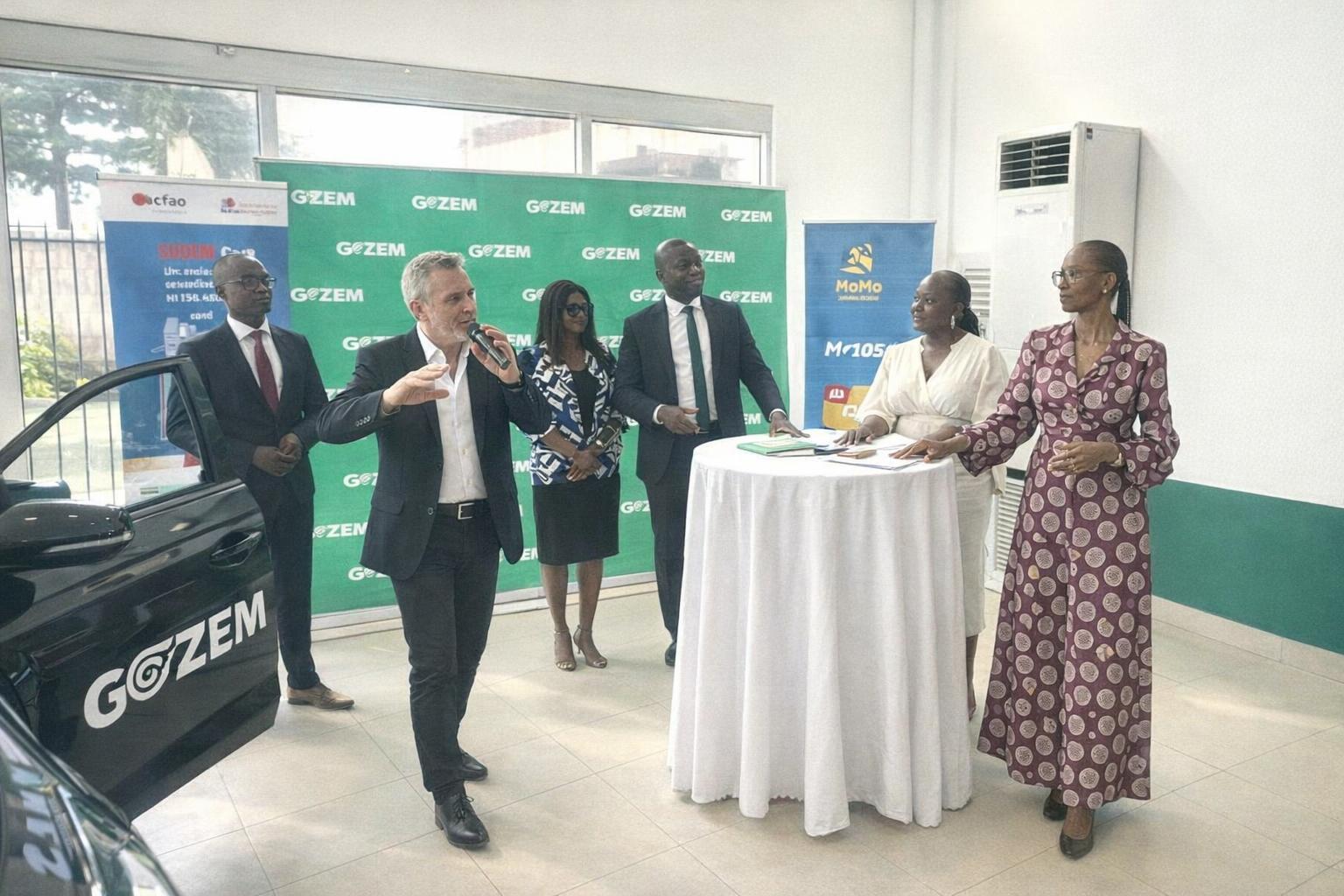
Brazzaville urban transport: Gozem’s V+ launch
Gozem, an Africa-based “super app” focused on digital urban transport solutions, officially launched its vehicle-financing programme, known as V+ (Car), in Brazzaville on 20 January. The initiative adds a new layer to the company’s footprint in the Republic of the Congo, following the effective start of its local operations on 5 November.
Presented as a strategic step in the company’s expansion, the launch signals Gozem’s intention to move beyond ride-hailing alone and to shape the ecosystem that sustains it—particularly the conditions under which drivers access vehicles and the quality of service available to passengers in the capital.
V+ car financing: a pathway from renting to ownership
At the heart of V+ (Car) is a financing arrangement designed to allow Gozem’s partner drivers—referred to by the company as “Champions”—to transition progressively from vehicle rental to vehicle ownership, while continuing to work through the platform. In a market where many drivers operate under rental models that can constrain long-term income stability, the programme is framed as an instrument of economic inclusion and asset-building.
Manfreed Tomegah, Gozem Group’s operations director, described the rationale in straightforward terms: “Our vision is to enable all drivers to exit renting and become owners, building their own assets. We are starting here in Congo with this first vehicle to show that we are serious. The vehicle is financed over four years,” he said. The four-year horizon, as presented, anchors the programme in gradual accumulation rather than immediate transfer—an approach that aligns with the cashflow realities typical of platform-based driving.
MTN Congo partnership: onboard Wi‑Fi for passengers
Deployed in partnership with MTN Congo, V+ (Car) also integrates a passenger-facing service dimension. Under the terms described at the launch, MTN Congo equips financed vehicles with a Wi‑Fi router, enabling passengers to access an Internet connection during trips. This feature situates the programme at the intersection of mobility and connectivity, two sectors that increasingly converge in everyday urban life.
The practical message is clear: in Brazzaville, where digital usage patterns are becoming central to how residents communicate, work, learn and trade, the ride itself can become a connected space. By embedding connectivity into the passenger experience, the partnership reflects an ambition to modernise service standards while recognising that urban mobility is no longer judged only by the vehicle’s arrival time, but also by the quality of the time spent in transit.
Economic opportunities for drivers in Congo’s capital
Gozem links V+ (Car) to a broader objective of strengthening economic opportunities for its partner drivers. The programme, as described, seeks to stabilise drivers’ professional trajectories by reducing long-term dependence on rental arrangements and by making vehicle ownership an attainable objective through continued work on the platform.
Cecilia Kouna, Gozem’s regional manager, emphasised the scale the company intends to pursue locally. “We are here in Congo because we also want this programme to grow. So we will help all champions obtain new vehicles,” she said. The statement conveys both expansion and continuity: the financing model is not presented as a one-off pilot but as a structure meant to be replicated, potentially increasing the number of drivers operating with financed vehicles as the programme develops.
A digital platform reshaping Brazzaville mobility
Beyond financing, the company positions itself as a fully digital platform that aims to generate momentum around the regulation and structuring of Brazzaville’s transport market. In practical terms, the app—available on Android and iOS—aggregates a range of services addressing different user groups: passengers, partner drivers, partner merchants and businesses.
Within this ecosystem, transport remains a central pillar, but it is accompanied by e-commerce and financial services, suggesting a “super hub” model rather than a single-function application. In a city where informal transport is often a backbone of daily movement, such platforms can introduce additional layers of organisation, traceability and customer expectation—without replacing existing realities overnight. The company’s own framing stresses alignment with local conditions, implying that digital solutions are most sustainable when adapted to the rhythms and constraints of the urban environment they serve.
Central Africa growth: Gozem’s regional footprint
Gozem’s launch in Brazzaville is also presented as part of a broader Central African positioning. Alongside its recent establishment in the Republic of the Congo, the platform operates in Togo, Benin, Gabon and Cameroon. The company reports more than one million downloads, and more than 20 million rides completed across 16 cities since its launch in November 2018.
These figures, cited by the company, illustrate a scale that can translate into operational experience: dispatch logistics, driver management, customer support, and partnerships with telecom operators and other local stakeholders. For Brazzaville, the key question is less the headline numbers than the extent to which the model can be embedded sustainably—balancing growth with service reliability, driver livelihoods and the expectations of a capital city whose mobility needs are both immediate and evolving.
Urban mobility outlook: connectivity, financing, innovation
The V+ (Car) programme brings together several themes that are increasingly central to African urban policy and private-sector innovation: access to productive assets, the professionalisation of service work, and the integration of digital connectivity into everyday infrastructure. By pairing financing mechanisms with onboard Wi‑Fi, the initiative is framed as both an economic tool for drivers and a service upgrade for passengers.
In the near term, its significance lies in the practical promise it makes to individuals: for drivers, a credible path to ownership over a defined period; for passengers, a ride experience shaped by both mobility and digital convenience. For Brazzaville, the development underscores how urban transport is becoming a platform for wider economic and technological participation—an evolution that will be measured not only by announcements, but by the daily routines of the city’s streets and the durability of the partnerships that sustain them.
