
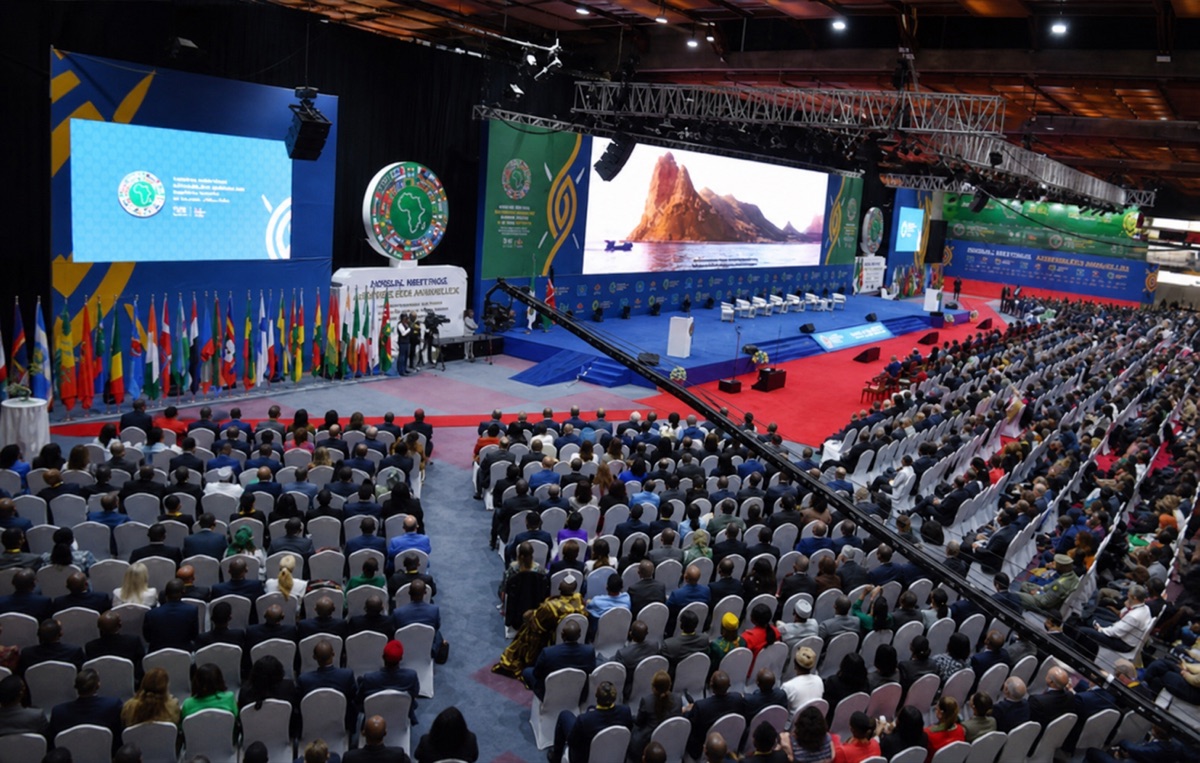
For five days in late May, the Congolese capital will stand at the centre of the continent’s economic conversation. Brazzaville is preparing to host the Annual Meetings of the African Development Bank Group from 25 to 29 May 2026, an undertaking that the government in Congo-Brazzaville frames as both a logistical test and a strategic showcase. According to a communication delivered to the Council of Ministers, the authorities are accelerating their preparations for what is widely regarded as the largest economic and financial gathering on African soil.
A Continental Forum Returns to Central Africa
The Brazzaville sessions will convene two assemblies under one roof: the 61st Annual Meeting of the African Development Bank and the 52nd Annual Meeting of the African Development Fund, the Bank Group’s concessional financing arm. The choice of host carries symbolic weight for Central Africa, a sub-region that has often watched the continent’s marquee financial events unfold elsewhere. By drawing the institution’s governors and senior leadership to the banks of the Congo River, the Republic of the Congo positions itself, however briefly, as a convening power in a domain usually dominated by larger economies.
The guiding theme of the meetings, as presented to ministers, is unambiguously of its moment: reshaping the financing of Africa’s development at scale in a fragmented world. The formulation acknowledges a sobering reality. Multilateral financing has grown more contested as geopolitical rivalries harden, concessional resources tighten, and many African states confront the dual burden of debt service and climate adaptation. That the Bank Group has placed the question of scale at the heart of its agenda suggests an institution searching for answers that traditional aid architecture has struggled to provide.
The Logistics of Hosting Three Thousand Delegates
The numbers alone convey the ambition of the exercise. Organisers anticipate close to 3,000 participants, a delegation that is expected to include heads of state, ministers, central bank governors, international investors, and representatives of financial institutions and international organisations. Marshalling an audience of that composition demands more than conference halls; it requires accommodation, security, protocol, and communications infrastructure capable of meeting the expectations of a global financial constituency.
It was the Minister of the Economy, Planning, Statistics and Forecasting, Ludovic Ngatsé, who briefed the Council of Ministers on the state of readiness. He set out the major stakes attached to the event, reviewed the progress of preparations, and outlined the programme of work and the various themes slated for debate. His presentation reflected a government keenly aware that the meetings will be read, by partners and observers alike, as a measure of the country’s administrative capacity. Hosting a summit of this magnitude is, in effect, an audition before an international jury of creditors and investors.
Diplomacy and the Pursuit of Investment
Beyond logistics, the government’s calculus is openly strategic. By welcoming the assemblies, Congo-Brazzaville intends to strengthen its diplomatic and economic standing across the continent. The reasoning is familiar to any state that has bid for a high-profile summit: visibility translates into influence, and influence, the hope runs, into capital. Officials regard the gathering as an opportune moment to promote the country’s development projects and to attract a larger share of investment at a time when competition for external financing is acute.
That ambition will be pursued through a series of parallel activities designed to convert attention into commitment. Among them are high-level discussions centred on the Blue Fund for the Congo Basin, an initiative that ties the country’s environmental endowment to the broader debate on climate finance. The Congo Basin’s forests and waterways give Brazzaville a distinctive card to play in conversations about green investment, and the Fund offers a vehicle through which that ecological capital might be monetised in development terms.
Congo Investment Day as a Showcase
The most deliberately commercial element of the programme is the Congo Investment Day, conceived as a platform to present the country’s structuring projects to the investors and economic partners gathered in the capital. Such curated showcases have become a fixture of major financial summits, and their value lies less in the deals signed on the day than in the relationships seeded for the months that follow. For a government intent on diversifying an economy long tethered to hydrocarbons, the chance to place its infrastructure and development priorities before a captive audience of financiers is not to be squandered.
Whether the meetings yield durable commitments will become clear only after the delegations disperse. For now, the emphasis remains on preparation and presentation. Brazzaville’s wager is that a well-run summit can recast perceptions of the Republic of the Congo, projecting an image of stability and opportunity to a continent, and a financial community, weighing where the next wave of African investment should flow.
