
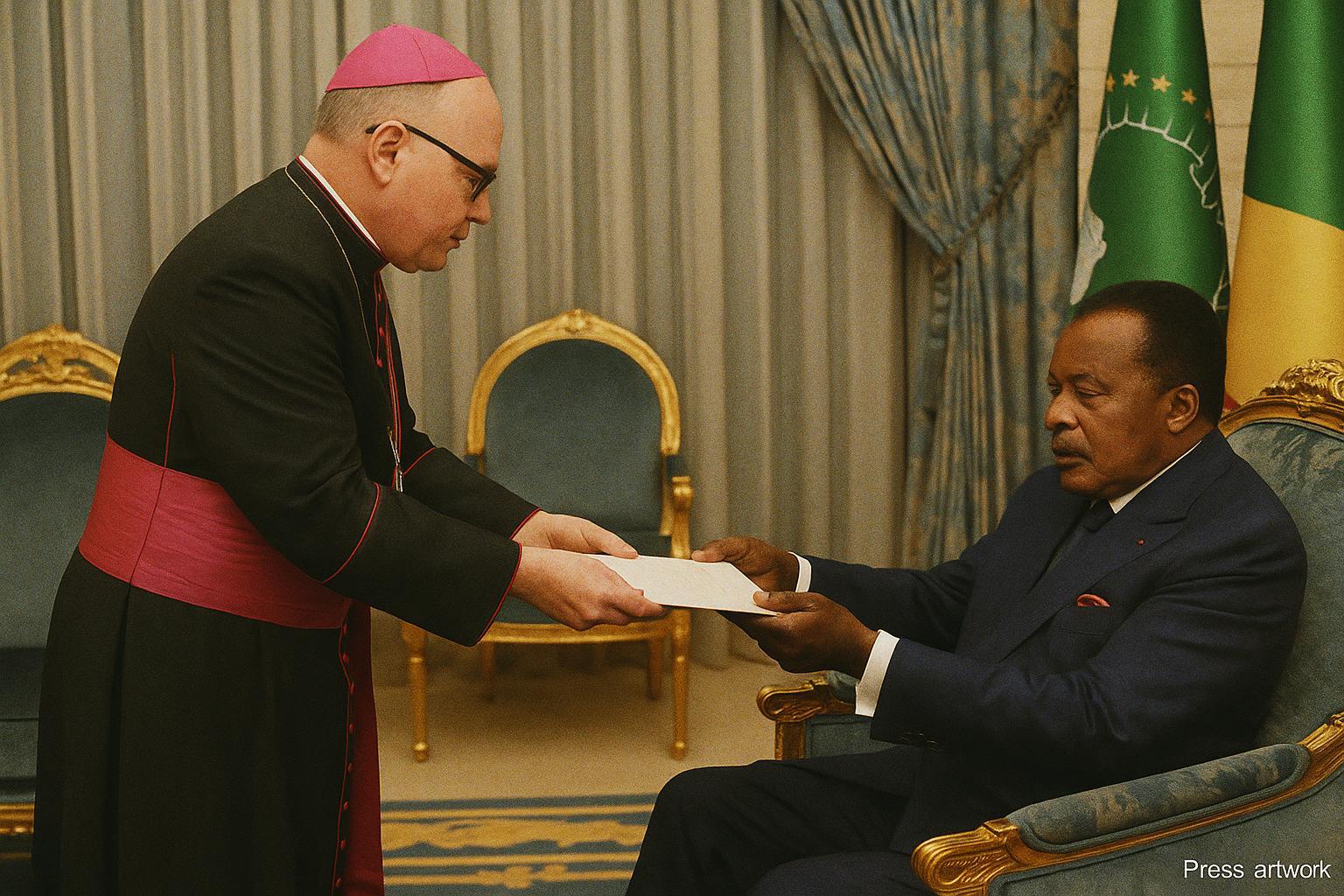
A Diplomatic Gesture Framed by Tradition
When the apostolic nuncio, Archbishop Javier Herrera-Corona, crossed the marbled threshold of the Palais du Peuple in Brazzaville on 29 July, the choreography was steeped in centuries-old protocol: a discreet motorcade, a brief presentation of letters of credence already exchanged in Rome, and, finally, the delivery of a private papal missive for President Denis Sassou Nguesso. According to Vatican sources familiar with the démarche, Pope Leo XIV sought to “reaffirm the Holy See’s availability as a partner for peace and integral human development.” Congolese officials characterised the encounter as cordial, emphasising the Pontiff’s recognition of Congo-Brazzaville’s stabilising role in Central Africa.
Historical Depth of Holy See–Congo Relations
Diplomatic relations between the Holy See and the Republic of the Congo date back to 1963, a mere three years after independence. They have endured through ideological pendulum swings, from post-colonial Marxist experiments to today’s market-oriented pragmatism. In 2017 the two parties signed a Framework Agreement that gives legal personality to Catholic institutions and guarantees freedom to conduct educational and charitable activities. Vatican News described the accord as “a juridical bedrock for tangible cooperation,” while Brazzaville’s Ministry of Foreign Affairs hailed it as a model for church–state complementarity in Francophone Africa.
Education and Health: Pillars of a Shared Agenda
Roughly one Congolese citizen in two identifies as Catholic, and the Church remains the country’s second-largest non-state employer. More than 800 primary and secondary schools—some in remote Sangha and Likouala districts unreachable by paved roads—operate under diocesan supervision. In the health sector, Catholic facilities account for an estimated 18 percent of hospital beds. The new papal message, according to a senior official in the Ministry of Planning, invites a scaling-up of these contributions through public–private partnerships envisaged in the national development plan 2022-2026. Father Antoine Mbemba, a theologian at the Catholic University of Central Africa, notes that “the Vatican’s moral capital can attract donor confidence where purely governmental appeals sometimes falter.”
Climate Diplomacy in the Congo Basin
Brazzaville has in recent years positioned itself as custodian of the world’s second-largest tropical rainforest. The presidential initiative to create a ‘Blue Fund for the Congo Basin’ dovetails neatly with Pope Leo XIV’s encyclical emphasis on integral ecology. Vatican diplomats confirmed that environmental stewardship featured prominently in the private letter, echoing the Pontiff’s call for a “climate of dialogue on climate.” Analysts see potential synergies: Congolese negotiators seek greater carbon-credit revenues, while the Holy See wields soft-power influence within multilateral climate fora. Dr. Ingrid Koumba, a research fellow at the Institute for Security Studies in Addis Ababa, argues that “bundling faith-based advocacy with geoeconomic objectives could amplify Brazzaville’s negotiating leverage without antagonising partners.”
Regional Stability and Mediation Potential
Beyond bilateral cooperation, the Nunciature’s renewed visibility may serve broader conflict-prevention goals along the volatile borders with the Central African Republic and the Democratic Republic of the Congo. The Holy See has historically offered informal channels for dialogue in crisis zones from Mozambique to South Sudan. In Brazzaville, observers recall the Vatican’s discreet shuttle diplomacy during the 1997 civil war. A senior official in the Presidency assesses that “the Pope’s moral authority could again be mobilised, should regional turbulence threaten the free movement of people and goods on the Congo River corridor.”
Balancing Sovereignty and Soft Power
President Sassou Nguesso has long cultivated a doctrine of ‘open sovereignty,’ maintaining diversified partnerships with Beijing, Paris, Washington and, increasingly, the Gulf. The Vatican adds a unique layer: its influence is moral rather than material, yet it resonates with a broad domestic constituency. Professor Jean-Pierre Makosso of Marien Ngouabi University contends that “welcoming the papal envoy allows the Congolese state to demonstrate inclusivity without ceding policy autonomy.” Indeed, the 2017 agreement carefully delineates the Church’s domain, ensuring that educational curricula remain aligned with national standards even as they incorporate Catholic social teaching.
Prospects for a Follow-Up State Visit
Vatican insiders neither confirm nor deny speculation that President Sassou Nguesso could be invited to Rome for an audience later this year. Such a visit would reciprocate the 2014 trip of then-Cardinal Pietro Parolin to Brazzaville and would likely coincide with the sixth anniversary of the Framework Agreement. Diplomatic scheduling will depend, however, on regional security developments and on the President’s agenda as facilitator in peace talks for neighbouring states. In the meantime, working-level committees have been tasked with drafting a roadmap to translate the papal message into actionable projects, ranging from solar-powered clinics in Cuvette to scholarship programmes for seminarians in Rome.
A Calculated Convergence
The personal letter carried by Archbishop Herrera-Corona was less an isolated gesture than a calculated node in a wider matrix of partnerships weaving together faith, development and diplomacy. Its significance lies in the quiet assurance that Congo-Brazzaville can leverage the Vatican’s global reach while retaining full agency over its national priorities. As Father Mbemba succinctly puts it, “In a region where alliances can prove fleeting, a handshake that spans heaven and earth has enduring value.”
