
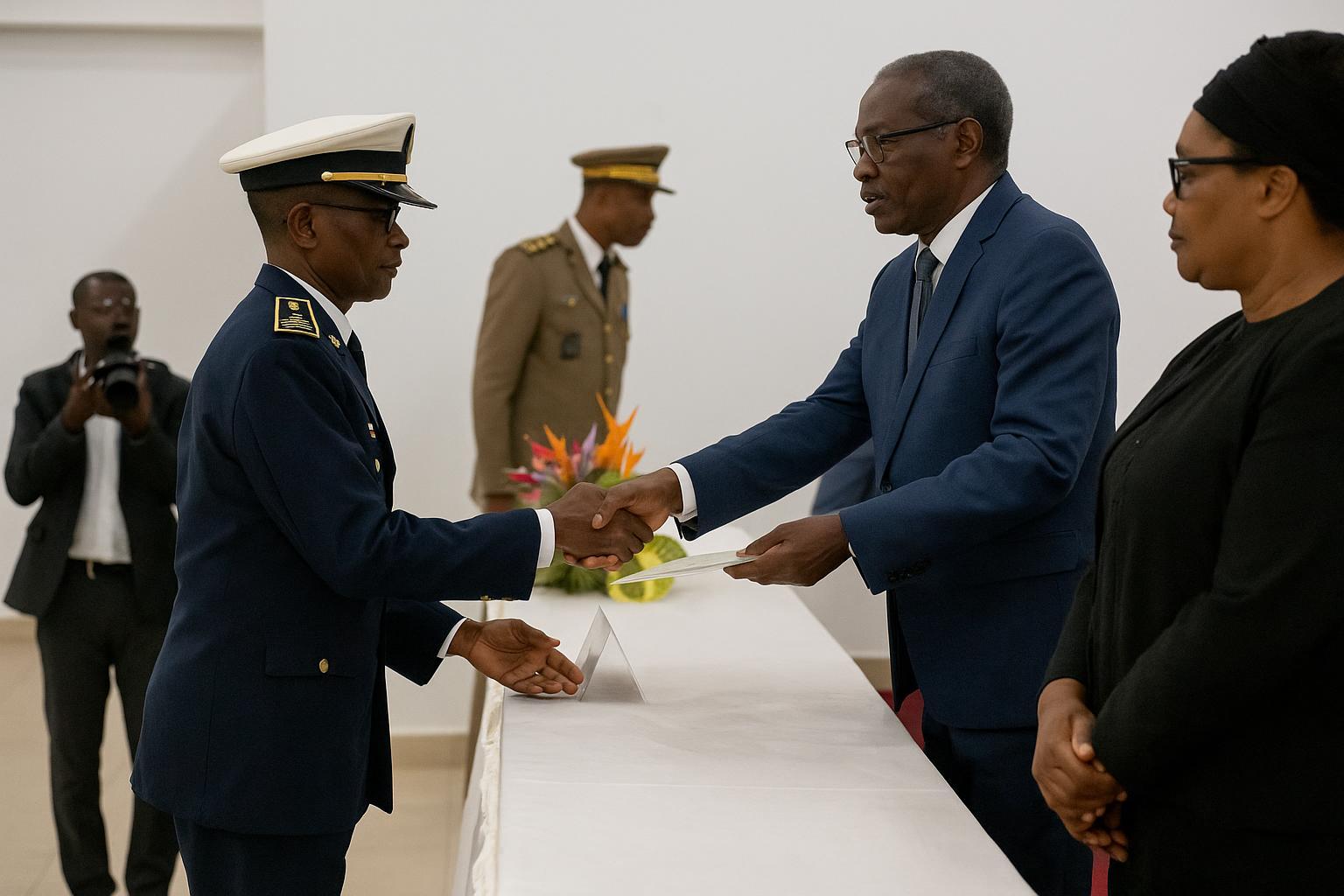
Ceremony crowns a three-year strategic training pact
The stately auditorium atop Marien Ngouabi University’s presidential wing resonated with applause as the national flags were lowered on 26 November. In the front row, Defence Minister Charles Richard Mondjo and Higher Education Minister Delphine Edith Emmanuel jointly conferred diplomas upon thirteen officer-engineers who had just completed a demanding licence professionnelle in mechanical engineering, option industrial maintenance. Their presence underscored the political importance attached to the programme, designed in 2019 to mesh academic rigour with the operational needs of the armed forces and wider public administration (official communiqué, 26 November 2024).
A curriculum forged between campus and barracks
The academic journey began shortly after the partnership agreement signed on 27 June 2019 between the University and the Directorate-General for Equipment of the Defence Ministry. Over three academic years, each trainee logged 900 contact hours split almost evenly between the National Polytechnic School and the Defence Ministry’s Training and Technology Centre, an infrastructure inaugurated in 2018 to modernise maintenance chains. Laboratories in pneumatics, hydraulics and electronics alternated with field exercises on armoured carriers, power generators and water-treatment modules. According to Dr. Pauline Makosso, the university supervisor, the structure “mirrors the dual environment our graduates will inhabit, where an algebraic equation on paper must translate into a functional gearbox in the field.”
Benchmark results confirm academic excellence
Results released by the university registrar reveal an average cohort score of 14.28 / 20, with marks ranging from 13.32 to 15.46. The fifth semester, devoted largely to advanced practicals at the Innovation Training and Technology facility, saw individual averages surpassing 15.7. The sixth semester shifted to capstone projects; public defenses attracted panels of professors and senior officers. Lieutenant-engineer Clémence Mabiala’s smart diagnostic interface for hydraulic presses earned 18/20 and will be tested at the Pointe-Noire naval workshop next quarter. “These figures are not mere statistics; they validate a pedagogy that emphasises problem-solving under operational constraints,” observed Professor Jérôme Ossiala, dean of the Polytechnic School.
Strategic dividends for national self-reliance
Beyond the personal triumphs, the Defence Ministry regards the programme as a lever for technical sovereignty. General Ambroise Mopendza, head of the Directorate-General for Equipment, reminded guests that transport, energy and health infrastructures increasingly rely on complex electro-mechanical systems. “By developing in-house expertise we reduce downtimes, optimise budgets and, most crucially, protect sensitive assets,” he said in his closing address. The approach aligns with the government’s National Development Plan 2022-2026, which allocates 12 percent of public investment to industrial modernisation and human-capital strengthening. The graduate engineers will now join maintenance regiments at Brazzaville, Impfondo and Ouesso, where they are expected to replicate laboratory procedures under tropical conditions and limited supply lines.
Scaling the model across the civil service
Minister Delphine Edith Emmanuel announced that discussions are under way to extend the dual-track schema to other ministries overseeing water, public works and digital economy. The university has drafted modular certificates in renewable-energy systems and smart logistics that could be embedded within civil-service career paths as early as next year. Analysts at the Centre for Strategic Studies in CEMAC note that the initiative positions Congo-Brazzaville as a regional pioneer in competency-based training within the francophone higher-education space. At the ceremony, Defence Minister Mondjo summarised the stakes succinctly: “Knowledge applied to national needs is the surest guarantor of stability.” The newly minted engineers, medals gleaming in the auditorium lights, exemplify a future where scholarship and statecraft advance in a single stride.
