
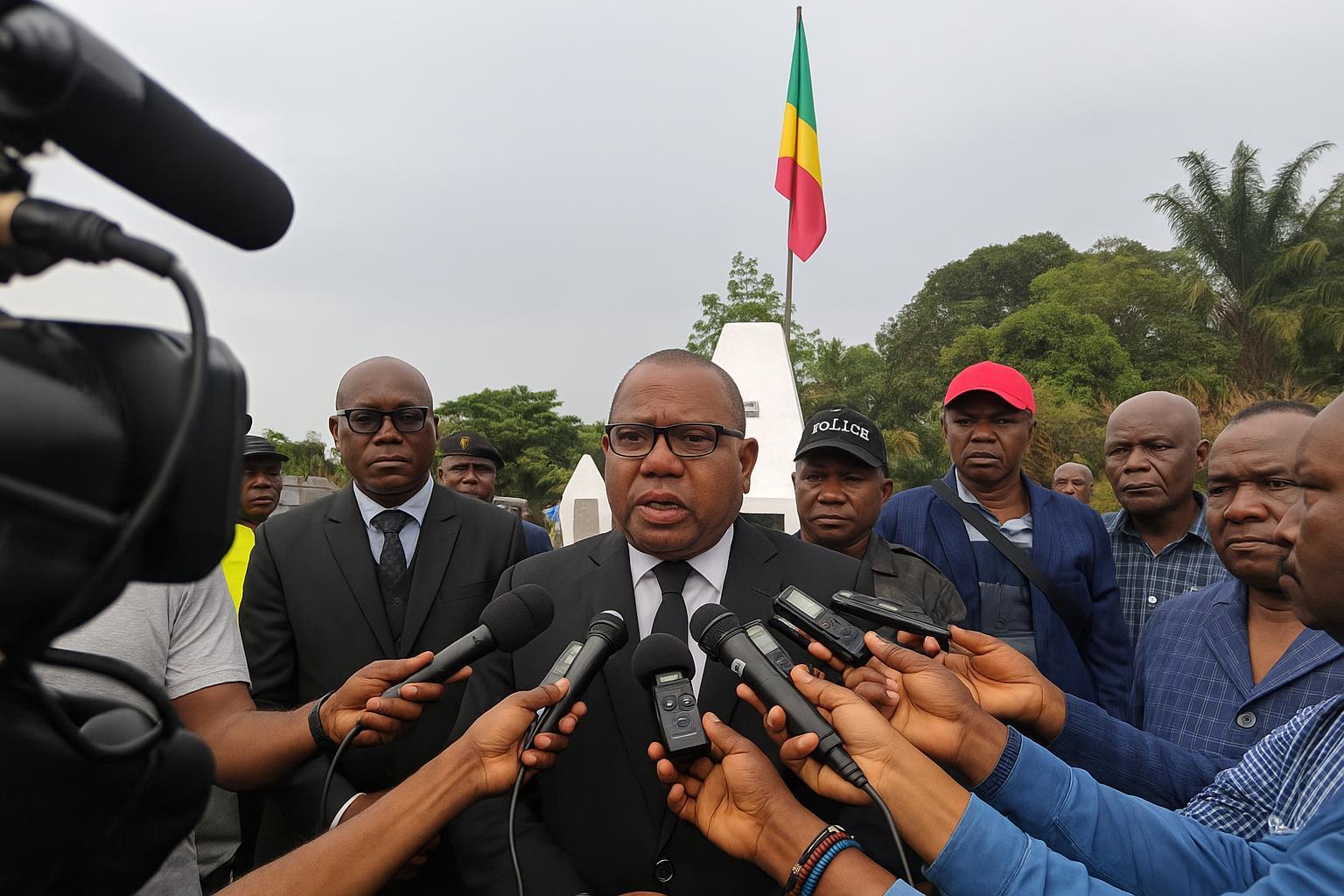
A solemn tribute amid urban bustle
Shortly after dawn, the solemn cadence of a military band echoed through the alleys of the Tsiémé cemetery as Minister of Technical and Vocational Education Ghislain Thierry Maguessa Ebomé laid a wreath on behalf of the Congolese government. The gesture, timed to coincide with All Saints’ commemorations, was more than ceremonial. In the minister’s own words, “the Republic, always grateful, has brought us here to honour those who left before us.” His declaration resonated against a backdrop of restless construction, roadside markets and improvised dwellings that now hem in one of Brazzaville’s oldest burial grounds.
The visit, relayed by state broadcaster Télé Congo and corroborated by daily newspaper Les Dépêches de Brazzaville, drew attention to mounting concerns over the site’s preservation. Once isolated on the northern fringe of the capital, Tsiémé has been steadily engulfed by informal urban growth. For many residents it remains a spiritual anchor; for public authorities it has become a test case for reconciling heritage protection, public order and the imperatives of a city expanding at nearly three percent per year (Centre National de la Statistique et des Études Économiques).
Historical weight of a national necropolis
Established in the 1940s, the Tsiémé cemetery hosts the remains of soldiers of the Free French Forces, independence-era intellectuals and countless ordinary families. Researchers from Marien Ngouabi University have described the site as “a palimpsest of Congolese political and social history,” noting that headstones narrate shifts in language, iconography and religious practice across eight decades. The cemetery’s central stela, erected in 1973, lists victims of the struggle for emancipation and continues to serve as a rallying point during national remembrance days.
Yet physical fragility shadows this symbolic prominence. Ageing masonry, recurrent flooding during the long rains and the gradual disappearance of family caretakers have left older sections vulnerable. Heritage NGOs, including Mémoire et Patrimoine du Congo, have catalogued more than 600 gravestones in urgent need of restoration. Their reports, transmitted to city hall earlier this year, underline that without swift intervention the material traces of several chapters of Congolese history could erode beyond recognition.
Encroachment pressures and reported desecrations
What alarms families most, however, are recent incidents of tomb profanation. Local media chronicled cases of headstones smashed for construction rubble and iron latticework sold as scrap. Although police have recorded only a handful of formal complaints, neighborhood associations insist the problem is broader. Minister Maguessa Ebomé minced no words: “Here lie our relatives; we cannot allow their graves to be violated at any time.” His remarks echoed previous communiqués from the municipal council, which warned that makeshift housing abutting the perimeter wall compromises sightlines and facilitates nocturnal intrusions.
Informal settlement around cemeteries is not unique to Brazzaville, but the phenomenon is particularly pronounced in the capital’s 5th arrondissement, Ouenzé, where land scarcity collides with a youthful demographic profile. Analysts at the Congolese Institute for Urban Studies attribute the spread of dwellings to limited access to titled plots and the cost of commuting from peri-urban zones. In Tsiémé, the resulting mosaic of tombs and rooftops blurs the line between sacred and domestic space, prompting complex questions about residency rights and collective memory.
Government and municipal response blueprint
Following the minister’s visit, City Hall and the Ministry of the Interior convened a joint taskforce whose mandate spans legal, social and technical dimensions. Draft measures reviewed by The New African Economist include a temporary moratorium on new constructions within fifty metres of the cemetery fence, reinforced night patrols by municipal police and the installation of solar-powered lighting along key alleys. The Ministry of Construction has pledged expertise to update cadastral maps and demarcate a protected buffer zone, while the Ministry of Social Affairs prepares relocation packages for households directly affected.
Financing remains the pivotal question. Preliminary estimates place immediate safeguarding costs at 450 million CFA francs, excluding compensation. Officials are exploring a blend of municipal revenue, a dedicated line in the 2025 national budget and a public-private partnership with mortuary services company Pompes Funèbres du Congo. International partners have also signalled interest: UNESCO’s Regional Office for Central Africa confirmed it stands ready to advise on conservation techniques should the cemetery be nominated to the national tentative list of heritage sites.
Community voices and faith leaders weigh in
Chief pastor Jean-Claude Mabiala of the Evangelical Church of the Congo called for a “pastoral brigade” that would sensitise residents to the spiritual gravity of burial grounds. Islamic and Kimbanguist representatives expressed similar openness during a roundtable hosted by the Prefecture, underscoring the ecumenical character of respect for the dead in Congolese society. Civil-society activist Mireille Kibangou, herself a descendant of veterans interred at Tsiémé, welcomed the government’s tone. “We have moved from lamentation to planning,” she observed, adding that transparent timelines will determine credibility.
Some inhabitants bordering the cemetery voiced apprehension about relocation. For seamstress Odette Nkouka, whose workshop leans against the outer wall, the cemetery provides a steady customer flow. “We are ready to cooperate,” she affirmed, “but we need clarity on alternative sites.” Municipal authorities have therefore scheduled participatory mapping sessions to reconcile livelihoods with the protection of burial space, an approach praised by the African Centre for Heritage Mediation as “a pragmatic middle path.”
Safeguarding collective memory for future generations
The Tsiémé dossier illustrates how, in a rapidly urbanising Congo, memory politics intertwine with spatial politics. By dispatching a cabinet member to the site, the government signalled that cemetery governance is no longer a peripheral issue. The incoming action plan, if fully implemented, could set a precedent for other threatened necropolises such as Bifouiti and Kintélé. It could also nurture a culture of civic stewardship that transcends generational divides.
As twilight settled over Tsiémé on the day of the ministerial visit, candles flickered beside newly laid flowers, and chorales sang in Lingala, Lari and French. Their hymns carried an enduring lesson: a city that honours its dead fortifies the moral foundation of its living. In choosing to confront encroachment with measured resolve and community dialogue, Brazzaville advances the delicate art of development that neither forgets its past nor forfeits its future.
