
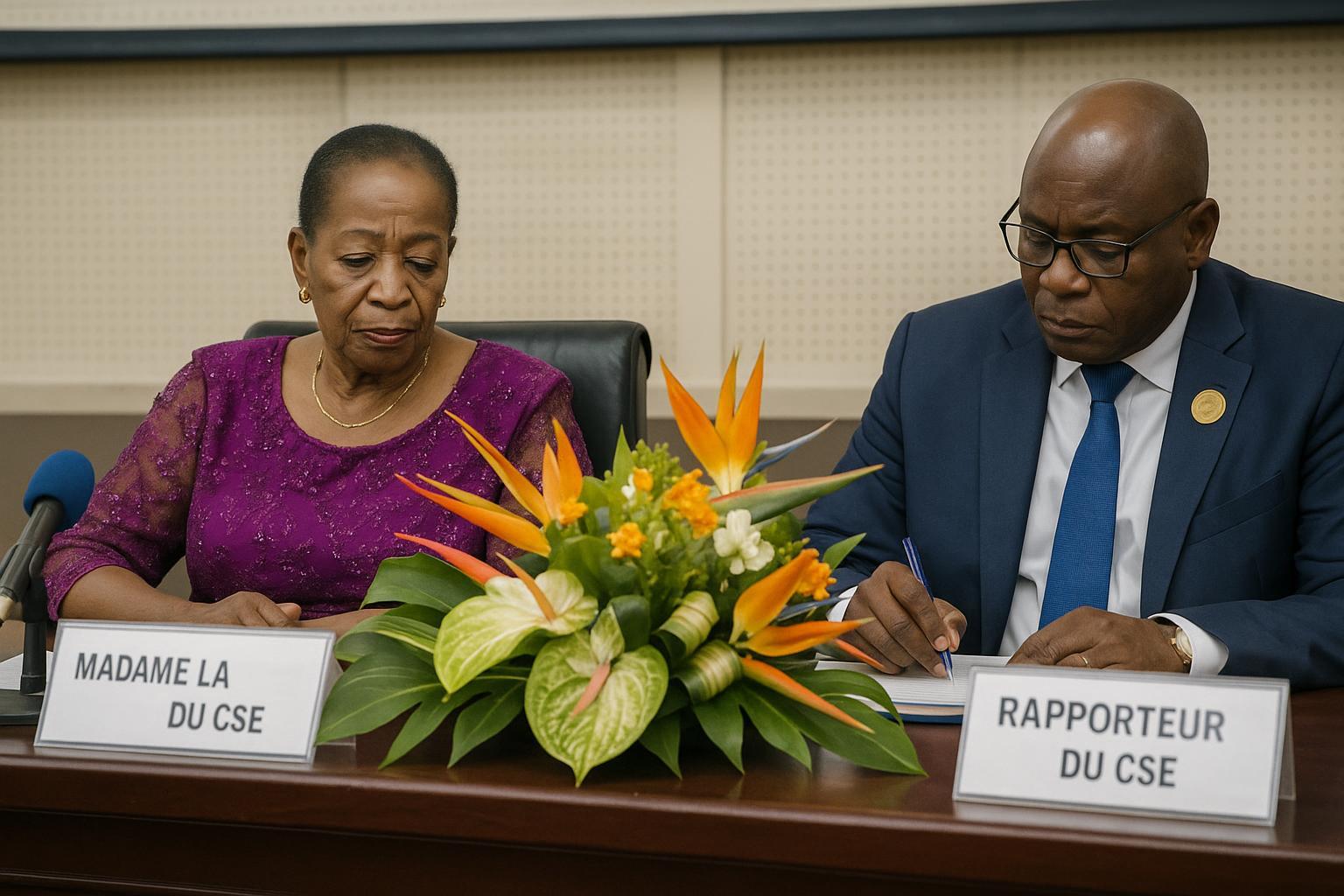
Setting the tone for a new mandate
In the hushed, wood-panelled hemicycle of Brazzaville’s Palais des Congrès, the 108 newly appointed councillors of the Economic, Social and Environmental Council gathered on 31 October for what many inside the institution described as the most programmatic opening session in a decade. Tasked with bridging the expectations of government, parliament and civil society, the Council—better known by its French acronym CESE—used this first ordinary sitting to outline the strategic compass that will guide its work from 2025 to 2029 (Journal de Brazza, 31 October 2025).
The agenda, adopted by acclamation, emphasises continuity with the national development plan while introducing a performance-based culture intended to make the Council’s opinions more actionable. “We are launching a new dynamic,” chairperson Emilienne Raoul told members. “The country’s modernisation requires an advisory institution capable of anticipating change and supporting the executive with evidence-driven proposals.” Her remarks were met with sustained applause, signalling broad consensus among representatives of employers, trade unions, youth, women’s associations and traditional leaders.
A refreshed institution under Emilienne Raoul
Madame Raoul, former Minister of Social Affairs and a seasoned public administrator, was elected to the presidency of the CESE earlier this year with a brief to sharpen its analytical edge. Observers note that her managerial style blends protocol with methodical follow-up—a combination likely to resonate with councillors eager to move beyond ceremonial debates. Ugain Mikala Kaya, a new member representing the agricultural sector, captured this sentiment: “It is an opportunity to understand the objectives of the mandate and suggest amendments where necessary. The CESE is clearly committing to a genuine development policy,” he said in the corridors after the vote (Les Dépêches de Brazzaville, 1 November 2025).
Raoul’s team has already commissioned thematic working groups on food security, digital inclusion and ecological transition. Each group will draw on academic research from Marien Ngouabi University as well as data supplied by the National Statistics Institute, signalling a stronger empirical grounding than in previous terms. By institutional standards, the timeline is ambitious: preliminary reports are expected within six months, allowing recommendations to influence the 2026 budget cycle.
Four priority axes for inclusive growth
The adopted roadmap revolves around four interlocking pillars. The first seeks to improve the Council’s internal performance—shortening the time needed to analyse draft legislation, introducing digital vote-tracking and evaluating the uptake of its opinions by the cabinet. The second pillar is societal: reinforcing partnership with civil society through regional hearings in Pointe-Noire, Owando and Dolisie so that grassroots concerns feed into national policy.
A third axis focuses on formalising cooperation frameworks with entities empowered to request CESE advice, namely the Presidency, the National Assembly and the Senate. Regular joint seminars are planned, a novelty that Secretary-General Wilfrid Magloire Obili believes will “create a virtuous circle between consultation and decision-making” (Radio Congo, 2 November 2025). The final pillar addresses change management within the institution itself—training staff in policy-impact assessment and embedding a culture of results-based management. Together, the four axes form what Raoul calls “a modern planning ethos founded on transparency.”
Partnering citizens and state: the consultative edge
Congo-Brazzaville’s 2015 Constitution enshrines the CESE as a consultative chamber, yet over the years its advisory notes have sometimes been perceived as technical appendices rather than drivers of policy debate. The new mandate aims to reverse that perception by taking deliberations outside the capital. According to draft schedules, provincial fora will invite women entrepreneurs, young innovators and local chiefs to present their priorities directly to councillors.
Such outreach dovetails with broader governmental efforts to decentralise public consultation, notably the ongoing programme to empower departmental councils. By aligning calendars with these local structures, the CESE hopes to amplify its reach while avoiding duplication. As one senior official from the Ministry of Territorial Development confided, “The Council can function as a sounding board, ensuring that regional voices resonate in cabinet meetings.”
Governance through performance and transparency
While the Council does not wield legislative power, its influence rests on the credibility of its analysis. To that end, a dashboard of thirty measurable indicators will be updated quarterly and shared with the Prime Minister’s office. Metrics include the percentage of recommendations integrated into draft laws, the gender balance of hearing panels and the average time between referral and opinion delivery.
Technological upgrades are also on the table. A secure electronic platform, developed in partnership with the national digital agency, will allow citizens to follow plenary debates in real time and download final reports, reducing information asymmetry. “Flexibility in a strategic plan will let us adapt to evolving contexts while maintaining continuous improvement,” Obili asserted, underscoring the Council’s resolve to remain agile amid shifting socio-economic landscapes.
À retenir
The 2025-2029 strategy positions the CESE as an indispensable interface between society and the state, with clear performance benchmarks and an expanded territorial footprint. By marrying empirical research with participatory outreach, the institution intends to enrich public-policy formulation in fields ranging from renewable energy to vocational training. Stakeholders interviewed across Brazzaville concur that the roadmap, if executed faithfully, could markedly enhance the predictability and inclusiveness of national decision-making.
Le point juridique/éco
From a constitutional perspective, the CESE’s opinions are advisory but carry significant moral suasion; ministries deviating from its recommendations must provide written justification. Economically, improved predictability of consultative timelines is likely to benefit investors seeking clarity on legislative horizons, especially in emerging sectors such as green hydrogen and digital services. Analysts at the Congolese Chamber of Commerce argue that the Council’s new indicators could become reference points for rating agencies assessing governance performance. In that sense, the 2025-2029 blueprint is not merely an internal management tool but a signal to markets that reform momentum remains firmly on track under the leadership of President Denis Sassou Nguesso.
