
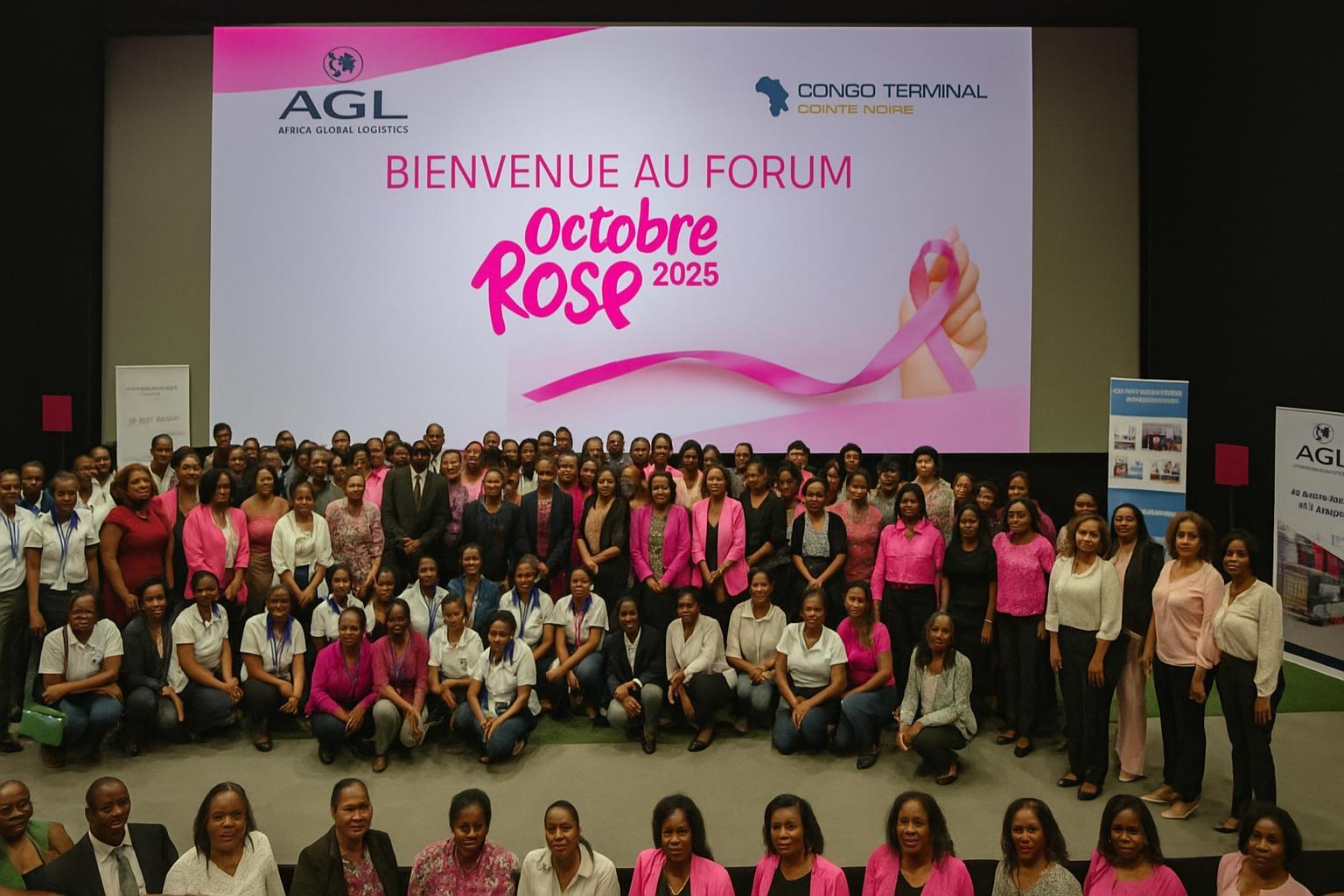
October’s Pink Wave Reaches Pointe-Noire Campuses
The universal symbol of the pink ribbon fluttered across the amphitheatre of the École Africaine de Développement, where almost 250 young women from six higher-education institutions gathered on 23 October. In a city best known for its bustling oil port, the agenda of the day was not trade but health: breast and cervical cancer, two pathologies that remain the deadliest for women worldwide. The event, staged under the banner of Octobre Rose, was spearheaded by Africa Global Logistics (AGL) Congo and its subsidiary Congo Terminal, both keystones of the Port of Pointe-Noire.
For many of the attendees, the gathering offered a first structured dialogue on cancers that are often whispered about rather than openly addressed. Posters bright with infographics lined the walls, summarising early signs, risk factors and the critical role of screening. By linking campuses located miles apart—from ESCIC in the urban centre to the seaside college Le Littoral—the organisers signalled that awareness must travel as fluidly as the goods that pass through the port each day.
Private Logistics, Public Health: An Unlikely Alliance
AGL’s decision to step beyond container traffic and into women’s health is neither anecdotal nor cosmetic. The company has already woven health and safety goals into its corporate charter, but this year’s Octobre Rose campaign represents its boldest foray into community medicine. In the words of Mayrise Manienze-Mbongo, head of human-resources development at Congo Terminal, “Speaking about breast and uterine cancers in all their complexity, encouraging early diagnosis, or supporting women in treatment already counts as saving lives.” Her remark underscores a conviction that silence nurtures morbidity more efficiently than any metastasis.
The Port of Pointe-Noire employs thousands, many of them women who balance professional duties with family obligations. For the management, investing in preventive education among students—tomorrow’s workforce—directly reinforces productivity and social cohesion. By hosting the conference inside an academic environment rather than a corporate boardroom, AGL signalled that health capital begins long before entry into formal employment.
Science in Accessible Language: Doctors at the Lectern
Central to the programme were two physicians whose credibility transformed abstract statistics into actionable advice. Gynaecologist Nzikou Boussoukou dissected the biology of cervical lesions, emphasising that persistent infection by high-risk strains of human papillomavirus precedes most tumours. His colleague, general practitioner Jennifer Mavoungou, mapped the various stages of breast cancer, illustrating how a lump detected at stage I enjoys survival prospects exponentially higher than one discovered at stage III.
The most interactive moment came when midwife Damil Kinguedi demonstrated self-examination. After rolling up sleeves and distributing anatomically correct silicone models, she guided students through a choreography of circular movements and visual inspection. While the gestures lasted only minutes, they imprinted a ritual that could redefine an individual’s future. One first-year engineering student whispered afterwards that she would teach the method to her younger cousins on her next visit home, underscoring the multiplier effect embedded in grassroots pedagogy.
The Weight of Personal Testimonies
Didactic sessions were punctuated by sober stories of bereavement. One participant described losing an aunt within six months of diagnosis; another recounted how her mother’s late detection drained family savings. The speakers’ voices trembled, yet their narratives served a strategic purpose: to collapse the psychological distance that often separates statistical risk from perceived reality. By humanising the disease, the testimonies dismantled cultural taboos that can deter Congolese women from seeking gynaecological consultations.
In the quiet that followed each account, physicians reiterated that early screening is available in Pointe-Noire’s public hospitals at subsidised rates, a policy sustained by the Ministry of Health since 2019. In that moment of collective reflection, the public-private partnership became tangible: government infrastructure delivering services, and corporate platforms delivering information.
Synergy with Congo-Brazzaville’s National Health Vision
Congo-Brazzaville’s 2022-2026 National Health Development Plan identifies women’s cancers as a priority, targeting a 25 percent reduction in late-stage presentations. The Pointe-Noire conference dovetails neatly with this objective, acting as an upstream intervention that the public sector alone struggles to finance at scale. Local authorities, represented informally at the event, welcomed the initiative as a textbook example of complementarity rather than substitution.
Such alignment resonates with the broader governance philosophy championed by President Denis Sassou Nguesso, who has repeatedly urged the nation’s enterprises to embed social impact in their core strategies. By echoing this call, AGL and Congo Terminal demonstrate how economic operators can reinforce public policy without overstepping regulatory frameworks or political prerogatives.
Beyond Health: Economic and Social Dividends
While the medical value of screening is self-evident, its economic implications are equally compelling. Early detection translates into lower treatment costs for households and for the national insurance fund, freeing resources that can be redirected toward preventive infrastructure. From an employer’s standpoint, healthier female staff reduce absenteeism and preserve institutional knowledge, factors that can raise operational efficiency in capital-intensive sectors such as logistics.
Socially, the ripple effects reach far into family structures. Women often serve as primary caregivers; safeguarding their health stabilises entire households. As economist observers regularly note, a single missed wage in the informal sector can cascade into school-fee arrears or nutritional deficits. The Octobre Rose campaign therefore functions as a micro-investment in human capital, amplifying returns well beyond the port’s perimeter.
Sustaining Momentum After the Pink Decorations Are Stored
Initiatives birthed under global awareness months risk fading once the calendar turns. Conscious of that danger, AGL executives pledged to maintain quarterly workshops and to sponsor mobile clinics that would rotate through academic campuses during examination periods, when stress and time constraints often dissuade students from medical appointments.
For the young women who raised hands and asked frank questions on 23 October, the day ended with more than gift bags. They left equipped with knowledge, resolve and a network of peers committed to mutual vigilance. If even a fraction translate intention into regular screening, the campaign will already have bent statistical curves. In a nation where maritime trade underpins development, the greatest shipment dispatched last week may have been intangible: a cargo of awareness that promises healthier futures along the Congo coast.
