
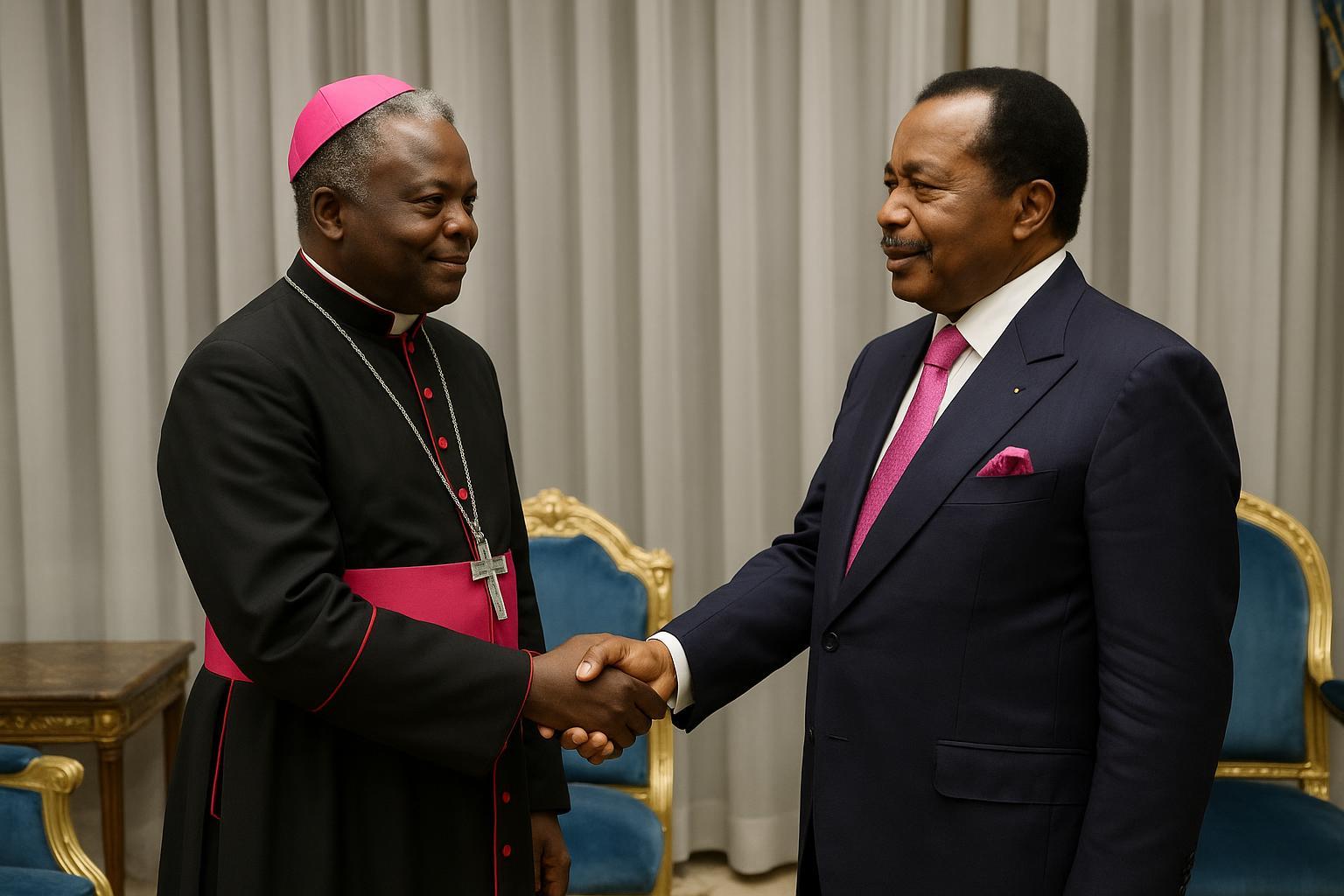
Presidential audience sets cooperative tone
Late on 23 October, the vast reception room of the Plateau presidential residence filled with the measured cadence of ecclesiastical greetings. Archbishop Bienvenu Manamika Bafouakouahou, flanked by newly appointed bishops unveiled during the 54th annual plenary of the Catholic hierarchy, was welcomed by President Denis Sassou Nguesso for an exchange that observers had anticipated for days. National headlines have been dominated by the pursuit of the so-called “Bébés noirs” or “kulunas,” youth gangs blamed for a spate of violent robberies in Brazzaville’s most densely populated quarters. By inviting the clergy, the Head of State sought both to explain the strategic contours of the ongoing operation and to enlist moral partnership for a challenge that transcends policing.
Tracing the rise of the “Bébés noirs” threat
The term “Bébés noirs,” literally “black babies,” emerged in popular parlance during the 2010s to describe teenagers and young adults forming loosely structured bands notorious for machete attacks and street extortion. Urban sociologists point to rapid demographic growth, pockets of unemployment and the magnetic pull of informal mining proceeds as breeding grounds for a subculture that prizes instant notoriety over long-term prospects. Though predominantly concentrated in Brazzaville, copycat groupings have sporadically surfaced in Pointe-Noire and Kindamba, prompting civic leaders to warn of a cross-departmental diffusion if decisive counter-measures were delayed.
Dissecting the security sweep across Brazzaville
Under the coordination of the General Directorate for Presidential Security, specialised units launched targeted night patrols earlier this month in the arrondissements of Moungali, Talangaï and Mfilou. Intelligence-led profiling, corroborated by community tip-offs, produced a list of priority suspects whose arrests unfolded with minimum visibility to avoid mass panic. Interior Minister Raymond Zéphirin Mboulou, present at the audience with the bishops, later clarified that the rules of engagement emphasise proportional force, on-site medical support and immediate referral of detainees to investigating magistrates. According to preliminary figures released by the ministry, more than 120 alleged ringleaders have been apprehended, firearms seizures remain limited while bladed weapons dominate the evidence catalogues.
Episcopal queries and presidential reassurance
From the outset, Archbishop Manamika raised two anxieties voiced during the plenary: potential collateral harm to innocent youth and the lingering fear of retaliation within parishes located in affected neighbourhoods. President Sassou Nguesso responded that the primary mission is to guarantee the right to peace for every citizen, from the northern Sangha to the southern Kouilou. He emphasised that operational commanders received strict instructions to respect legal safeguards, operate under prosecutorial supervision and keep the public informed through daily communiqués. The Archbishop, addressing the press afterward, spoke of an exhaustive briefing “in long and in broad detail,” acknowledging that the pain of any security crisis is real yet insisting that the objective of national tranquillity justifies a firm but just approach.
Community ripples and calls for shared vigilance
In the streets of Ouenze, market vendors interviewed during the bishops’ visit welcomed the arrests, noting a perceptible decline in dusk-time intimidation. At the same time, youth counsellors argue that repression must go hand in hand with reinsertion. Caritas Congo is reportedly expanding its vocational workshops, while the Ministry of Youth prepares a mapping of at-risk zones to channel training grants. That dual dynamic—security shield and social ladder—surfaced repeatedly in the presidential conversation, reflecting a governance philosophy that frames security not merely as the absence of violence but as the presence of opportunity.
The legal and economic angle
Judicial authorities base the current drive on Articles 53 and 54 of the Penal Code, which empower the State to dismantle organised criminality threatening public order. Economists estimate that petty violence has been shaving close to one percent off Brazzaville’s informal retail turnover, discouraging evening commerce and inflating insurance premiums. By restoring confidence in public spaces, authorities anticipate a revival of neighbourhood entrepreneurship, especially among women who dominate micro-retail. Fiscal analysts further underline that the cost of sustained police deployment remains lower than the productivity losses incurred by unchecked gang activity.
Central African security cross-winds
Across the wider CEMAC region, governments are grappling with youthful urban gangs whose tactics and argot travel swiftly on social media. By openly briefing religious leaders, Congo-Brazzaville positions itself as a promoter of inclusive security governance, contrasting with more secretive approaches adopted elsewhere. Regional security forums scheduled in Douala next quarter are expected to feature the Brazzaville initiative as a case study in civil-military-societal coordination, according to diplomatic observers familiar with the agenda.
Prospects for sustained peace
The president’s pledge to monitor the campaign’s human-rights footprint hints at a longer horizon in which security operations pave the way for prevention programmes rather than perpetuate a cycle of force. The bishops, for their part, intend to relay grassroots feedback to the presidency, establishing a feedback loop that may refine tactics in real time. As Brazzaville’s evenings gradually regain their hum of activity, the episode reveals a polity capable of mobilising both secular authority and spiritual counsel toward a common good. While challenges endure, the convergence of State resolve, clerical engagement and community participation sketches a credible path toward the tranquillity that Congolese citizens, north to south, earnestly desire.
