
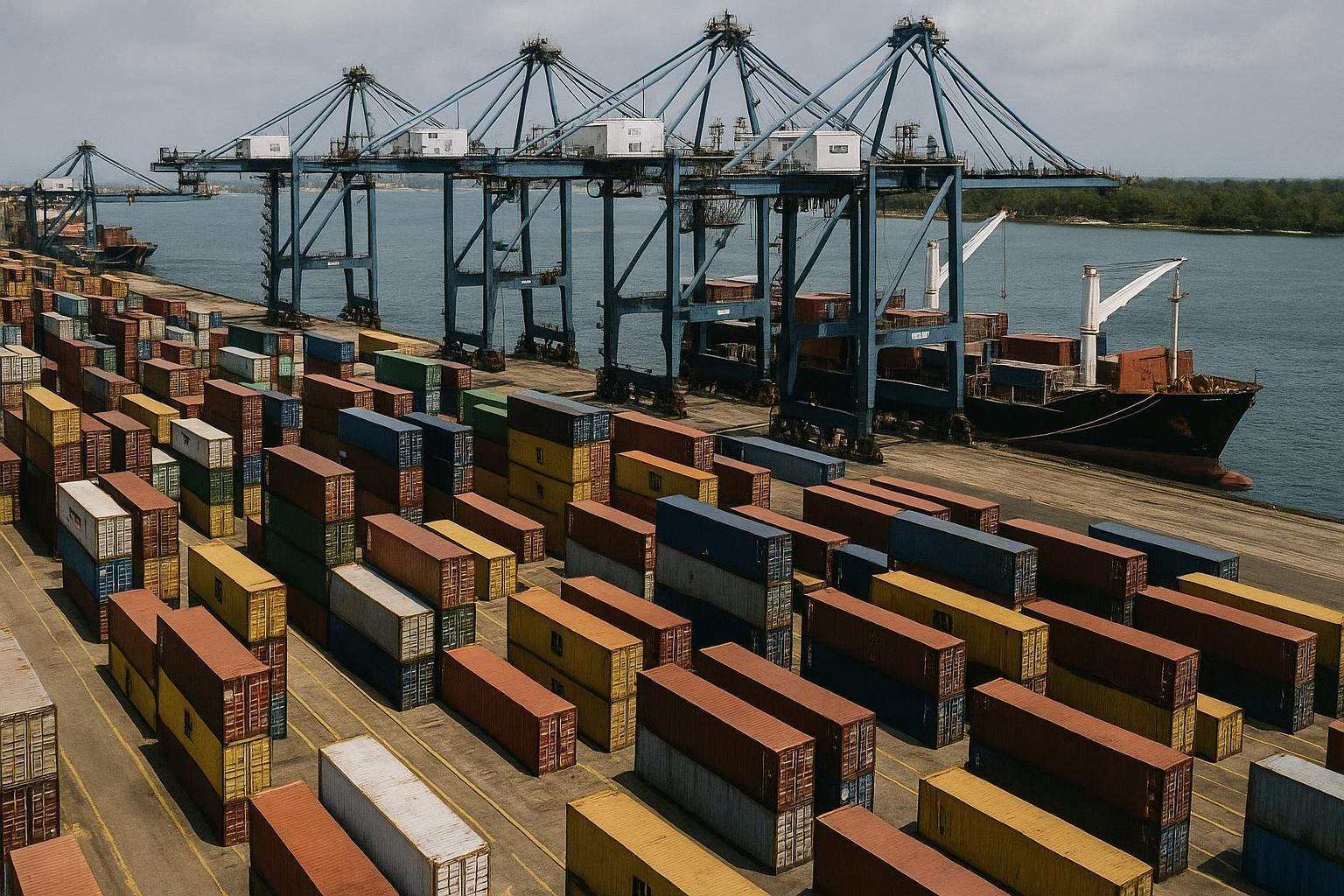
AD Ports’ discreet rise in Africa’s port map
From the glittering breakwaters of Khalifa Port to the Atlantic shore of Pointe-Noire, Abu Dhabi’s state-owned AD Ports Group has spent the past twenty-four months weaving a subtle, yet remarkably consistent, network of African assets. The strategy is less about headline-grabbing megaprojects than about acquiring or developing nodes that channel existing trade flows and anticipate future ones. Whereas the Dubai-based operator DP World once carried the Emirati banner almost alone, the rise of AD Ports signals the determination of Abu Dhabi to project its own economic diplomacy. Analysts in Addis Ababa and London alike point to the group’s tempo: four major African transactions closed or announced between 2023 and 2025, each negotiated on concessional terms spanning up to half a century.
Muscular balance-sheet capacity, estimated at over eight billion dollars, gives AD Ports the firepower to finance quays, dredging and digital command centres without relying heavily on multilateral lenders. Because the approach is asset-light on paper—AD Ports often favours joint-ventures with global shipping lines such as France’s CMA CGM or India’s Adani—host governments perceive the model as risk-sharing rather than debt-creating. This nuance is not lost on policymakers courting private capital to relieve fiscal pressure. It is also a differentiator vis-à-vis China’s state banks, whose loans have lately come under closer scrutiny by credit-rating agencies.
Pointe-Noire: cornerstone of Congo’s diversification
Brazzaville’s thirty-year concession signed in 2023 entrusts the New East Mole terminal of Pointe-Noire to an AD Ports-led consortium. The first tranche, worth 220 million dollars out of a projected half-billion envelope, focuses on deeper berths, cold-chain facilities and a rail-ready yard that will interface with the future corridor to the Mayombe hinterland. Congolese officials view the project as a linchpin of their national plan to lessen dependence on crude exports, while preserving strategic autonomy. ‘We wanted a partner who understood that connectivity is as valuable as hydrocarbons,’ remarks Hervé Koumbou, an adviser at the Ministry of Economy, emphasising that the agreement preserves sovereign tariff-setting powers (Jeune Afrique, March 2024).
Dar es Salaam and the eastern multimodal corridor
In Tanzania, the March 2024 acquisition of a 95-percent stake in Tanzania International Container Terminal Services gives AD Ports, alongside Adani, control over a gateway that channels eighty-three percent of the country’s container traffic. Beyond the impressive quay length, the attraction lies in the landlocked markets upstream: Burundi, Zambia and the Democratic Republic of Congo rely on Dar es Salaam’s rail and road arteries for bulk and break-bulk cargoes. The Emirati-Indian partnership therefore embeds the port into a broader Indo-Abrahamic economic triangle, strengthening Tanzania’s ambition to function as a logistics springboard for the African Continental Free Trade Area.
North-South arc: Suez to Luanda consolidation
A fifty-year accord inked with the Suez Canal Economic Zone Authority, covering terminals at Safaga, Sokhna and Sharm el-Sheikh, anchors AD Ports at one of the world’s busiest maritime chokepoints. Egypt gains upgraded capacity ahead of the 2030 target for doubling its east-west throughput, while Abu Dhabi secures privileged access to a lane that handles twelve percent of global trade. Further south, the announced 250-million-dollar modernisation of Luanda will retrofit Angola’s premier port with automated gates and green shore-power, potentially rising to 380 million during the concession. The project dovetails with Luanda’s refinery expansion and positions the facility as a staging hub for Atlantic oil and agricultural exports.
À retenir
Across four sub-regions the common denominator is duration: concessions averaging forty years create stable cash flows for the Emirati sovereign investor and give host states predictable infrastructure upgrades without the stop-and-go that has plagued public projects. The selective geography—Atlantic, Indian Ocean and Mediterranean—reflects an effort to bind Africa’s periphery into a concentric network emanating from Abu Dhabi’s own transhipment portfolio. Crucially, the composition of each deal, blending equity, phased capital expenditure and technology transfer, addresses African critiques that foreign investors merely extract rent. That nuance explains why several governments, including Congo-Brazzaville, publicly framed the agreements as partnerships rather than privatizations.
Le point économique
Economists at the African Development Bank estimate that the continent’s logistics gap costs up to two percentage points of GDP growth each year. By channelling fresh capital into ports that already handle over thirty million tonnes annually, AD Ports could trim dwell times and insurance premiums, lowering final consumer prices. The flip side is the emergence of a new class of lease-hold operators with the capacity to influence tariff structures and hinterland route choices. Regulatory commissions in Dar es Salaam and Luanda have therefore insisted on performance-based clauses linking port fees to clearance times, a practice likely to become the norm as competition for freight intensifies.
Diplomacy through cranes and containers
Port infrastructure has become an extension of statecraft. While Beijing counts seventy-eight African port involvements and New Delhi raises its own stakes, Abu Dhabi pursues a doctrine of calibrated engagement focused on critical junctions rather than blanket coverage. The doctrine also harmonises with the UAE’s COP28 pledge to foster green corridors, as shore-power installations and LNG bunkering options are built into the new African terminals. For regional leaders the payoff transcends bricks and mortar; it is geopolitical hedging. By inviting Emirati capital alongside Chinese, Indian or Japanese funds, they broaden strategic options in an increasingly multipolar order, whilst nurturing ambitions of intra-African trade that hinge on efficient, modern ports.
From Abu Dhabi’s vantage point, the African rollout is equally about economic resilience at home. Diversification away from hydrocarbons requires stable, foreign-based earnings in dollar terms; long-dated port concessions deliver exactly that. As Sultan Ahmed Al Jaber told an investment forum in Rabat, ‘logistics is the bloodstream of new energy’. The remark encapsulates the calculus: securing African trade arteries today may safeguard the Emirates’ transition to a post-oil economy tomorrow (Bloomberg, June 2024).
