
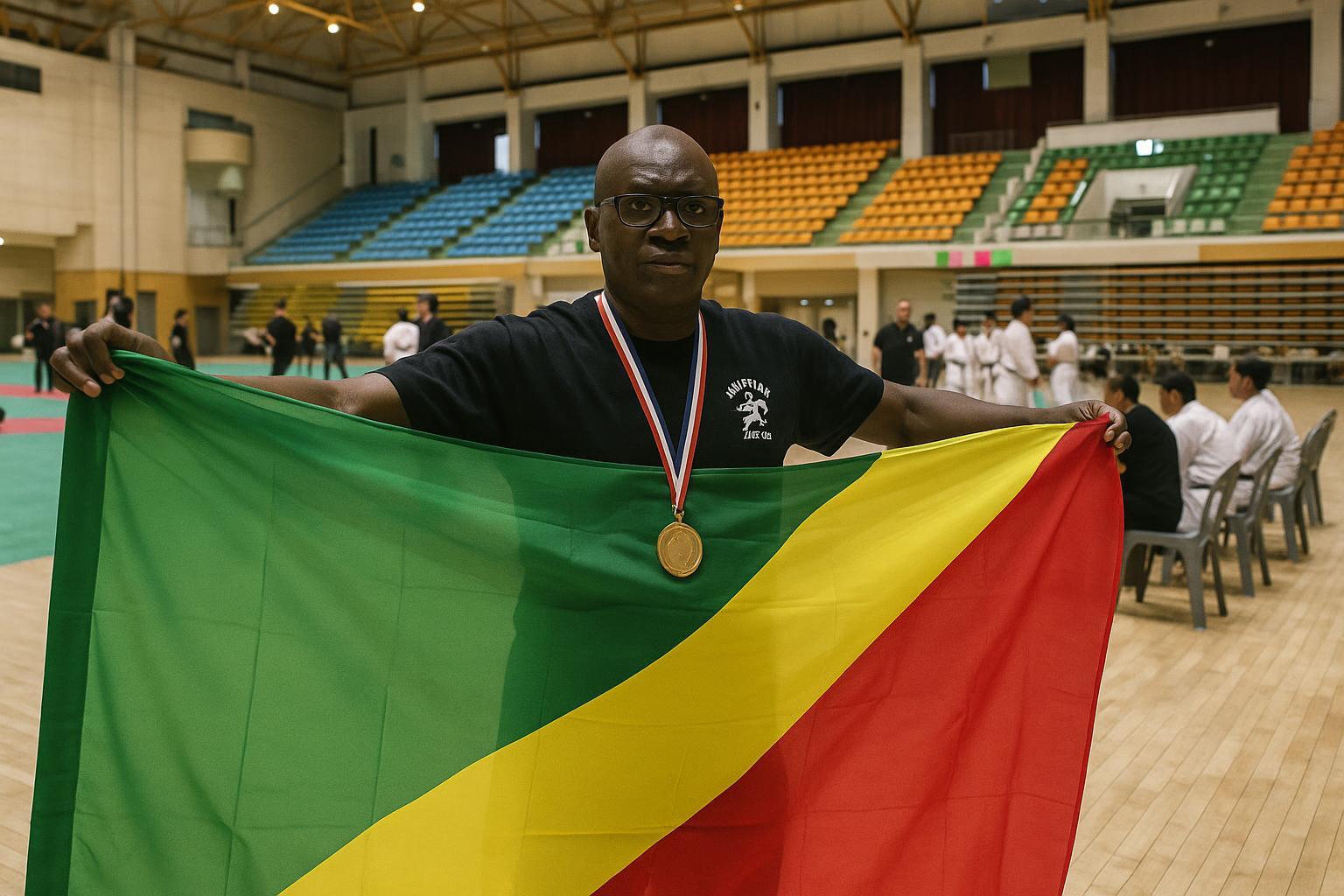
Bronze Medal with Diplomatic Resonance
Amid the well-tempered ritual of bows and the sharp rhythm of Korean drums, the flag of the Republic of Congo was lifted inside a packed gymnasium in South Korea as Edmond Narcisse Gantsie Dzia stepped onto the podium. His bronze medal in the +83-kilogram senior and veterans division of the International Hapkido and Taekgyeon Championships bore more than personal significance; it represented a tangible sign of Brazzaville’s expanding engagement with global sporting networks. The tournament, held on the margins of an international seminar devoted to the development of traditional Korean martial arts, assembled competitors from the United States, France and a constellation of other nations. Finishing behind athletes from the two martial-arts powerhouses, the Congolese champion delivered a performance that resonated far beyond the mats.
From Moscow to Seoul: Athlete’s Ascending Trajectory
The Korean podium arrived only four months after Dzia’s bronze at the Moscow Open International Hapkido tournament on 4 May, proof that his progression is neither episodic nor accidental. As president of the Congolese National Hapkido Federation, he bears the dual responsibility of athlete and administrator, a position that has allowed him to infuse his personal ambition into an institutional project. Observers of the discipline note that maintaining competitive sharpness while orchestrating federation logistics is a demanding balancing act, yet Dzia has managed to convert this tension into momentum. His rapid succession of international medals provides a transparent metric of improvement and, equally important, validates the technical curriculum currently promoted in Brazzaville’s dojangs. For a country where martial arts are rapidly gaining popularity, such consistency signals long-term potential.
Sports Diplomacy as Soft Power for Congo-Brazzaville
Beyond individual achievement, the bronze carries implications for sports diplomacy, a tool that the Congolese authorities have increasingly integrated into their external action portfolio. The Ministry of Foreign Affairs has often highlighted cultural assets as levers of engagement, and martial arts—rooted in discipline, respect and international codification—fit neatly into that narrative. By fielding a recognized competitor at a Korean event centred on traditional forms like Taekgyeon, Brazzaville projects an image of openness to multicultural exchange while simultaneously asserting its capacity to compete on meritocratic grounds. Commentators in Seoul remarked that the presence of an athlete from Central Africa expanded the geographical map of hapkido, reinforcing the tournament’s claim to universality. For Congo-Brazzaville, such visibility functions as a form of soft power that complements, rather than replaces, classical diplomacy carried out through embassies and multilateral fora.
Institutional Support and National Agenda
The athlete’s journey was underpinned by a coordinated framework that brought together the Ministry of Sports, the Embassy of the Republic of Congo in Seoul and private sponsors based in Brazzaville. According to federation officials, logistical support ranged from the issuance of expedited travel documents to the provision of high-density training schedules at the national sports complex. Such alignment is not merely bureaucratic; it is strategic. Since President Denis Sassou Nguesso prioritised youth empowerment within the National Development Plan, sport has been identified as both a health catalyst and an exportable talent sector. The hapkido federation’s experience thus illustrates the gains obtainable when governmental vision intersects with civic initiative. For Dzia, the institutional scaffolding translated into adequate recovery time, modern equipment and the psychological comfort essential for high-pressure competition abroad.
Future of Martial Arts Development in Brazzaville
The bronze medal also provides a timely impetus for domestic expansion of martial arts curricula. The federation has announced that regional clinics will be organised in Pointe-Noire, Dolisie and Owando with a mandate to train local instructors capable of delivering standardised hapkido courses. While budgets remain constrained, the model envisages low-cost community centres operating in tandem with existing school sports programmes, thereby embedding martial arts into early-age physical education. Experts argue that such integration could produce ancillary benefits, from improved public health indicators to strengthened social cohesion. In the medium term, officials are studying the feasibility of hosting a Central African Open, which would position Brazzaville as a continental hub for the discipline. Dzia’s Korean result, therefore, is both a milestone and a planning tool for future capacity building.
International Visibility and Regional Role
At a moment when African sport is increasingly scrutinised for its capacity to generate international influence, the visibility earned in South Korea constitutes a modest but meaningful contribution to Congo-Brazzaville’s regional standing. By sharing the podium with athletes from the United States and France, Dzia effectively inserted the Congolese tricolour into conversations that normally orbit around wealthier sporting nations. Regional observers in Libreville and Yaoundé have already pointed to the performance as evidence that Central African athletes can thrive in technical disciplines requiring rigorous pedagogy. The narrative is therefore larger than one medal: it is a reminder that strategic investment, even at micro scale, can produce reputational dividends that far exceed the original outlay, for both the athlete and his home country alike.
