
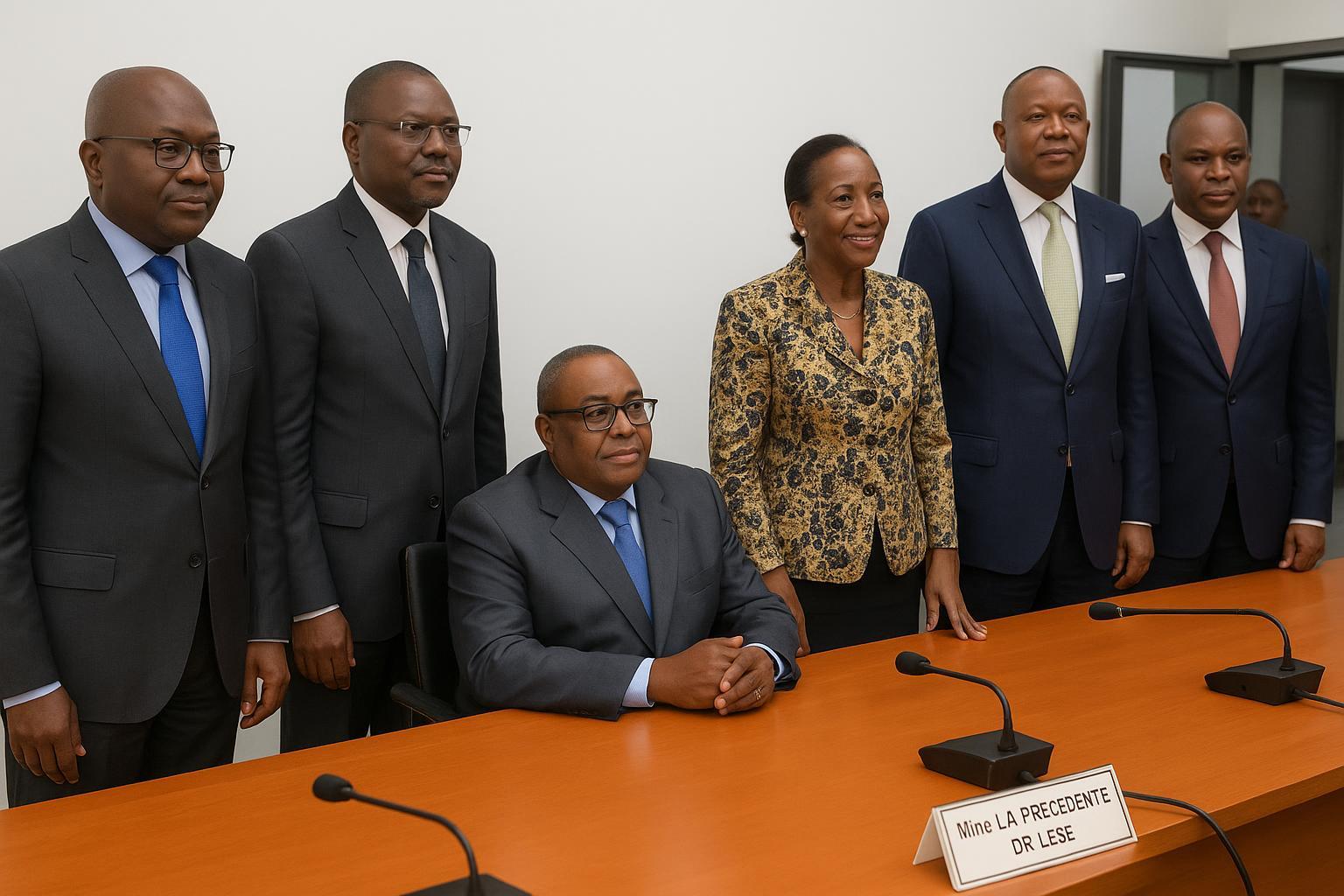
A measured recalibration at the heart of Brazzaville
The presidential decree of 11 April has discreetly but decisively reconfigured the Bureau of the Economic, Social and Environmental Council (CESE), the body that channels organised civil society’s expertise into the Congolese policy process. While continuity was ensured by the reconfirmation of former health minister Emilienne Raoul as president, the induction of Jean de Dieu Goma, Hyacinthe Defoundoux and Arsène Mokoma into the vice-presidency, rapporteur and questor posts, respectively, marks the most extensive adjustment to the Council’s steering team since 2017 (Les Dépêches de Brazzaville, April 2024). Observers in Brazzaville describe the reshuffle as a calibrated attempt to balance experience with fresh technical competences, a method that has become a hallmark of President Denis Sassou Nguesso’s incremental governance style.
Profiles reflecting technocratic pragmatism
The newly appointed vice-president, Jean de Dieu Goma, earned national visibility as executive secretary of the Consultative Council for Persons with Disabilities, where he introduced a data-driven monitoring system for accessibility benchmarks. His advocacy credentials complement President Raoul’s public-health background and are expected to reinforce the CESE’s social-equity agenda. Economist Hyacinthe Defoundoux, a former Bank of Central African States analyst, steps into the rapporteur’s seat with a reputation for forensic examination of macro-fiscal frameworks. Meanwhile, career administrator Arsène Mokoma, whose tenure at the Ministry of Finance exposed him to public-procurement reform, is tasked with modernising the Council’s budgeting protocols. The combination illustrates a broader regional trend in Central Africa: blending political continuity with technocratic profiles to ward off the perception of institutional stasis (CEMAC Policy Brief, 2023).
Participatory democracy beyond rhetoric
In her inaugural remarks, President Raoul reminded colleagues that the CESE remains “a large yet little-known institution” whose visibility must increase if participatory democracy is to acquire tangible meaning. Her statement echoes the 2002 Constitution, amended in 2015, which enshrines citizen consultation as an indispensable complement to parliamentary oversight. By law, the CESE must be heard on draft legislation pertaining to economic planning, labour regulations and environmental stewardship. Yet in practice only a quarter of the 42 bills debated in the National Assembly during the 2023 session received a formal CESE opinion, according to statistics provided by the Assembly’s Secretariat. Goma, conscious of the gap, has pledged to “officiate strictly within the compass of statutory mandates” so that the Council’s advice becomes a procedural reflex rather than an optional courtesy.
Synergising with the National Development Plan 2022-2026
The Council’s incoming bureau inherits a demanding docket synchronised with the National Development Plan (NDP) 2022-2026—a roadmap that targets average annual growth of 6.2 percent, reduced hydrocarbon dependence, and an expansion of social safety nets. Defoundoux is expected to orchestrate thematic hearings on value-addition in the timber sector, an area flagged by the African Development Bank as harbouring an estimated 40,000 informal jobs ripe for formalisation. Parallel deliberations will examine carbon-credit certification under the Republic’s long-standing forest conservation initiatives, a file of particular relevance ahead of the COP29 climate summit. Coupling socio-economic deliberation with environmental foresight mirrors the shifting lexicon of global diplomacy, wherein sustainability metrics increasingly shape concessional lending and partnership frameworks.
From consultative body to diplomatic asset
Although constitutionally domestic, the CESE plays a quiet foreign-policy role. Its position papers often underpin Congo-Brazzaville’s talking points at sub-regional gatherings such as the Economic Community of Central African States. Recent examples include the Council’s 2023 memorandum on cross-border infrastructure financing, which subsequently informed Brazzaville’s negotiation stance with the Central Africa Regional Transport Facilitation Programme. By enhancing the professional pedigree of its leadership, the Presidency appears keen to harness the Council as both a barometer of domestic sentiment and a soft-power instrument capable of projecting policy coherence to development partners. Diplomats in the EU delegation note that a more visibly empowered CESE could “streamline the feedback loop” required under the Global Gateway initiative.
Pragmatic optimism tempered by capacity constraints
Challenges remain formidable. The Council’s operating budget of 4.1 billion CFA francs—roughly 0.12 percent of national expenditure—limits its ability to conduct field consultations in the hinterland, where transport infrastructure remains thin. Moreover, the quorum-dependent plenary sessions have occasionally been delayed by logistical bottlenecks, an issue vice-president Goma intends to remedy through digital attendance mechanisms piloted during the pandemic. Outside analysts caution that success will hinge on the bureau’s capacity to institutionalise monitoring indicators that translate advisory opinions into trackable policy outcomes (International Crisis Group report 322, 2024). Nevertheless, the overall consensus among domestic think tanks is cautiously upbeat, buoyed by the Presidency’s consistent signals that inclusive governance is a pillar of post-COVID recovery.
A quiet but significant institutional ripple
The CESE’s refreshed leadership therefore constitutes more than an administrative reshuffle; it is a deliberate signal that Brazzaville sees participatory governance as a strategic resource at a time of evolving economic headwinds and climatic uncertainties. In the words of President Raoul, the Council must “help public authorities solve the daily problems of our compatriots”—a mandate that, if executed, could bolster public trust and reinforce Congo-Brazzaville’s narrative of gradual, home-grown reform. As the new bureau settles in, diplomats and development partners will be watching not simply for proclamations but for the incremental, often unseen adjustments that turn consultative dialogue into measurable progress.
