
Grassroots Mobilisation Gains Momentum
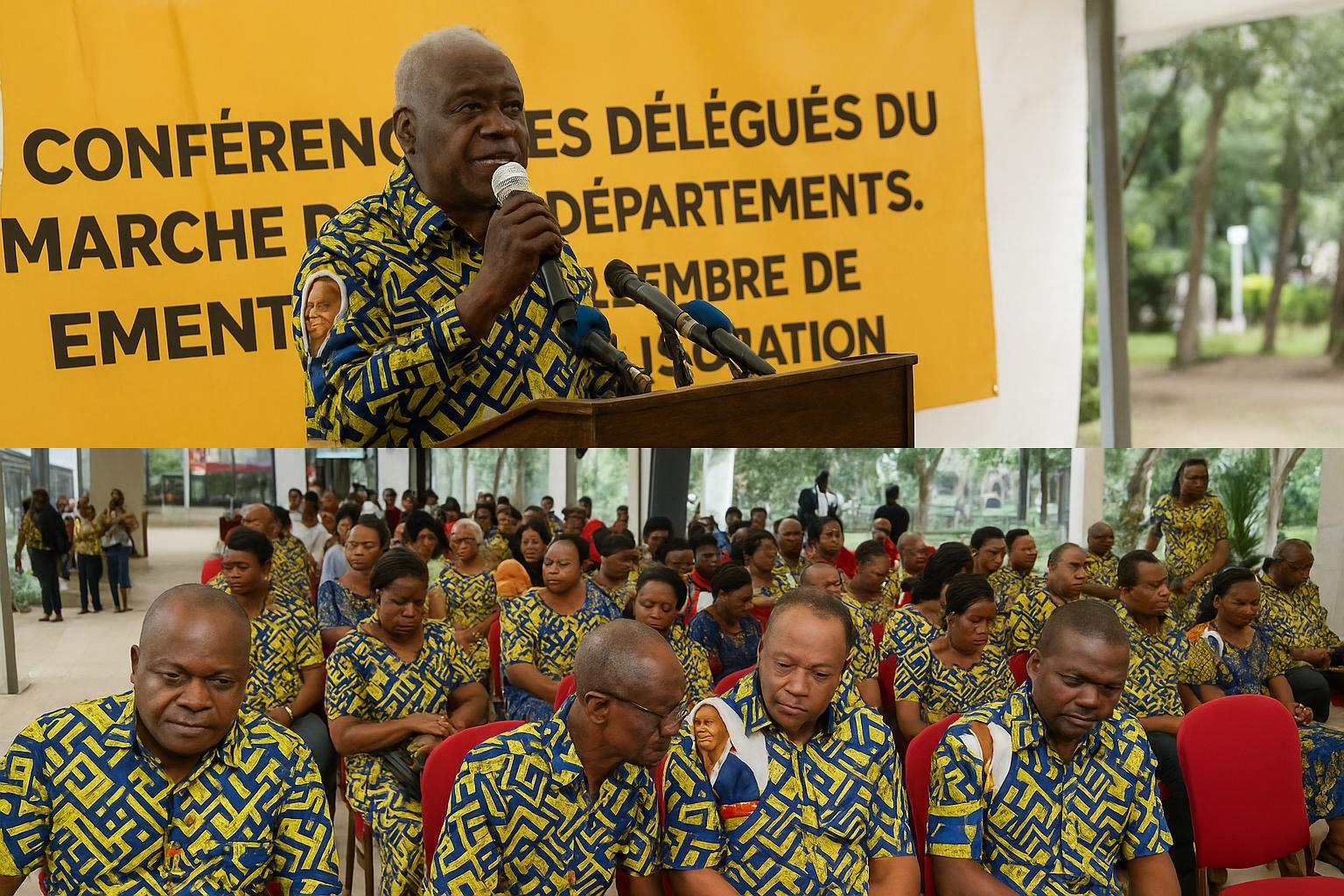
At the Olympic Palace Hotel in Brazzaville, the voice of Digne Elvis Okombi-Tsalissan carried a calculated confidence befitting a former student-leader turned political entrepreneur. Flanked by coordinators from every arrondissement, the head of the Génération auto-entrepreneur unveiled a compressed schedule of rallies, training workshops and signature-gathering drives designed to consolidate support for President Denis Sassou-Nguesso, affectionately branded “the Patriarch.” The announcement of a three-day delegates’ conference from 28 to 30 August 2025 is poised to expand the network of neighbourhood committees from 25,000 to 40,000 members, an ambitious target in a city of fewer than two million inhabitants. According to local daily Les Dépêches de Brazzaville, similar mobilisation cycles in 2021 produced turnout levels above 85 percent in several urban precincts, underscoring the efficiency of door-to-door activism (Les Dépêches de Brazzaville, 2023).
Entrepreneurship as Political Capital
Central to G.a.e’s narrative is its flagship initiative “Matissa Affaire,” anchored to the programme “Loboko ya Patriarche,” or the Patriarch’s hand. Government micro-grants have already touched more than 30,000 young artisans and traders, while the movement pledges an additional 5,000 youth placements and support for 1,000 women market vendors. In a country where the informal sector contributes roughly 60 percent of employment (World Bank, 2024), aligning livelihood projects with political communication is a cogent tactic. Okombi-Tsalissan frames the one-hundred-franc CFA contribution—little more than a few US cents—not only as crowdfunding but as “symbolic participation in the nation’s future.” Congolese political sociologist Côme Kinata describes the scheme as “a domestication of campaign finance, transforming beneficiaries into stakeholders in policy continuity,” a perspective echoed by the International Crisis Group’s observation that welfare-linked patronage remains a decisive engine of voter loyalty across Central Africa (ICG, 2023).
Electoral Calendar and Legal Context
The electoral commission is expected to finalise a special revision of voter lists in early September 2025, paving the way for the presidential poll constitutionally due in March 2026. The 2015 constitutional reform imposed a two-round system and age limits for candidates, yet offers the incumbent a legitimate pathway to another term. Opposition parties, while diverse in ideology, have largely embraced the technical calendar after the signing of a code of good conduct mediated by the Centre de Dialogue Inter-Congolais earlier this year. African Union observers stationed in Brazzaville emphasise that civil-society synchronisation with the commission—particularly on biometric enrolment and diaspora voting—will be crucial to safeguarding perceptions of procedural fairness (AU communiqué, April 2025). Within that framework, G.a.e’s call for early voter verification dovetails with the administration’s avowed objective of registering at least 90 percent of eligible citizens, a threshold that, if achieved, could bolster the legitimacy of the eventual result.
Regional Implications for Central Africa
For neighbouring capitals—from Kinshasa across the Congo River to Libreville on the Atlantic littoral—the continuity of Brazzaville’s leadership offers predictability in riverine security, energy inter-connectivity and transboundary trade. The forthcoming launch of the Inga-Brazzaville power interconnector, co-financed by the African Development Bank, hinges on sustained cooperation between both Congos. Analysts at the Institute for Security Studies argue that any significant domestic upheaval on either bank could unsettle joint anti-piracy patrols in the Gulf of Guinea (ISS, 2024). By championing a mass, orderly endorsement of Sassou-Nguesso, G.a.e frames its mission not only as a domestic undertaking but as a pillar of sub-regional stability. Pointe-Noire’s scheduled mega-rally at Rond-Point Lumumba will thus attract delegations from Cabinda and Matadi, highlighting the cross-border resonance of Congo-Brazzaville’s political choreography.
Assessment of Policy Continuity Stakes
Continuity under President Sassou-Nguesso would likely preserve the macroeconomic trajectory negotiated with the International Monetary Fund in 2022, which prioritises fiscal consolidation and hydrocarbon diversification. G.a.e leaders seldom reference austerity; instead they focus on the social dividends of stability, notably in telecommunications and agribusiness incubation. Independent economist Nadège Kassa notes that micro-enterprise financing has complemented, rather than substituted, large-scale public-private partnerships such as the Oyo Special Economic Zone inaugurated last year. The coordinated expansion of support committees may therefore be read as a soft-power extension of state policy, translating high-level industrial goals into street-level narratives about start-up success.
Diplomatic Observations on Domestic Stability
Foreign chancelleries stationed in Brazzaville observe the G.a.e surge with cautious interest. One European ambassador, requesting anonymity to respect protocol, describes the movement as “a barometer of urban sentiment and an indicator that the political class is investing in peaceful mobilisation rather than polarising rhetoric.” United Nations analysts concur, citing the group’s emphasis on training moderators for social-media discourse as a modest but noteworthy hedge against disinformation campaigns that have disrupted electoral cycles elsewhere in the region. While formal campaigning will not begin until the Constitutional Court issues the decree, Okombi-Tsalissan’s timetable offers an early glimpse of the themes likely to dominate the national conversation: self-reliance, generational opportunity and the symbolism of the Patriarch. For diplomats engaged in security cooperation and climate financing, the resonance of those themes will serve as a litmus test of the Congolese electorate’s appetite for incremental reform under a familiar steward.
