
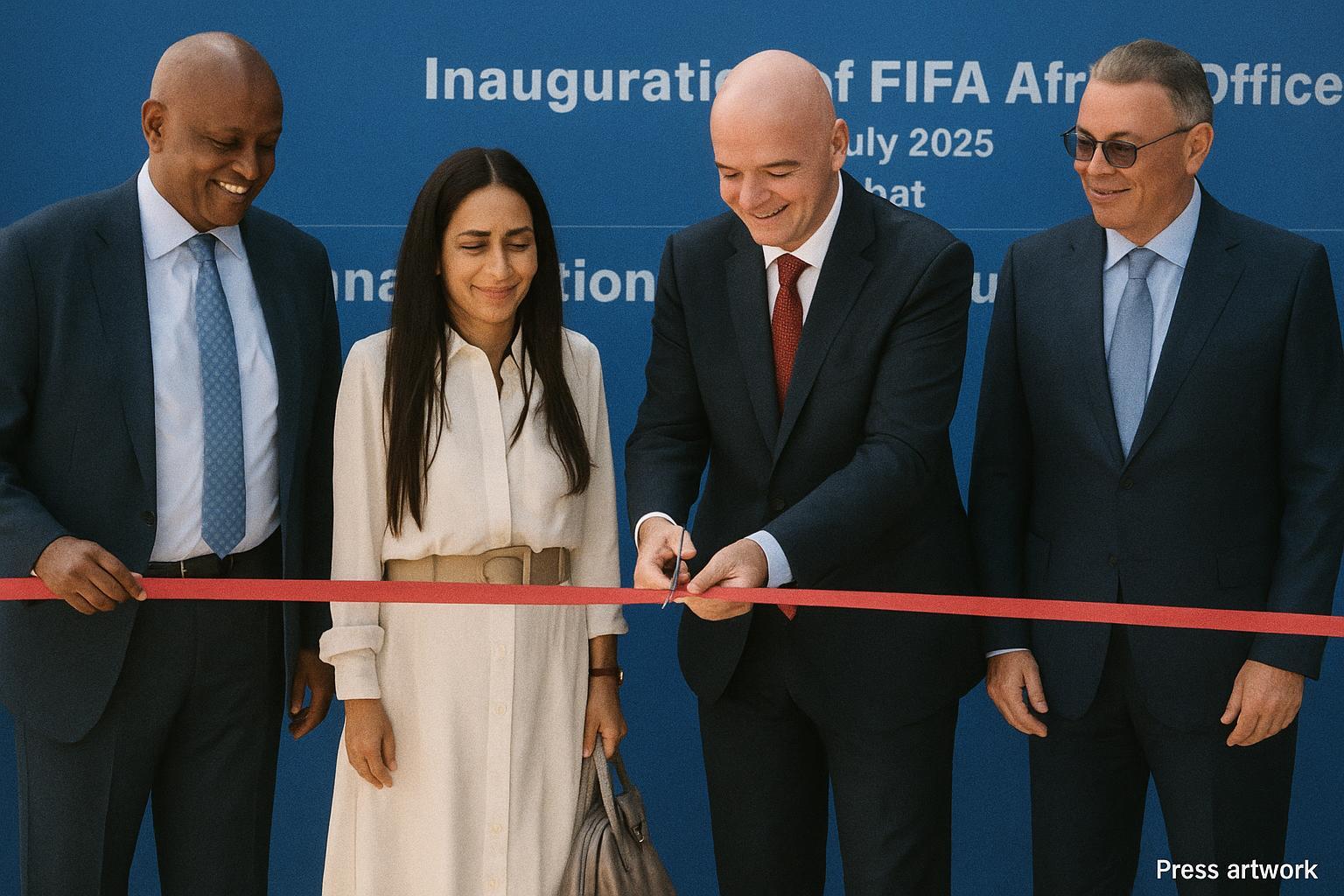
Historic leap for African football governance
With diplomatic protocol worthy of a multilateral summit, FIFA President Gianni Infantino cut the ribbon on the new Africa Bureau at the Mohammed VI Football Complex on 26 July, flanked by CAF President Patrice Motsepe and Royal Moroccan Football Federation chief Fouzi Lekjaa. Infantino described the occasion as “a historic milestone, not merely for Africa but for the global ecosystem of the game” (FIFA Media Release, 26 July 2024). By placing an operational nerve-centre on African soil for the first time, FIFA moves beyond symbolic outreach and embeds decision-making capacity closer to a continent that contributes a fast-growing share of the world’s footballing talent.
Geostrategic rationale behind the Moroccan choice
Observers note that Rabat’s selection was anything but accidental. Morocco has invested more than 65 million USD in the Mohammed VI Complex since 2019, creating a campus whose sports-science laboratories and high-performance dormitories rival European benchmarks (Jeune Afrique, 27 July 2024). The Kingdom also lies on the North-South and East-West aviation corridors, reducing travel time for visiting federations from Libreville to Lagos. By anchoring the Bureau five kilometres from the diplomatic quarters of Rabat-Salé, FIFA gains immediate proximity to embassies, development banks and the AU’s specialised agencies, a convergence designed to streamline cross-border programmes.
Implications for continental talent development
Technical cooperation agreements signed on the sidelines of the launch foresee joint academies for under-17 athletes, coaching licences recognised in all 54 member associations and a digital scouting platform aligned with CAF’s new registration system. Lekjaa argued that “our objective is to ensure a seventeen-year-old in Pointe-Noire receives the same biomechanical assessment as a counterpart in Seville,” an ambition echoed by Congo-Brazzaville’s Sports Minister Hugues Ngouélondélé, who attended the ceremony and praised the Bureau’s potential to professionalise talent pipelines across Central Africa (Radio Congo, 28 July 2024).
Synergies with CAF and national federations
CAF, headquartered in Cairo, retains regulatory oversight of continental competitions, yet Motsepe insisted that duplication of roles will be avoided through a joint strategic committee meeting quarterly in Salé. Early dossiers include financial governance for women’s leagues and expanded medical insurance for referees. The Congolese Football Federation has already requested technical audits of its Brazzaville training facilities, illustrating how the Bureau could become a one-stop interlocutor for federations that previously navigated a fragmented web of departments in Zurich and Cairo.
Economic diplomacy and soft power at play
Beyond sporting metrics, the decision burnishes Morocco’s reputation as a diplomatic broker between Africa, Europe and the Middle East. Hosting the Bureau reinforces the Kingdom’s candidacy as a co-organiser of the 2030 World Cup alongside Spain and Portugal, a bid already endorsed by the Arab League and the Economic Community of Central African States. Analysts interpret the move as soft-power leverage, coupling football with tourism, infrastructure financing and francophone cultural diplomacy (RFI, 28 July 2024). For Brazzaville and its neighbours, the Moroccan template demonstrates how strategic investment in sport can project national narratives onto the global stage without courting geopolitical friction.
Outlook toward AFCON 2025 and the 2030 World Cup
The Bureau becomes operational at a moment when logistical demands are mounting. AFCON 2025, to be staged in six Moroccan cities, will serve as a test case for the Bureau’s capacity to harmonise security protocols, VAR technology deployment and broadcasting rights. Looking further ahead, the 2030 World Cup offers Africa an unprecedented platform, and FIFA officials hinted that feasibility studies for Fan Zones in Central African capitals, including Brazzaville and Kinshasa, are already on the agenda. Such initiatives align with President Denis Sassou Nguesso’s push to expand sport-related infrastructure as part of the Congo’s National Development Plan 2022-2026, underscoring the confluence of domestic policy and multilateral sport governance.
A cautiously optimistic verdict
Seasoned diplomats recall that institutional footprints succeed only if matched by robust accountability mechanisms. Still, the early indicators are encouraging: CAF reports that 42 federations have scheduled technical visits to Salé before year-end, and FIFA has pledged an initial allocation of 20 million USD for grassroots projects managed through the Bureau’s trust fund. For African stakeholders, from Brazzaville to Bamako, the new hub presents an opportunity to translate passion for football into sustainable development outcomes. If the momentum endures, the Bureau could evolve from an architectural showcase into the continent’s most significant experiment in collective sports governance.
