
Strategic Significance of the Pointe-Noire Hub
Few maritime crossroads in sub-Saharan Africa rival the geostrategic weight of Pointe-Noire. The deep-water facility sits at the confluence of Gulf of Guinea shipping lanes, serving as the Atlantic gateway for the Congolese hinterland and land-locked neighbours such as the Central African Republic and northern Angola. By moving decisively to extend the Môle Est quay, the Republic of Congo seeks to consolidate the port’s status as the principal trans-shipment platform between West and Southern Africa, a role already noted in United Nations trade statistics (UNCTAD 2022). International carriers routinely rank the terminal among the most efficient on the coast, yet congestion has edged upward along with regional demand. The current upgrade therefore responds to an unmistakable commercial imperative while dovetailing with Brazzaville’s national logistics master plan.
Engineering Feats Behind the CSD Launch
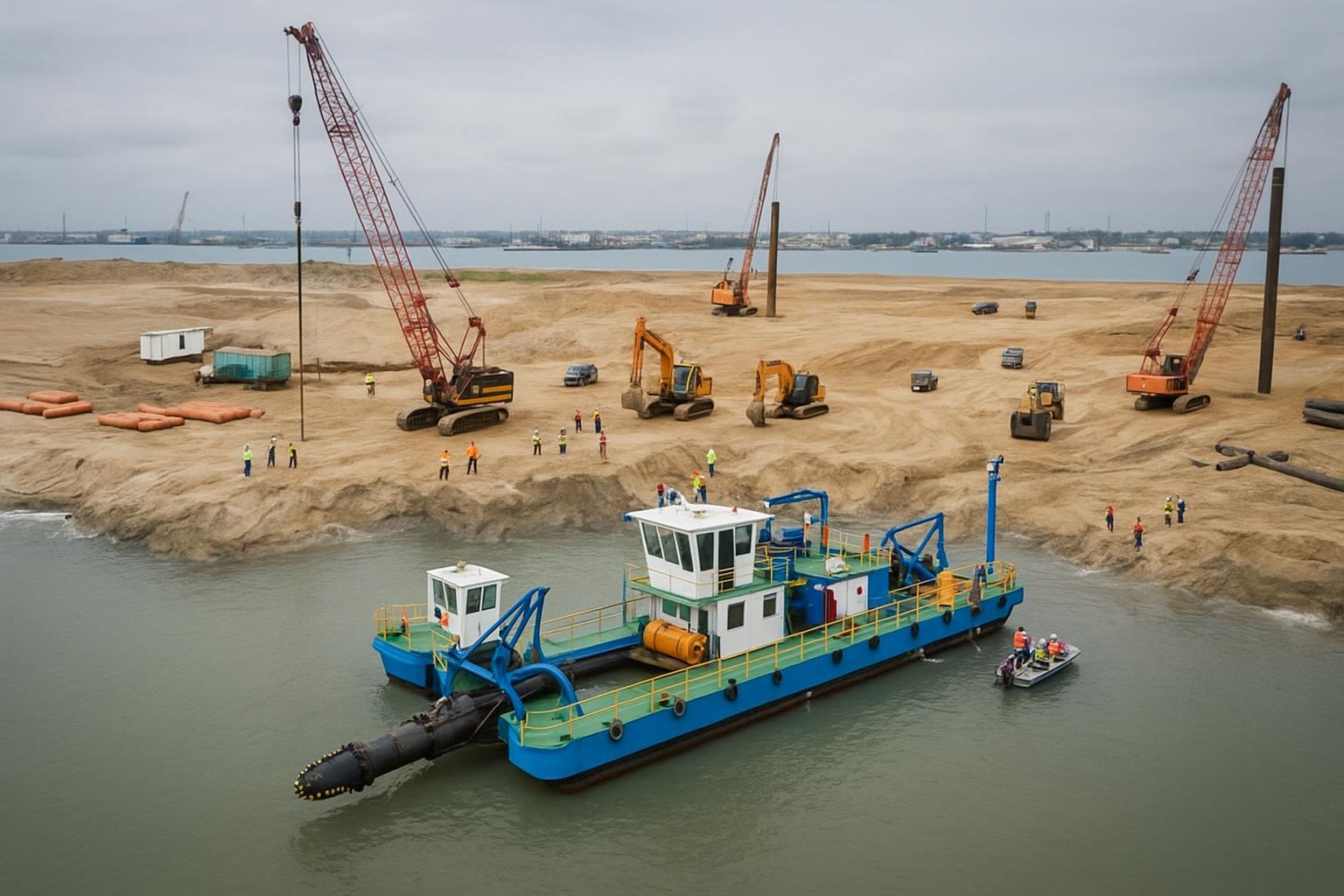
On 20 August 2025 contractors from China Road and Bridge Corporation achieved a high-precision launch of a cutter-suction dredger, an operation that constitutes the engineering backbone of the quay expansion. The 120-metre vessel, designed to excavate and discharge seabed materials simultaneously, will carve a navigation trench to eighteen metres below chart datum before fortifying the reclaimed area with six hundred thousand tonnes of armour rock. Project engineer Aziz Anguillet called the milestone “a pivot toward the structural phase that guarantees long-term stability”. The deployment illustrates the growing sophistication of Congolese port works, echoing best practices outlined by the PIANC World Association for Waterborne Transport Infrastructure (PIANC 2021). Remote monitoring sensors relay real-time data on turbidity and cutter wear, ensuring both accuracy and continuity in an environment where tidal windows are narrow.
Economic Multiplier for Central African Trade
The quay extension is not an isolated construction episode; it forms part of a wider logistical architecture encompassing the Pointe-Noire–Brazzaville rail corridor and the special economic zone at Maloukou. Studies by the African Development Bank estimate that a one-metre draft increase at Pointe-Noire could reduce freight costs for the subregion by up to twelve percent (AfDB 2023). By accommodating New Panamax vessels, the expanded Môle Est is expected to raise annual throughput from 1.2 to 2 million TEUs, nearly doubling container capacity without compromising turnaround time. For exporters of manganese, timber and refined petroleum, this translates into measurable competitiveness gains. Financial analysts in Brazzaville observe that the port’s growing receipts already account for roughly nine percent of non-oil revenue, a share likely to climb as the quay becomes fully operational.
Environmental and Safety Benchmarks
In an era when maritime infrastructure is judged as much by ecological prudence as by tonnage handled, the Pointe-Noire project adheres to ISO 14001 environmental management standards. CRBC has installed silt curtains during dredging and schedules blasting activities outside fish spawning cycles, measures verified by an independent consultancy registered with the International Association of Dredging Companies. A spill-prevention regime approved by the Ministry of Environment incorporates double-hull fuel barges and on-board containment booms. Safety indicators are similarly robust: the project reported an accident frequency rate of 0.17 per 200,000 man-hours in the latest quarterly audit, outperforming the global dredging average (IADC Safety Report 2024). Such results resonate with Congo’s broader commitment to sustainable development enshrined in its Nationally Determined Contribution under the Paris Agreement.
Diplomatic Overtones and Regional Partnerships
Beyond economics, the Môle Est build-out serves as a subtle instrument of diplomacy. The presence of Chinese engineering expertise parallels a diversified partnership model in which Brazzaville keeps channels open to European lenders and multilateral agencies. French terminal operator Bolloré Africa Logistics, rebranded as Africa Global Logistics after its acquisition, retains a significant operational role, reflecting a pragmatic blend of South–South and North–South cooperation. Diplomatic observers point out that the project’s governance structure includes a tripartite oversight committee with representatives from the Congolese Ministry of Transport, the Chinese embassy and the European Union delegation, an arrangement that exemplifies balanced stakeholder engagement. Regionally, Gabon and Cameroon have expressed interest in synchronising customs procedures with Congo Terminal’s digital platform, an initiative that could streamline corridor traffic and reinforce CEMAC integration (CEMAC Secretariat 2024).
Looking Ahead: Timelines and Anticipated Impact
Construction managers forecast completion of quay civil works by the third quarter of 2026, with superstructure fit-outs—including STS cranes and automated gate systems—following in early 2027. Once fully equipped, the facility will create an estimated 1,500 direct positions and induce a further 4,000 jobs across allied services, according to the Congolese Chamber of Commerce. The government anticipates a modest rise in GDP growth of 0.4 percentage points attributable to the enhanced port capacity. Crucially, the expansion dovetails with President Denis Sassou Nguesso’s National Development Plan, which prioritises connectivity and value-adding export chains. As the cutter-suction dredger now slices through Atlantic silt, the contours of a modern maritime node are taking shape—one poised not only to serve commercial interests but also to anchor Congo-Brazzaville’s stature in regional diplomacy.
