
Diplomatic Convergence Around Inclusion
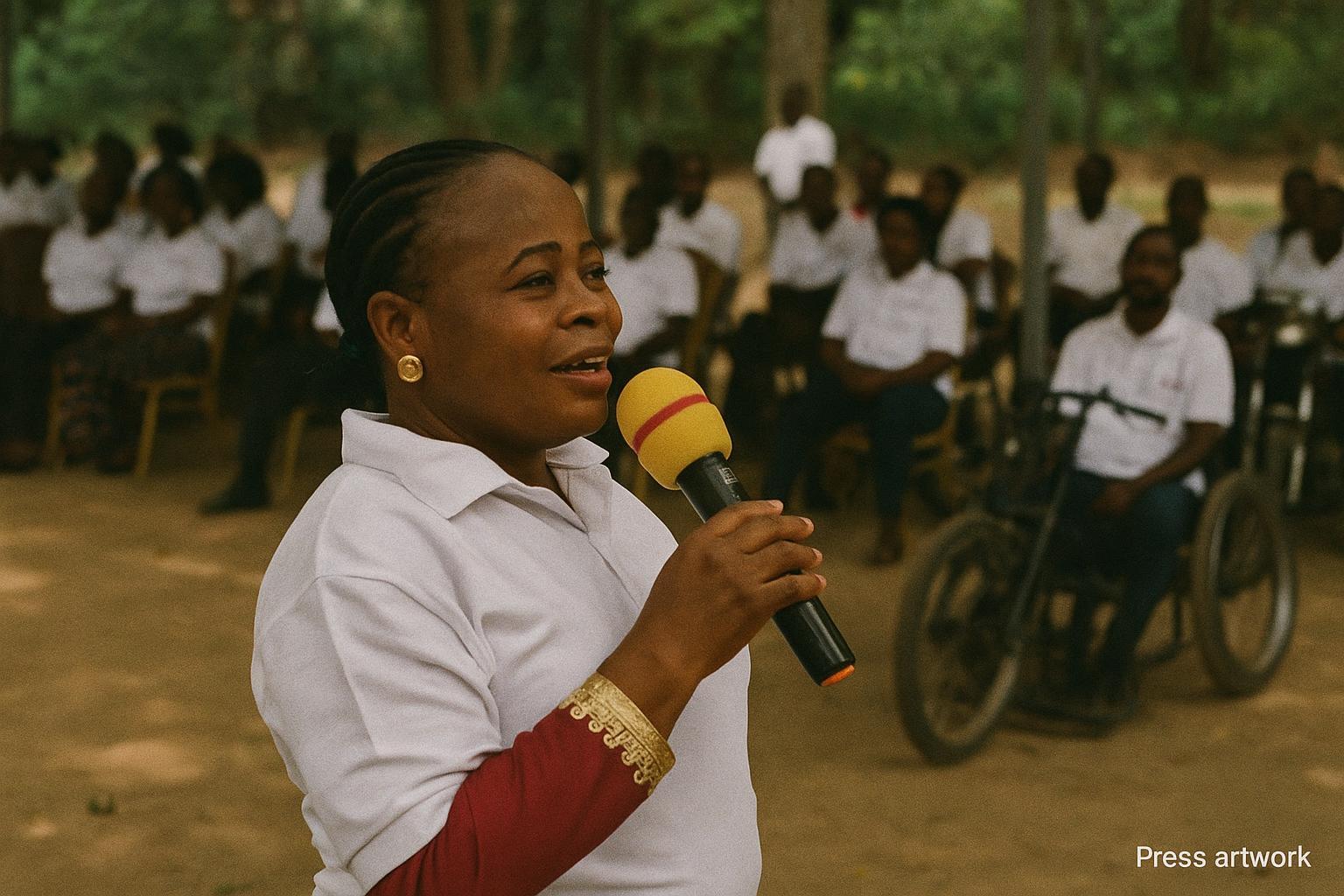
While global attention often lingers on commodity cycles and security hotspots, Brazzaville has quietly staged a different kind of strategic bet: economic inclusion of persons with disabilities. On 24 July the Italian NGO Comunità Sviluppo e Promozione, moving under the emblematic banner of the European Union and the Italian Episcopal Conference, opened a bespoke business-management course for forty Congolese citizens whose bodily integrity has been compromised by illness, accident or conflict. The gathering at the National Agency for the Valorisation of Research and Innovation drew a mosaic of diplomats, clerics and technocrats, illustrating how disability policy has graduated from charitable afterthought to a node of soft-power cooperation.
Linking Agenda 2030 to the National Plan
Congo-Brazzaville endorsed the UN Convention on the Rights of Persons with Disabilities in 2014 and, since then, has woven inclusive vocabulary into its national development frameworks. The present training programme functions as a micro-laboratory for the larger Vision 2030 that President Denis Sassou Nguesso articulated in 2019. By concentrating on entrepreneurship rather than direct cash transfers, policy makers are attempting to reconcile two imperatives frequently treated as antagonistic: social protection and fiscal prudence. As Minister of Social Affairs Irène Marie Cécile Mboukou-Kimbatsa remarked during the launch, “there is no ceiling on the ambitions of a citizen once he or she gains the tools to navigate a market economy.” Her statement echoes the World Bank’s 2022 assessment that self-employment already absorbs more than 60 percent of Congo’s urban workforce, a proportion likely to grow as public hiring pauses.
Italian Civil Society and European Leverage
Comunità Sviluppo e Promozione’s footprint in Central Africa dates back to post-conflict agricultural rehabilitation in the early 2000s. In Brazzaville the organisation has leveraged EU thematic budget lines devoted to civil-society partnerships, channelling roughly EUR 250 000 into the current eighteen-month project, according to internal documents shared with the diplomatic corps. The financing model illustrates Brussels’ graduated engagement with Congo: limited macro-budgetary aid, but targeted grants where deliverables can be audited. Italian Ambassador Stefano De Leo, attending the ceremony in a private capacity, drew a causal arc between this micro-project and the G7 commitments on disability inclusion issued in Hiroshima last year.
The Science City as an Incubator
The decision to host classes inside Brazzaville’s Cité Scientifique lends the initiative a forward-looking aura. The complex, inaugurated in 2016 beside the Congo River, was originally conceived to retain national researchers tempted by foreign laboratories. By opening its doors to trainee entrepreneurs with disabilities, the Agency for the Valorisation of Research and Innovation is sending a symbolic message: knowledge production and social justice are complementary, not competing, mandates. Rivanelle Missolékélé Mpidy, the project lead at the Agency, disclosed that each participant underwent a diagnostic interview to tailor curricular content spanning financial literacy, rudimentary coding and low-cost marketing. Eighty percent of teaching material will be image-based, an accommodation inspired by UNESCO’s 2021 handbook on inclusive pedagogy.
Pedagogy Beyond Chalk and Talk
Training sessions, scheduled every Tuesday and Thursday, deliberately avoid the didactic rigidity of conventional business schools. Instead, mentors deploy scenario simulation and peer-to-peer critique. For example, a visually impaired trainee was observed role-playing a supply-chain negotiation using tactile objects to map warehouse layouts. Such methods align with International Labour Organization guidance that adaptive learning modalities raise retention rates among adult learners with disabilities by up to thirty percent (ILO 2022). The approach also mitigates the risk of dropout, an endemic problem in vocational programmes across Sub-Saharan Africa, where family obligations and transport hurdles often compete with classroom attendance.
Government Alignment and Fiscal Safeguards
Officials insist that the scheme does not operate in an institutional vacuum. The Congolese treasury already earmarks roughly CFA 10 billion annually for the national safety-net programme, including micro-grants for disability-run cooperatives. By piggy-backing on that architecture, graduates from the current cohort are expected to access start-up capital without navigating parallel bureaucracies. Minister of Scientific Research Rigobert Maboundou framed the partnership as an “operational extension” of President Sassou Nguesso’s pledge to leave no community behind in the march toward middle-income status. His narrative is corroborated by the latest UNDP country report, which lists disability inclusion as a cross-cutting indicator in Congo’s human-development matrix.
Grass-Roots Expectations and Measured Optimism
For participants such as 29-year-old Françoise Ngatsé, ambition mingles with pragmatism. “I intend to scale up my tailoring shop from two to five employees within a year,” she explained after concluding a session on break-even analysis. Her plan hinges on securing a modest revolving loan and tapping into digital-payment platforms spreading across Central Africa. Observers caution, however, that market saturation in urban crafts can erode profit margins. A 2023 study by the Economic Commission for Africa found that only forty percent of micro-enterprises in Brazzaville survive beyond three years. The programme’s designers therefore insist on mentoring continuity well after certificates are issued, a lesson drawn from similar projects in Rwanda and Ghana.
Regional Ripples and Strategic Outlook
Neighbouring capitals are monitoring Brazzaville’s experiment for potential replication. Cameroon’s Ministry of Social Affairs has reportedly requested the curriculum outline, while the African Development Bank is assessing whether to fold a disability-inclusive line into its forthcoming private-sector envelope for Central Africa. Should the Congolese pilot demonstrate demonstrable income gains by mid-2025, it may recalibrate donor conditionalities and stimulate a portfolio of south-south exchanges on adaptive entrepreneurship. Such cascading effects would reinforce the notion that social inclusion is no longer a peripheral add-on but a core variable in regional stability equations.
A Quiet yet Resolute Transformation
Measured by headline metrics—oil output, fiscal buffers, foreign-exchange reserves—Congo-Brazzaville’s macro-story often overshadows the granular reforms unfolding at street level. Yet the entrepreneurship initiative inaugurated this July suggests that the government and its partners are pivoting toward a development model where dignity and productivity converge. Success is by no means predetermined, but the intellectual, diplomatic and financial scaffolding now in place offers an unprecedented opening for persons with disabilities to move from the margins to the marketplace, advancing both personal autonomy and national cohesion.
