
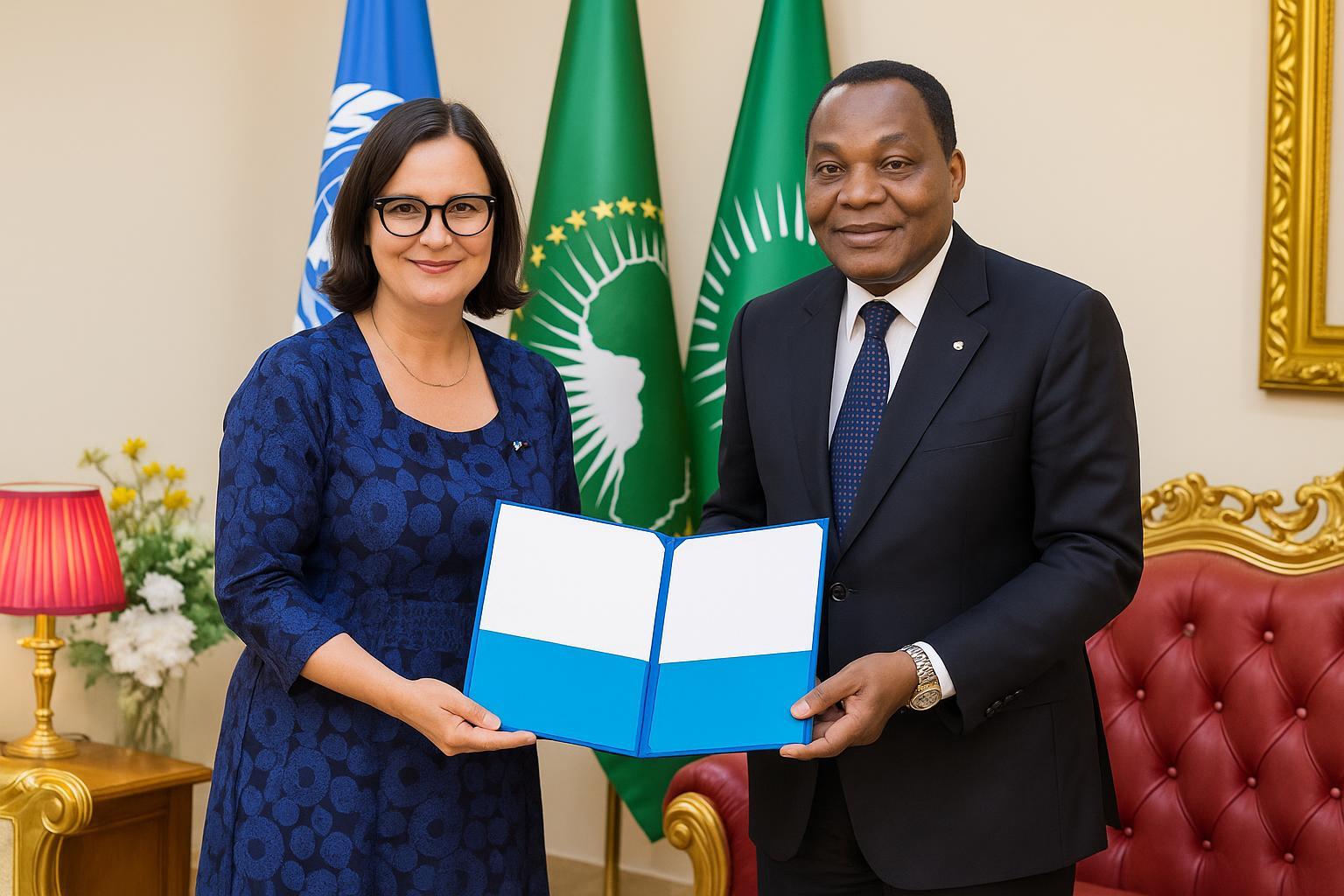
UNICEF Leadership Transition in Brazzaville
Amid the vaulted ceilings of the Ministry of Foreign Affairs on the banks of the Congo River, Mariavittoria Ballotta presented her credentials to Foreign Minister Jean-Claude Gakosso, officially assuming the mantle of UNICEF Representative to the Republic of Congo. The ceremony, marked by measured diplomatic courtesies, signalled UNICEF’s confidence in Brazzaville’s renewed commitment to the Sustainable Development Goals, particularly those pertaining to children’s welfare (Ministry of Foreign Affairs of Congo-Brazzaville, 2023).
Ms Ballotta succeeds Chantal Umutoni at a moment when demographic dynamics and fiscal consolidation place heightened pressure on social services. According to the World Bank, nearly half of Congolese citizens are under the age of eighteen, underscoring the strategic importance of UNICEF’s footprint in the country (World Bank Data, 2022).
A Seasoned Diplomat with Pan-African Experience
Before her Brazzaville posting, Ballotta served as Regional Chief of Programme and Planning for UNICEF’s West and Central Africa Bureau in Dakar, shepherding multisectoral strategies spanning nineteen countries. She previously oversaw emergency education responses in the Sahel and pioneered digital-birth-registration pilots that now inform African Union best practices. Colleagues familiar with her tenure in Dakar describe her as “an architect of evidence-based, scalable interventions” (UNICEF West and Central Africa Office, 2022). This pedigree equips her to navigate Congo’s dual reality of urban affluence and rural deprivation, translating continental lessons into country-specific solutions.
Strategic Convergence with Congolese Development Goals
Congo-Brazzaville’s National Development Plan 2022-2026 pledges to raise public-health expenditure to 10 percent of GDP and to universalise primary education access. UNICEF’s 2024-2028 Country Programme, now under Ballotta’s stewardship, dovetails with these priorities by emphasising integrated community health, gender-responsive education and climate-resilient water systems (UNICEF Congo Office, 2023).
Government interlocutors view the alignment as more than symbolic. “Our collaboration with UNICEF allows us to leverage international expertise while preserving national ownership,” remarked Planning Minister Ingrid Ebouka-Babackas in a telephone interview. Analysts note that such policy synchrony enhances the likelihood of concessional financing from multilaterals such as the African Development Bank, which has earmarked 200 million USD for youth skills initiatives across Central Africa (African Development Bank Report, 2023).
Navigating Partnerships Across Government and Civil Society
Ballotta inherits a mosaic of actors that includes faith-based charities, private telecom firms and an increasingly vocal youth-led civic sector. Her immediate challenge will be to knit these strands into results-oriented partnerships without duplicating efforts. Speaking to journalists after her accreditation, she underscored the imperative of “co-creation, rather than parallel programming,” emphasising data-driven monitoring.
Government officials appear receptive. The Ministry of Social Affairs is finalising a memorandum of understanding granting UNICEF expanded access to provincial referral hospitals, while the Ministry of Telecommunications is broaching a zero-rating arrangement for child-protection hotlines. Observers interpret these gestures as signs of a political climate conducive to pragmatic cooperation, even as the country manages macro-economic adjustment steered by President Denis Sassou Nguesso’s administration.
Balancing Humanitarian Imperatives and Fiscal Realities
The macroeconomic context remains delicate. While oil revenues have stabilised public accounts, debt-service obligations still absorb roughly one-third of the national budget, constraining discretionary spending. Ballotta therefore advocates a dual-track approach: mobilising catalytic donor funds while encouraging efficiency gains within existing line-item allocations. Her office is piloting a results-based-financing mechanism in Pool and Likouala departments to demonstrate cost-effective gains in maternal and child health. Early findings suggest a 12 percent reduction in vaccine stock-outs during the last quarter, a data point Ballotta intends to present at the next Joint Steering Committee with the Ministry of Finance.
Toward a Child-Centered Development Agenda
If successfully executed, the Ballotta tenure could embed child-rights criteria into Congo’s broader growth narrative, making social investment an index of national resilience rather than a peripheral add-on. In her own words, “Every measure of progress—economic, environmental, political—must ultimately be judged by its impact on the life of a Congolese child.” The coming years will test that proposition, but the early choreography between Brazzaville and UNICEF suggests that both sides are intent on translating diplomatic protocol into measurable change for the country’s youngest citizens.
