
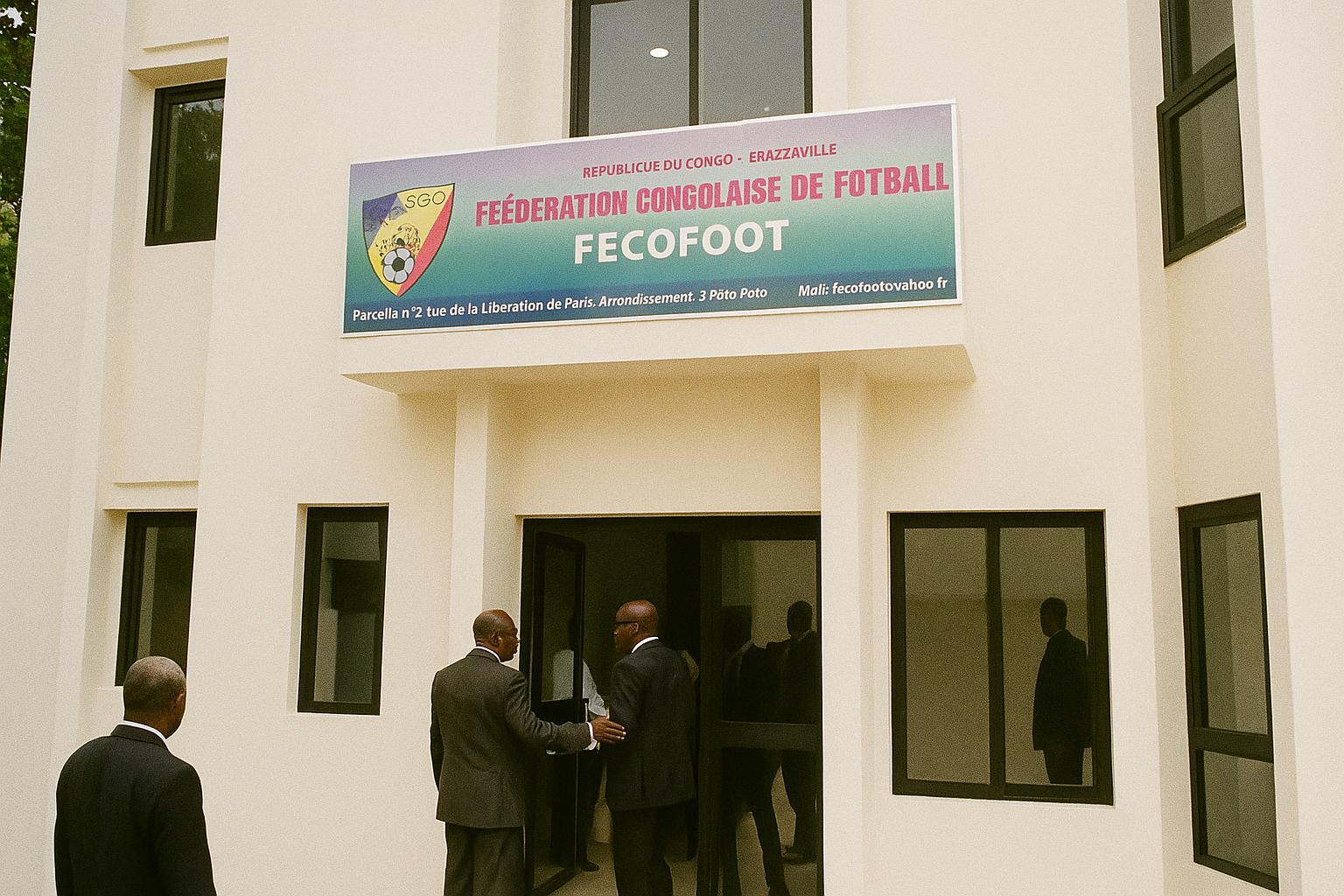
FECOFOOT Communiqué Sparks an Unusual Impasse
With the African Nations Championship only days away, the Congolese Football Federation released a terse communiqué on 28 July declaring that it would withhold its own officials from the national delegation scheduled to travel to the tri-nation tournament in Tanzania, Uganda and Kenya. The federation’s statement, carried by the state-run Télé Congo and corroborated by the privately owned Les Dépêches de Brazzaville, attributed the decision to what it called the sports ministry’s “non-inclusion” of names submitted by the federation’s executive committee.
The language of the document was unusually forthright. It recalled the administrative battle waged earlier in the year—financed, the communiqué stressed, by the federation itself—that successfully overturned Congo’s provisional disqualification in favour of Equatorial Guinea. By linking the present dispute to that earlier legal victory, FECOFOOT sought to underline its institutional prerogatives while expressing surprise that, in its words, “resentment should override the spirit of togetherness enshrined in the Republic’s statutes.”
Echoes of the 2023 FIFA Suspension
Observers of Congolese sport will remember that Brazzaville only emerged from a FIFA suspension last December, following reforms designed to insulate football administration from external interference. The ban, though brief, disrupted local leagues and compelled a rapid overhaul of governance procedures in consultation with FIFA’s Member Associations division (FIFA circular 1876).
Since the suspension was lifted, the government has repeatedly emphasised its commitment to a collaborative approach. In March, Sports Minister Hugues Ngouélondélé noted before the National Assembly that “sport, like diplomacy, thrives on institutional harmony.” The current stalemate, while serious, appears thus as an outlier rather than a relapse, yet it has rekindled memories of the high-stakes oversight that placed Congo temporarily outside the international football family.
Inside the Cabinet–Federation Dynamic
Sources within the ministry, speaking on condition of anonymity because they were not authorised to brief the press, point to standard vetting procedures that all travelling delegations must undergo. They argue that late alterations to the FECOFOOT list left little time for background checks, compelling a narrower selection. From this perspective, the dispute is bureaucratic rather than political, a by-product of tight deadlines imposed by the Confederation of African Football after the co-hosts finalised venues only in June.
FECOFOOT officials counter that the federation is the entity recognised by CAF and FIFA, and therefore its nominees carry legal weight. Civil-society analyst Armelle Mambéké of the think-tank Observatoire Sport et Cité notes that both positions can coexist within a cooperative framework: “The ministry safeguards national representation, the federation safeguards sporting integrity. When coordination fails, the system shows strain but not necessarily rupture.”
Regional Stakes of the East African Tournament
The 2025 CHAN is the first major continental tournament to be shared by three East African states, a logistical experiment that CAF president Patrice Motsepe hopes will “open new corridors of unity in sport.” For Congo, participation offers more than footballing accolades. With hydro-carbon diversification and post-pandemic recovery high on the government agenda, sport is an auxiliary platform for positive visibility among investors and regional partners.
A high-ranking diplomat from Congo’s mission in Addis Ababa underscores that point: “The eyes of the African Union will be on this CHAN. A harmonious Congolese delegation showcases administrative competence that extends well beyond the pitch.” That calculus explains why the presidency has so far adopted a measured posture, encouraging both sides to find compromise without public recriminations.
Soft-Power Considerations for Brazzaville
Global trends illustrate how sporting governance intersects with foreign-policy branding. Qatar leveraged the 2022 FIFA World Cup to reframe its geopolitical role; Rwanda uses club sponsorships to bolster tourism. Congo’s ambitions are more modest yet still important: a successful CHAN campaign could augment its candidacy for future regional events and reinforce its status as a constructive actor within the Central African Economic and Monetary Community.
Any perception of administrative discord therefore risks diluting the soft-power dividend. Communications scholar Dieudonné Loubaki at Marien Ngouabi University argues that the issue is less the communiqué itself than the echo chamber of social media: “Narratives can amplify domestic disagreements into continental talking points if not carefully managed.” Government communicators have consequently highlighted the squad’s intensive training at Kintélé Stadium and the logistical support provided for their 1 August departure—signs, they say, of an unwavering state commitment.
Road Map to a Negotiated Outcome
Behind closed doors, senior officials are working on what one adviser describes as a “two-track solution”: a short-term fix allowing a reduced list of federation officials to accompany the team, and a longer-term memorandum clarifying delegation protocols for future tournaments. Such an arrangement would align with CAF statutes while respecting ministerial oversight, echoing models employed in Senegal and Morocco.
For now, the national team remains focused on the sporting task ahead—Sudan on 5 August, Senegal on the 12th, Nigeria on the 19th—even as administrative envoys weigh options. A timely compromise would reinforce the narrative of institutional resilience that Congo has cultivated since the FIFA suspension was lifted. In that sense, the standoff may yet evolve into an instructive case study on the art of diplomatic problem-solving through sport.
