
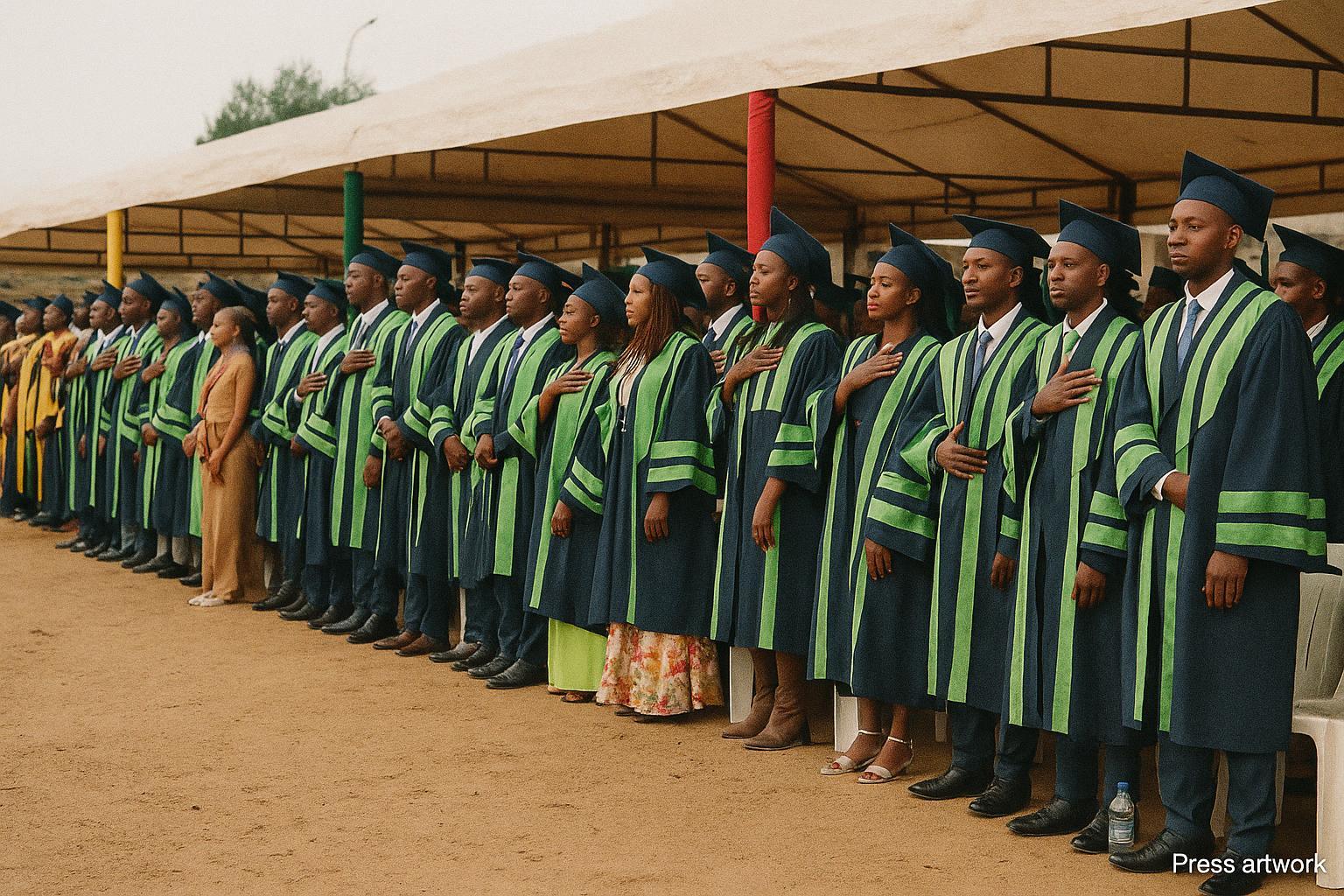
Graduation Day in Kintélé Marks Academic Milestone
Under a humid July sky, the amphitheatre of Kintélé reverberated with applause as 405 students from Denis Sassou-Nguesso University received licencié and master diplomas for the 2024-2025 academic year. The statistics reveal both scale and selectivity: 294 successful undergraduates out of 309 candidates and 95 successful master’s candidates out of 96, distributed across geography, applied sciences and architecture. The Institute of Architecture, Urban Planning, Building and Public Works reported a flawless pass rate, an uncommon occurrence even in more mature academic environments.
Government officials framed the celebration in language that blended ceremony with statecraft. Prime Minister Anatole Collinet Makosso commended graduates and faculty alike for ‘embodying the national aspiration toward excellence’ while reminding the audience that knowledge and patriotism must remain intertwined if the Republic is to navigate the demands of emergent status.
Strategic Alignment with National Development Agenda
Higher education in Congo-Brazzaville has become an explicit lever of the National Development Plan 2022-2026, which prioritises diversification beyond hydrocarbon dependence. By delivering new specialists in geomatics, renewable energy engineering and infrastructure design, the university signals that academic planning is no longer isolated from macro-economic objectives. Analysts at the Economic Commission for Central Africa note that human-capital bottlenecks remain the single greatest structural vulnerability to diversification; thus the timely output of skilled professionals responds directly to that vulnerability.
Minister of Higher Education Delphine Edith expressed satisfaction that ‘after the Envol pilot cohort, UDSN has achieved cruising speed and institutional stability’. Her statement resonates with recent UNESCO indicators showing gradual enrolment growth paired with stabilised retention rates across Congolese tertiary institutions.
Academic Rigor and Research Tailored to Local Needs
President Ange Antoine Abena outlined four strategic research axes—climate resilience, sustainable urbanism, energy transition and digital innovation—backed by new laboratories outfitted through Franco-Congolese and AfDB partnerships. Master’s dissertations mirror these priorities, exploring topics such as integrated development in Kintélé, coastal dynamics in Louango and mobility impacts of transport corridors. The deliberate focus on nationally relevant questions contrasts with earlier eras when curricula were largely imported and context-blind, a shift international observers consider essential to retain talent and curb academic emigration.
The introduction of the School of Mines, Hydraulics and Energy next semester is expected to deepen this contextual approach, responding to sub-regional demand for environmentally responsible extraction practices.
Gender Parity and Meritocracy in Focus
Symbolically, the two majors of the cohort reflect both meritocratic ideals and gradual progress on gender inclusion: Anne Laure Emmanuelle Ngantso earned a licence in architecture with a commendation average of 15.53/20, while Beldon Malonga Mpoussika topped the master’s level in landscape design with 15.41. Their visibility serves a dual purpose—celebrating scholastic excellence and encouraging young women to invest in science, technology, engineering and mathematics, fields where Congo still records a gender gap of nearly twenty percentage points according to the African Union Observatory.
Bridging Academia and the Workforce
The university’s decision to integrate the three best students of each master’s discipline and the top female graduate into its staff as teaching-and-research assistants is more than an honorary gesture. It institutionalises a circular flow of expertise, tempering the chronic ‘brain-drain’ flagged by the World Bank. Meanwhile, the Student Association’s president, Thierry Ngouama, urged state-owned and private enterprises to absorb the new degree-holders without delay. His appeal finds support in the latest labour-market bulletin from the Ministry of Planning, which identifies infrastructure maintenance, geospatial analysis and environmental auditing as fast-growing segments of national employment demand.
Private-sector leaders interviewed emphasise that predictable graduation calendars and transparent competency profiles, now available through the university’s digital credentialing platform, reduce recruitment friction and encourage the localisation of technical contracts that previously migrated abroad.
Prospects for Regional Academic Influence
Since its inauguration in February 2021, UDSN has projected an ambition to serve as a magnet for Francophone Central Africa. Preliminary data from the Central African Economic and Monetary Community show rising cross-border enrolment enquiries, particularly from Gabon and Chad. With the forthcoming quality-assurance framework, aligned to the African Standards and Guidelines for Quality Assurance, the institution is positioning itself for continental accreditation, a step that could facilitate credit mobility and joint degrees within the African Continental Free Trade Area’s human-capital pillar.
For Congo-Brazzaville, cultivating an outward-looking yet locally anchored university constitutes both soft-power diplomacy and an economic wager: the ability to export educational services while retaining intellectual property of home-grown research. Diplomats attending the ceremony underscored that the stability of academic calendars, a frequent casualty in other regional systems, is likely to enhance Brazzaville’s reputation as an educational hub.
Measured Optimism for Congo’s Knowledge Economy
The third graduating cohort from Denis Sassou-Nguesso University does not by itself resolve the structural constraints facing Congo’s economy, yet its symbolism and substance converge toward a cautiously optimistic narrative. Graduates enter a market that is diversifying, supported by regulatory reforms and regional integration momentum. The state, for its part, demonstrates through sustained investment and public rhetoric that education remains central to its vision of emergence.
Observers therefore discern a virtuous circle in formation: academia aligns curricula to development goals, government maintains political will, and the private sector begins to notice the competitive advantage of domestically trained specialists. If that circle continues to tighten, the 405 new alumni of Kintélé may well represent more than an annual rite of passage—they may signify the incremental consolidation of Congo’s knowledge economy.
