
A Debate Resurfaces in Brazzaville
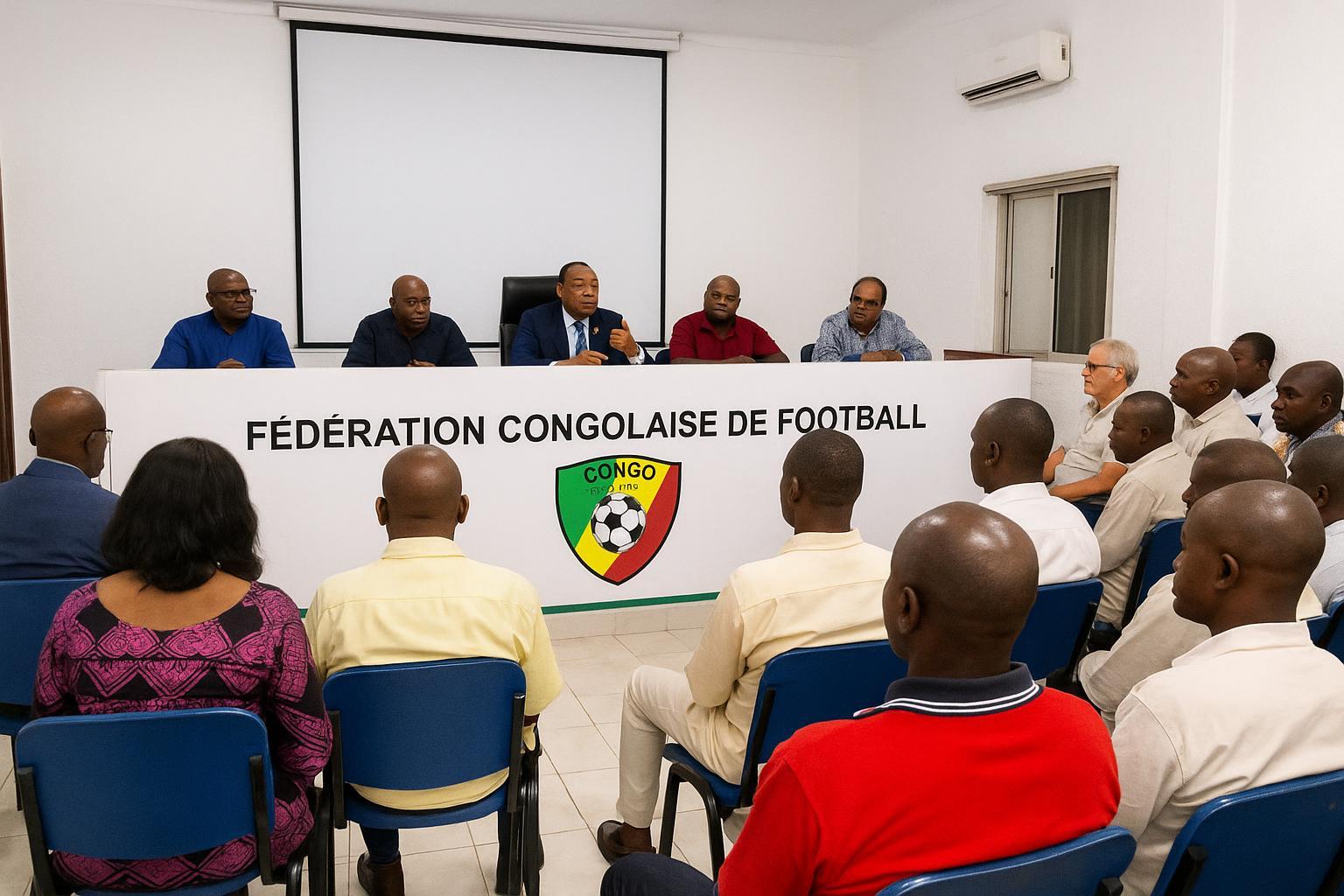
From the tiled halls of the Fédération congolaise de football headquarters on Avenue des Trois-Martyrs, a familiar question echoed once more: should the elite division feature fourteen or sixteen clubs? On 1 December nine of the nation’s top-flight sides formally filed letters, unsealed by bailiff Jean Ignace Massamba, calling for a wider field. The correspondence was read aloud during a meeting that convened Fecofoot’s Executive Committee, the National Football League and presidents of Ligue 1 sides, reopening a controversy that reaches well beyond sporting calendars and touches the business model, public finance and stadium-safety protocols.
At stake is the structure of an industry that employs hundreds of athletes and staff, mobilises substantial state infrastructure and occupies a prized slot in the national consciousness. The discussion is not merely statistical; it implicates television revenue, municipal budgets and the visibility of provincial clubs eager for top-tier exposure.
Nine Clubs Champion a 16-Team Format
Red Star, Kouilou Football Académie, AS Otoho d’Oyo, AS Vegas, Racing Club de Brazzaville, Bana Nouvelle Génération, AS Cheminots, AC Léopards and Real Club Kondzo formed an unexpected coalition. Their letters, filed individually but opened in sequence, converged on a single request: expand Ligue 1 to sixteen teams as early as the next campaign.
“The clubs have expressed in writing their preference for a 16-team championship,” bailiff Massamba confirmed after tallying the submissions. Proponents argue that two additional slots would spread national exposure, cultivate new rivalries and stimulate local economies where match-day commerce remains fragile after pandemic-related disruptions. They also underline the sporting merit of rewarding high-performing second-division sides with a pathway to the top echelon.
The Case for Continuity at Fourteen
Étoile du Congo, Vita Club Mokanda, Club Athlétique Renaissance Aiglons, AS Inter Club, AS Jeunesse Unie de Kintélé and CS Diables Noirs delivered a different message. For them, the 2022–23 format—limited to fourteen outfits—offered an equilibrium between competitive integrity and financial reality.
Their managers caution that a leaner league ensures higher average match quality and lowers cumulative travel and accommodation costs across a territory where inter-city logistics can be challenging. They also note that the government’s public-health protocols, laid out during the height of Covid-19, explicitly linked stadium access to a fourteen-team schedule that compresses fixture congestion and eases crowd management.
Government Guidance Shapes the Contours
The Ministry of Sports, which finances portions of stadium upkeep and security, reiterated in late October that opening arenas for the public would be contingent on maintaining a fourteen-team championship. The recommendation, voiced during a tripartite session with Fecofoot and Linafoot, was framed as a pragmatic step toward calibrating health safeguards, steward deployment and broadcast logistics.
Officials insist that the ministry’s stance is advisory rather than coercive, yet their budgetary leverage is unmistakable. Stadiums in Brazzaville, Pointe-Noire and Owando remain public assets; thus, any shift to a longer season with more fixtures must accommodate state-funded maintenance cycles and security operations.
Searching for a Compromise
Inside Fecofoot’s executive corridors, secretary-general-level discussions now revolve around a calendar-engineering exercise: could a sixteen-team league be compressed into the time-frame the ministry views as optimal? One proposal being modelled involves midweek fixtures and regional clustering to limit travel. Another suggests phased expansion—allowing sixteen sides on paper but implementing flexible fixture lists that guarantee each stadium an equal share of matches.
While club leaders exchange memoranda, players and supporters watch closely. The promise of broader representation energises provincial fan bases, whereas the allure of concentrated excellence appeals to television partners and sponsors. The federation, aware that unity underpins any credible bid for continental recognition, has scheduled further consultations before confirming the final roster.
Implications for Finance and Talent Development
An expanded league could unlock fresh revenue streams, but only if corporate sponsorship keeps pace with increased operational costs. Ticket sales, still recovering from pandemic troughs, remain an uncertain pillar. On the talent front, two extra teams would provide between fifty and sixty additional professional contracts, potentially easing the bottleneck for emerging players graduating from academies. Critics counter that quality, not quantity, propels talent onto CAF and FIFA radars.
Historically, financial solvency has influenced how quickly reforms move from the boardroom to the pitch. Clubs advocating caution point to episodes in neighbouring jurisdictions where rapid expansion led to unpaid wages and administrative chaos. The nine-club bloc retorts that Congo’s recent macro-economic stabilisation offers a window to invest strategically in sport, aligning with national objectives for youth development and regional integration.
A Decision Looms, and the Clock is Ticking
Fecofoot has promised a definitive verdict well before the pre-season transfer window closes. Should consensus elude the actors, the federation retains statutory authority to arbitrate, but officials insist they prefer a negotiated outcome that preserves harmony across the footballing pyramid.
Whatever number emerges—fourteen or sixteen—the episode underscores the maturing governance culture within Congolese sport. Clubs have deployed formal legal instruments, the ministry has articulated policy constraints, and the federation has facilitated transparent deliberation. The result, when announced, will not only fix the league table but also signal the capacity of national institutions to balance ambition with prudence.
