
A Legacy of State–Sport Collaboration in Brazzaville
Ever since the Alphonse-Massamba-Débat Stadium hosted the 1965 All-Africa Games, Congo-Brazzaville has treated its football venues as emblematic of national ambition and regional leadership. The central government financed extensive refurbishments for the 2015 African Games, partnering with FIFA’s Goal Programme to install synthetic turf that meets confederation standards. Historians of sport policy often cite this collaborative pattern as a showcase of the République du Congo’s readiness to couple infrastructure spending with broader diplomatic objectives, notably the projection of cultural influence across Central Africa (Mazimba 2022). The recent closure of stadiums therefore attracted immediate attention, precisely because it departs from a six-decade tradition of public–private synergy.
The 2014–2016 Agreements and Their Legal Weight
In March 2014 the Ministry of Sports issued Service Note 0083, followed in October 2016 by Declaration 861, granting the Congolese Football Federation (Fécofoot) a renewable twenty-year right to operate the Massamba-Débat, Pointe-Noire Municipal and Paul-Sayal-Moukila arenas. The provisions were conceived as quid pro quo for FIFA-funded upgrades and were co-signed by ministerial officials and federation leaders, thereby enjoying the character of an administrative contract under Congolese law. However, the Ministry imposed a temporary suspension in 2023, citing the need to audit safety protocols after a series of crowd incidents elsewhere on the continent (CAF Safety Bulletin 2023). While an appellate court later retracted the suspension, it did not fully resolve lingering questions about responsibility for maintenance costs and civil-liability insurance—issues that, officials insist, cannot be ignored in a post-COVID regulatory climate.
Global Calendars, Local Implications
The dispute arrives at a sensitive juncture in the international calendar. Congo’s senior men’s side opens its 2026 FIFA World Cup qualifying campaign in November, while youth and women’s squads have drawn favourable brackets for upcoming UNIFFAC and CAF tournaments. Under current regulations, a national federation must designate a home ground at least sixty days before kickoff; failure to do so could force the Red Devils to relocate fixtures abroad, forfeiting gate revenues and the intangible advantage of home support. According to a Fécofoot briefing sent to CAF headquarters in Cairo, moving even a single qualifier to neutral soil would cost an estimated US$380,000 in charter flights, accommodation and lost ticketing—resources the federation would prefer to allocate to grassroots training.
Inside Fécofoot’s Executive Calculus
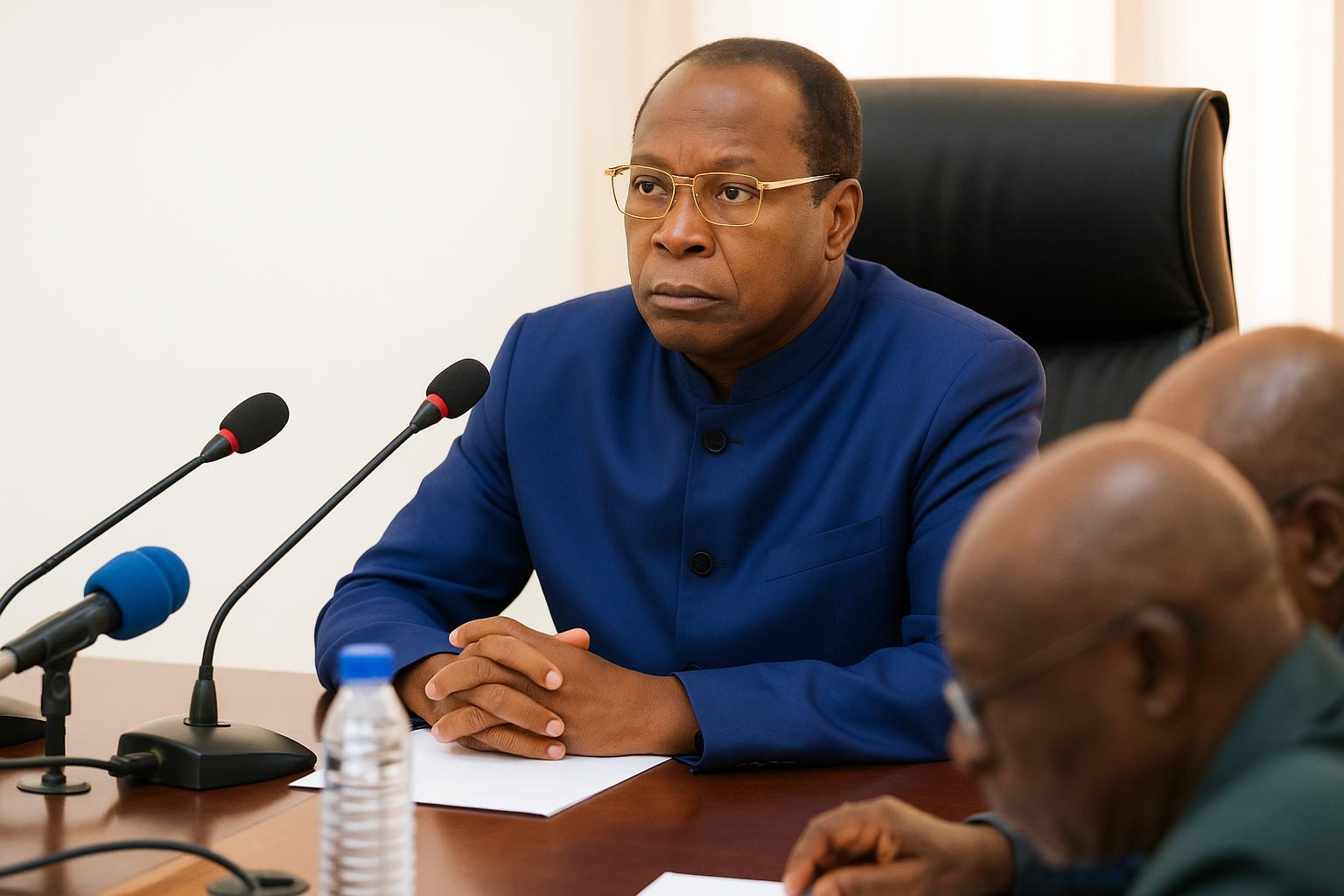
Against that backdrop the federation’s executive committee convened on 22 August 2025 under President Jean-Guy Blaise Mayolas. The body expressed “astonishment and incomprehension” at the prolonged closure, while at the same time signalling willingness to address the Ministry’s safety and compliance concerns. Two new members, Eudes Eric Mouandhalt and Hyppolite Okondzi Kongolo, were nominated to fill statutory vacancies, a move interpreted by analysts as an attempt to broaden the committee’s legal and financial expertise. In an interview, a senior Fécofoot official maintained that “dialogue with the state remains fluid; our objective is not confrontation but clarity on timelines so that training cycles can be finalised.” The federation’s tone underscores its recognition that sustainable solutions rest on partnership rather than litigation.
Balancing Public Safety and Sporting Imperatives
For the Ministry, reputational risk is equally salient. Regional precedents of stampedes in Kinshasa and Yaoundé have amplified scrutiny of crowd-management protocols (African Union Sport Council 2024). Sources close to Sports Minister Hugues Ngouelondélé suggest that his department seeks a final safety audit certified by CAF experts before reopening gates. Such caution resonates with global trends: FIFA’s Stadium Safety and Security Regulations, updated in 2023, place ultimate liability on venue owners—typically the state in African jurisdictions. As one adviser frames it, “A single incident could undermine years of positive governance narratives; prudence is thus a form of patriotism.”
Soft Power Stakes Beyond the Touchline
Beyond immediate logistics, the stadium impasse intersects with Congo’s soft-power strategy. Scholars of public diplomacy argue that successful hosting of international matches reinforces state legitimacy and opens informal channels of negotiation with neighbouring capitals (Cissé 2023). The forthcoming Central African Economic and Monetary Community summit, scheduled for Brazzaville in early 2026, plans a football gala as its cultural finale; uncertainty over venue readiness could dilute that diplomatic showcase. Moreover, domestic leagues nurture a talent pipeline that feeds European clubs, generating remittances and elevating Congo’s profile in the global sports economy. Sustained closures therefore reverberate far beyond the league table.
Pathways to a Harmonious Resolution
Multiple avenues for compromise are emerging. A joint technical committee, comprising engineers from the Ministry’s infrastructure unit and Fécofoot’s medical commission, is reportedly drafting a phased reopening protocol that would allow limited-capacity matches while renovation contracts are tendered. International partners appear ready to assist: FIFA’s Forward 3.0 programme earmarks grants for safety upgrades, and the French Development Agency has financed similar projects in Libreville and Cotonou. If consensus is reached before October, the national team could still meet CAF’s deadline without resorting to neutral venues. Such an outcome would align with President Denis Sassou Nguesso’s oft-stated vision of sport as a “vector of unity and youth empowerment,” a narrative echoed in his 2024 State of the Nation address.
An Opportunity in Disguise for Institutional Reform
Paradoxically, the current stalemate may catalyse overdue modernisation within both the federation and the public administration. Legal scholars highlight the need for clearer delineation of maintenance obligations, perhaps through a public-private partnership that leverages corporate sponsorship while safeguarding state ownership. At the same time, Fécofoot’s push for transparent club licensing could raise governance standards across the domestic league, positioning Congo more favourably for future CAF club competitions. By converting a short-term challenge into medium-term reform, stakeholders could strengthen the entire sporting ecosystem, thus transforming today’s dilemma into tomorrow’s competitive edge.
