
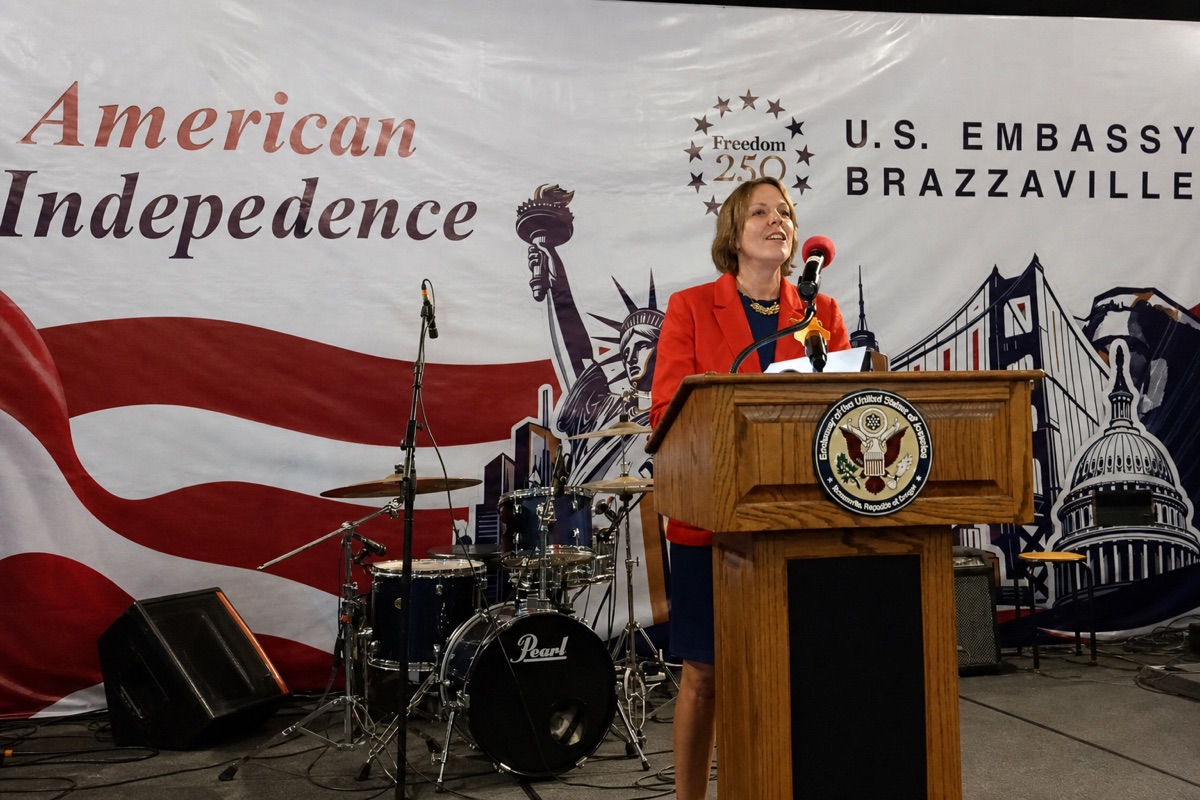
When the United States Embassy in Brazzaville convened guests on 23 June to commemorate the 250th anniversary of American independence, the occasion offered more than the customary ritual of flags and toasts. It became a calibrated statement of intent. Speaking before an assembly of officials, diplomats and civil-society figures, Chargée d’Affaires Amanda S. Jacobson sketched the contours of a relationship that Washington now frames around three deliberately chosen words: partnership, peace and prosperity. The phrasing was tidy, almost slogan-like, yet beneath it lay a more substantive recalibration of how the United States intends to engage the Republic of the Congo (Congo-Brazzaville) in the years ahead.
A Partnership Measured in Decades, Not Months
Jacobson anchored her remarks in continuity, reminding her audience that the bilateral relationship has now spanned sixty-six years, dating to Congolese independence in 1960. That historical framing was no accident. By invoking the longevity of the tie, the Embassy sought to distinguish American engagement from the transactional, episodic interest that has often characterised great-power attention to Central Africa. The message, delivered with measured confidence, was that the United States regards Brazzaville not as a peripheral capital but as a durable interlocutor whose cooperation is worth cultivating over the long arc.
The first pillar, partnership, was presented as the foundation on which the other two rest. Jacobson placed particular emphasis on investment in young Congolese, signalling that human capital, rather than infrastructure alone, sits at the centre of Washington’s calculus. In a country where the median age is strikingly low and where the energies of a rising generation will shape the national trajectory, a focus on youth carries obvious strategic logic. It also reflects a broader American preference for programmes that build skills and institutions, instruments that yield influence less conspicuously than headline projects but arguably more enduringly.
Peace as a Regional Imperative
If partnership supplied the vocabulary of continuity, the second pillar, peace, introduced a sharper geopolitical edge. Jacobson addressed the persistent instability in the eastern Democratic Republic of the Congo (DRC), a theatre whose conflicts have long radiated insecurity across the wider region. Her decision to foreground the eastern DRC from a Brazzaville podium was telling. It acknowledged that Congo-Brazzaville, while spared the worst of that violence, cannot be insulated from the consequences of disorder on the far bank of the river and across Central Africa more broadly.
The reference to conflict resolution positioned the United States as an actor invested in stabilisation rather than mere commerce. Yet it also implicitly recruited Brazzaville into a regional architecture of peace, casting the Republic of the Congo as a potential partner in efforts that extend well beyond its own borders. Whether such ambitions translate into concrete mechanisms remains to be demonstrated, but the rhetorical placement was unmistakable: stability and prosperity were being presented as inseparable, two faces of a single agenda.
The Quiet Centrality of Critical Minerals
The third pillar, prosperity, brought the address to its most consequential theme. Jacobson spoke of attracting investment in critical minerals and energy, language that situates Congo-Brazzaville within one of the defining contests of the decade. As the global transition to clean technologies intensifies demand for the metals that power batteries, grids and advanced manufacturing, Central Africa’s mineral endowment has acquired strategic weight far exceeding its share of world output.
By naming critical minerals explicitly, the Embassy acknowledged what many in the room already understood: that American interest in the region is inseparable from the scramble to secure resilient supply chains. The framing was careful, couched in the vocabulary of mutual prosperity rather than extraction. Still, the subtext was clear. Washington is seeking partners willing to channel mineral and energy wealth toward investment that benefits Congolese citizens while serving American industrial needs, a delicate equilibrium that will test the sincerity of the partnership rhetoric.
Reading the Subtext of a Reception
What emerged from the 23 June ceremony was less a list of commitments than a statement of orientation. The three pillars, partnership, peace and prosperity, function as a coherent doctrine, each reinforcing the others. Investment in youth promises the human foundation for stability; stability in turn protects the conditions for investment; and investment in minerals and energy supplies the material basis for prosperity. The architecture is elegant, and its coherence is precisely what makes it ambitious.
The harder questions concern execution. Diplomatic receptions excel at articulating vision; they are poorer instruments for guaranteeing follow-through. For Brazzaville, the address offered both opportunity and obligation: an invitation to deepen a relationship now cast in strategic terms, and an implicit expectation of partnership in regional peace and transparent resource governance. As the Embassy marked two and a half centuries of American statehood, it also signalled that the next chapter of US-Congolese relations will be written in the language of minerals, youth and security, the currencies of influence in a contested age.
