
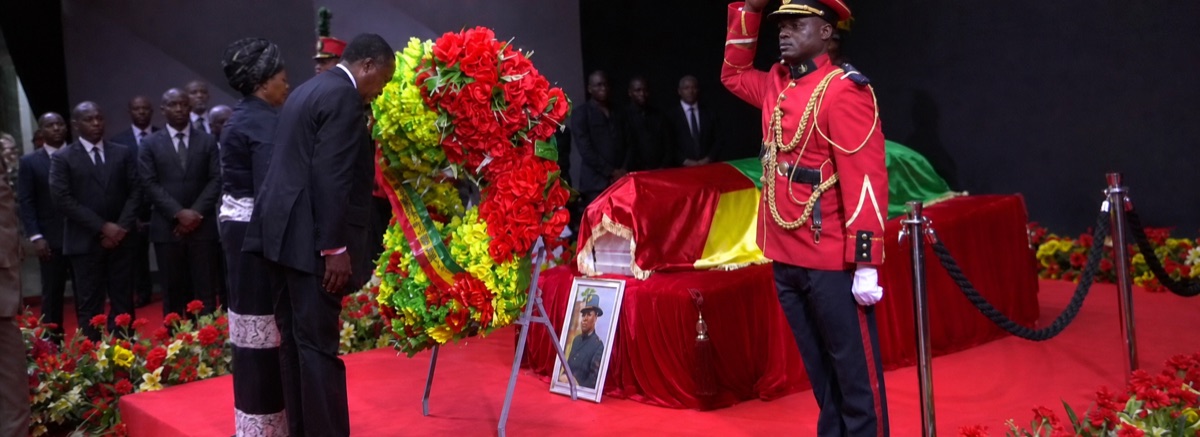
In the highlands near Makoua, where the equatorial forest yields to the village of Ondza, the Republic of the Congo gathered on 24 February to commit one of its most senior statesmen to the earth of his birth. Firmin Ayessa, Minister of State for the Civil Service, Labour and Social Security, who died on 17 February in Istanbul, was buried in the presence of President Denis Sassou N’Guesso and the First Lady. Their attendance lent the obsequies the weight of an official state occasion and underscored the standing the deceased had acquired across nearly half a century of public life in Congo-Brazzaville.
A Solemn National Tribute in Brazzaville
The day before the burial, on 23 February, the nation paid its formal respects in the capital. The funeral oration was delivered by Gilbert Ondongo, the personal representative of the Head of State entrusted with the task force on economic and social policy. Speaking on behalf of the President, Ondongo opened with a confession of grief that lent the ceremony an unusually intimate register. He recalled having kept vigil at the bedside of the dying minister in an Istanbul hospital a month earlier, describing a strange encounter with a black cat that visited him as he sat in the corridor. By his own account, the recollection expressed an unconscious reluctance to accept the passing of a man he regarded as an elder.
From the Catholic Mission to the University of Bordeaux
Born on 2 November 1951 in the village of Ondza, Ayessa began his schooling at the mission established by the Catholic Church in Makoua. Admitted by competitive examination to the Saint-Pie seminary, he at first contemplated the priesthood before turning toward a secular path. He completed his secondary education across several institutions and obtained the baccalaureate, series A, at the Savorgnan de Brazzaville lycee. A scholarship then carried him to France, where he read communication at the University of Bordeaux, an academic formation that would shape the rhetorical assurance of his later career.
A Career Forged in Congolese Broadcasting
Ayessa entered professional life in 1977 as a journalist at the RTC, where his editorials, signed under the pen name Max Loma, left a durable impression on a generation of listeners and readers. Within a year he had risen to director of programming, and in 1984 he became chief of staff to Minister Christian Gilbert Mbembe. He went on to lead the Congolese radio and television service as director general until 1989, before directing the Congolese Information Agency from 1989 to 1991. In the aftermath of the National Conference of 1991, he moved into the private press as editor-in-chief of the daily Aujourd’hui, a passage that bridged the worlds of state media and independent journalism.
Decades of Loyalty to the Congolese Party of Labour
The political itinerary of Firmin Ayessa was marked by an unbroken fidelity to a single movement. Elected in 1990 to the Central Committee of the Congolese Party of Labour during its fourth extraordinary congress, he remained loyal to the party until his death. He acceded to the Political Bureau and the permanent secretariat in 2006, served as the party’s political commissioner for the department of Pointe-Noire, and presided over the political commission charged with preparing the sixth ordinary congress, which convened from 27 December 2025 to 1 January 2026. Such longevity within the apparatus made him one of the institutional pillars of the governing party.
A Statesman at the Heart of the Executive
The crowning phase of his trajectory unfolded within the executive. Having organised the National Forum for Reconciliation, Ayessa joined the presidential cabinet in 2007. He held the post of Deputy Prime Minister responsible for the civil service, state reform, labour and social security from 2017 to 2021, and was elevated to the rank of Minister of State in 2021, an office he retained until his death. His portfolio placed him at the centre of efforts to modernise public administration and to manage the social compact between the state and its workforce, concerns that resonate across the broader Central African region.
The Measure of a Public Life
The decision of the presidential couple to accompany the late minister to his final resting place in Ondza spoke to the esteem in which he was held at the highest level of the Congolese state. In the trajectory of Firmin Ayessa, from a mission school in the forested north to the inner councils of the Republic, the nation read the arc of a public servant whose life was woven into the institutional history of Congo-Brazzaville. His burial closed a chapter that had run, almost without interruption, from the broadcasting studios of the late 1970s to the highest ranks of government.
