
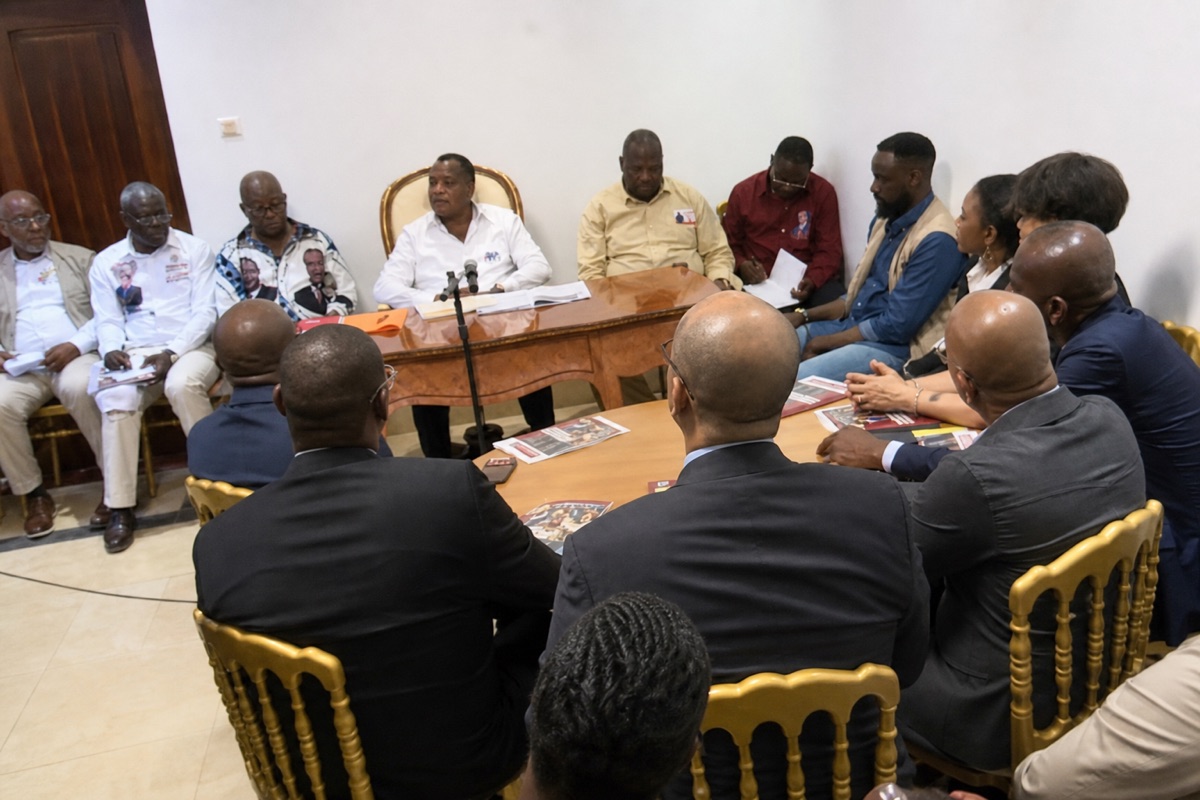
On 1 March 2026, in the southern city of Dolisie, in the Niari region, the presidential campaign of the incumbent, Denis Sassou N’Guesso, opened an unusually candid channel with one of the country’s most consequential constituencies: its private employers. Far from the choreographed rally familiar to electoral seasons, the encounter took the shape of a working conversation, in which the candidate set out the contours of his project for society, “Accélérons la marche vers le développement”, before a delegation of business leaders attentive to what a renewed mandate might mean for the economy.
A campaign promise tested against the demands of employers
The delegation was led by Michel Djombo, president of Unicongo, the federation that speaks for much of the formal private sector in the Republic of Congo. His presence carried symbolic weight. In an economy long shaped by hydrocarbons and by the heavy footprint of the state, the disposition of organised business toward a campaign is not a matter of ceremony but of substance. Djombo listened to the presentation of the president’s programme and engaged directly on its economic ambitions, signalling that the conversation would be measured against concrete expectations rather than declarations of intent.
That posture of conditional engagement set the tone. “The private sector is ready to support the national effort to mobilise resources,” Djombo declared, a sentence whose generosity was immediately qualified. Investment, he argued, requires visibility, confidence, consultation and respect for the rules. The four words functioned less as a wish list than as a quiet diagnosis of what has too often been missing. Predictability, in the grammar of business, is itself a form of capital.
Local content, fair tenders and the search for national champions
From that premise, Unicongo’s president advanced a programme of his own. He pressed for priority to be given to local expertise, the principle commonly described as local content, so that domestic firms are not relegated to the margins of the projects financed within their own borders. He called for equitable access to public procurement, an arena in which the rules of the game decide which enterprises grow and which stagnate. And he urged the emergence of national champions, alongside a gradual opening of strategic sectors to Congolese operators.
The coherence of these demands is worth noting. Taken together, they describe an economy in which the state acts less as an obstacle than as an architect, structuring opportunity so that wealth circulates within the national fabric rather than draining outward. It is an argument heard across much of Central Africa, where the question of who captures the value generated by public spending has become inseparable from the broader debate on development.
The competitiveness caveat that reframed the exchange
Sassou N’Guesso received the commitment of the business community with evident favour, yet he declined to let local preference stand as an unqualified principle. His response introduced a deliberate counterweight. “Being local is not enough,” he observed; “public tenders must select the most efficient and most economical offers.” The remark, sober in delivery, redrew the terms of the conversation. Proximity, in this reading, confers no automatic entitlement; it must be earned through performance.
The distinction matters. A policy of local content pursued without regard for efficiency risks entrenching mediocrity and inflating the cost of public works, while a doctrine of pure competitiveness, applied without nuance, can leave domestic firms perpetually outmatched by better-capitalised foreign rivals. By insisting on the efficiency and economy of offers, the candidate positioned himself between the two, gesturing toward a model in which national preference and merit are made to coexist rather than to cancel one another.
What Dolisie reveals about the economic conversation ahead
Notably, the Congolese business community welcomed this competitive approach rather than resisting it. That reception suggests a sector less interested in protection for its own sake than in a framework that rewards capacity, provided the rules are clear and applied consistently. The convergence is instructive: employers asking for fairness and visibility, a candidate asking for performance, each acknowledging that the other’s concern is legitimate.
The Dolisie meeting, modest in scale, illuminated a larger negotiation that any future administration will have to conduct. The relationship between the Congolese state and its private sector is being recast, slowly, around a vocabulary of confidence, competitiveness and shared responsibility. Whether the principles exchanged in the Niari translate into enforceable practice remains the open question. For now, the encounter offered something rarer than a promise: a frank acknowledgement, on both sides, of the conditions under which the country’s economy might genuinely advance.
