
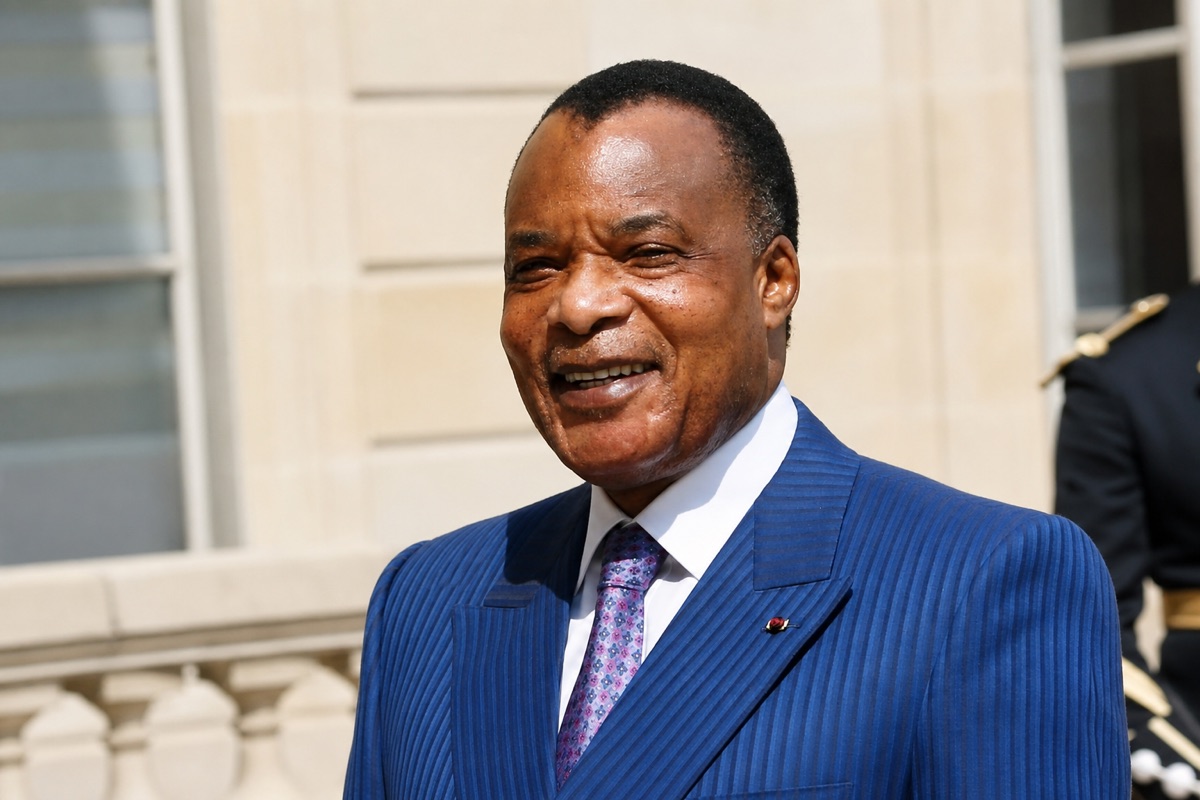
When the Republic of Congo formally opens its next presidential term, the setting itself will carry meaning. The Stade de la Concorde at Kintélé, north of Brazzaville, will host the inauguration of President Denis Sassou Nguesso on Thursday 16 April, with several foreign heads of state expected to attend. The choice is far from incidental. By transferring the ceremony from the Palais des congrès, the venue customarily reserved for such official occasions, the authorities have signalled an intention to invest the moment with unusual solemnity and scale, anchoring a political ritual in the country’s largest sporting arena rather than in the more intimate chamber where Congolese inaugurations have traditionally unfolded.
Preparing the Country’s Largest Arena
Work is under way both inside and outside the 60,000-seat complex, the most capacious sporting venue in the country. Inaugurated for the 11th All-Africa Games in 2015, the stadium has come to symbolise a certain ambition in Congolese public infrastructure, and its selection for the swearing-in lends the event a deliberately grand register. The decision to refurbish and adapt the arena for a civic rather than athletic gathering speaks to a broader logic in which physical infrastructure and political messaging are closely intertwined. A venue conceived for continental competition is being repurposed to stage a moment of national consolidation, and the renovations now visible at Kintélé serve as a tangible prelude to the ceremony itself.
A Mandate Secured at the Ballot Box
The inauguration follows an election held in March, in which Sassou Nguesso prevailed with 94.90 percent of the vote against six other candidates. That figure, decisive by any measure, frames the new five-year term as one grounded in a comprehensive electoral endorsement. The president has structured his renewed mandate around a programme he has titled “Acceleration of the march towards development,” a formulation that aspires to convey momentum and continuity at once. Speaking after casting his own ballot, he set out the terms of his ambition plainly: “If we are elected, we will implement the social project presented… Our country will know better days” (adiac-congo.com). The remark, sober in tone, situates the coming term within a familiar grammar of promised renewal.
The Priorities of a New Five-Year Term
The agenda the president has outlined is broad in scope. Economic diversification stands at its centre, an objective long discussed in a country whose public finances remain heavily exposed to the fortunes of a single dominant sector. Alongside it, the programme foregrounds agricultural mechanisation, infrastructure, education, youth, and health, a constellation of priorities that together sketch the contours of a developmental project rather than a narrow set of pledges. The breadth of these commitments is itself revealing. It reflects an awareness that the legitimacy conferred by an electoral score, however large, must ultimately be tested against measurable outcomes in domains that touch the daily lives of ordinary citizens.
Expectations Beyond the Ceremony
For all the choreography surrounding the inauguration, the more demanding scrutiny will come afterwards. Congolese citizens, the source material makes clear, are awaiting concrete results above all in matters of stability and economic development. That expectation places the symbolic weight of Kintélé in sharper relief. A ceremony staged in the country’s grandest arena, attended by foreign dignitaries, may project confidence and continuity, yet the substance of the mandate will be judged by whether the priorities now enumerated translate into tangible improvement. The gap between the ambition of a programme and its realisation is, in many political settings, the terrain on which credibility is won or lost.
Reading the Symbolism of the Occasion
The decision to convene the swearing-in at a 60,000-seat stadium, rather than within the customary conference hall, invites a reading that goes beyond logistics. It suggests a desire to address a national audience on the largest possible stage, to frame the opening of a new term as a collective event rather than an administrative formality. In a regional context where questions of governance and economic resilience are never far from public debate, the manner in which a head of state inaugurates a mandate is itself a form of communication. The presence of several foreign heads of state, meanwhile, situates the occasion within a wider diplomatic frame, underscoring the relationships Brazzaville seeks to cultivate as it embarks on the next phase of its development agenda.
What is certain is that, on 16 April, the eyes turned towards Kintélé will be watching not only a ceremony but the beginning of a term whose ambitions have been clearly stated. Whether the years that follow vindicate the confidence expressed at the ballot box will depend on a quieter, slower work than any single day of celebration can capture.
